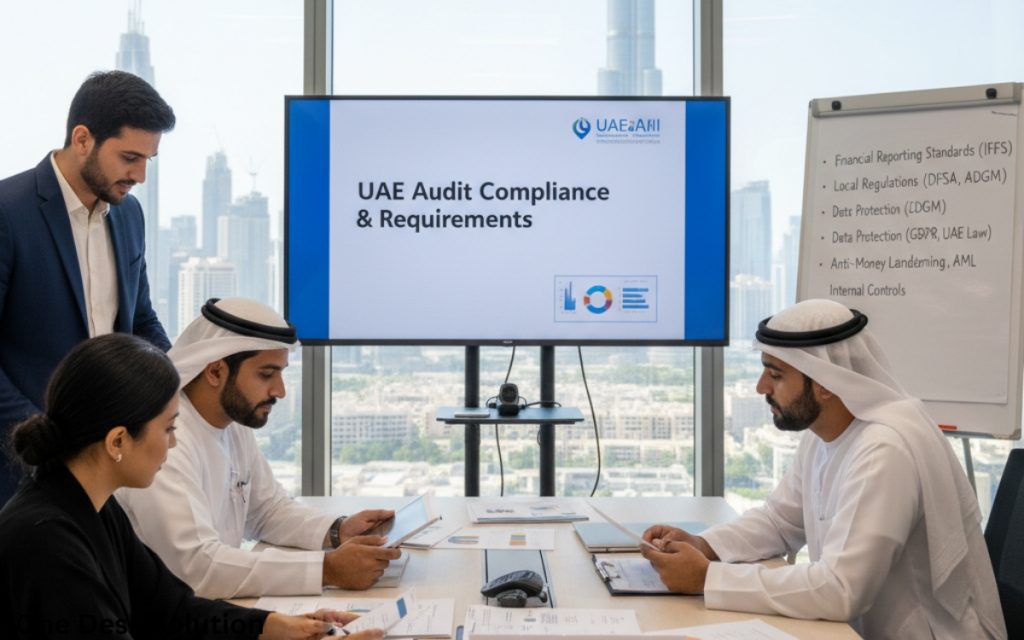
Audit Requirements by Business Type in Dubai: Mainland, Free Zone and Tax Rules (2026)
Which Dubai businesses must be audited, under which rule, by when and by whom: mainland LLCs, branches, sole firms, free zone companies, DIFC, Qualifying Free Zone Persons and real estate
Quick Summary: Dubai has no single audit rule. Your duty comes from four layers: company law, your free zone authority, Corporate Tax and any sector regulator. Mainland LLCs, joint stock companies and foreign branches are generally required to have an annual audit, sole establishments generally are not, free zones set their own rules (DMCC, for example, asks for audited accounts within 180 days of year end), and Corporate Tax requires audited statements above AED 50 million of revenue and for every Qualifying Free Zone Person. Check each layer, because the strictest one decides.
📋 Table of Contents
- Introduction: Why There Is No Single Rule
- Audit Requirements in Dubai at a Glance
- The Four Layers That Decide Your Audit Duty
- Audit Requirements by Business Type
- Mainland LLCs, Joint Stock Companies and Branches
- Sole Establishments, Civil Companies and Professional Firms
- Free Zone Companies: DMCC, JAFZA and Others
- Corporate Tax: The AED 50 Million Test and QFZPs
- Real Estate Developers, Brokers and Owners Associations
- Regulated Firms and Lender Requirements
- Deadlines and Filing Windows
- Who Can Sign Your Audit
- The Six-Step Audit Process
- What Happens If You Skip the Audit
- What Is Not an Audit Requirement
- How to Prepare for Your Audit
- Common Audit Compliance Mistakes
- What We Could Not Verify
- How One Desk Solution Can Help
- Frequently Asked Questions
- Related Resources
🔍 Introduction: Why There Is No Single Rule
Business owners often ask whether their Dubai company needs an audit, and the honest answer depends on what kind of company it is and where it is licensed. A mainland LLC is generally required to have its accounts audited every year, according to audit-firm guides that cite Article 27 of Federal Decree-Law No. 32 of 2021, while a sole establishment generally has no statutory audit under company law, according to Zoho Books (May 2026). The same two businesses can then face a different audit trigger under Corporate Tax.
Free zones add their own rules. DMCC asks member companies to submit audited financial statements within 180 days after each financial year end, and JAFZA companies give the authority an audit report each year, according to consultancy summaries. Corporate Tax then adds a revenue test: audited financial statements are needed above AED 50 million of revenue, and every Qualifying Free Zone Person (QFZP) needs them at any revenue, under Ministerial Decision No. 84 of 2025.
This guide maps each business type to its audit requirement, deadlines, who can sign the audit, what happens if you skip it, and where the sources disagree. Our audit & assurance services team can run the audit, and our accounting & bookkeeping services team can get your records ready first.
Not Sure Which Audit Rule Applies to Your Company?
Tell us your company type, licence location and annual revenue. We'll tell you what to file and when.
✅ Audit Requirements in Dubai at a Glance
| Topic | What the sources report | Source and date |
|---|---|---|
| Mainland LLCs and joint stock companies | Annual audit required; no revenue threshold under company law | AuditFirmsDubai (updated 23 October 2026); Mondaq (22 June 2026) |
| Foreign company branches | Must submit an audit report each year | Mondaq (22 June 2026); AuditFirmsDubai |
| Sole establishments | No statutory audit requirement under company law; a bank or licensing authority may still ask for one | Zoho Books (29 May 2026, modified 1 June 2026) |
| DMCC | Audited financial statements within 180 days after each financial year end, by a DMCC-approved auditor | MBG Corporate Services (modified 30 March 2026) |
| JAFZA | Every FZE and FZCO gives JAFZA an audit report each year; sources differ on the timing | AuditFirmsDubai; Qaspro Global (updated 9 November 2026) |
| DIFC | Audited accounts, with a carve-out for small private companies (turnover under US$5 million and no more than 20 shareholders, as reported in 2018) | White & Case (November 2018); CMS (30 April 2019) |
| Corporate Tax | Audited statements above AED 50 million of revenue; every QFZP and every tax group regardless | Qaspro Global; KPMG on Ministerial Decision No. 84 of 2025 |
| Record-keeping penalty | AED 10,000 for a first violation, AED 20,000 for a repeat within 24 months | Qaspro Global, citing Cabinet Decision No. 75 of 2023 |
| Economic Substance reports | No longer required for financial years ending after 31 December 2022 | Clyde & Co (21 October 2024) |
| Dubai DET at renewal | Does not usually ask for the audit report when you renew a mainland licence, though the legal duty remains | AuditFirmsDubai; BCL Globiz (modified 26 August 2026) |
Check before you act: most of the sources above are consultancy and audit-firm summaries, not the legislation itself. Confirm the rule that applies to you with your licensing authority, the Federal Tax Authority or your auditor.
🧱 The Four Layers That Decide Your Audit Duty
Work through the layers in order. A business can be exempt at one layer and still be caught by the next.
Four Layers That Decide Your Audit Duty
Swipe sideways to see the full chart
Sources: AuditFirmsDubai (updated 23 October 2026), Zoho Books (May 2026), MBG Corporate Services, Qaspro Global (updated 9 November 2026) and Law No. 8 of 2007. These are summaries of the rules and the details are explained in the sections below.
- Layer 1, company law: your legal form decides whether the Commercial Companies Law requires an audit.
- Layer 2, free zone rules: each free zone sets its own audit and filing rules for its companies.
- Layer 3, Corporate Tax: revenue, QFZP status and tax group membership can trigger an audit on their own.
- Layer 4, sector rules: real estate and financial activities can add regulator-specific requirements.
- Activity rarely decides it alone: BCL Globiz says the mainland obligation applies regardless of company size, revenue or activity.
🗂️ Audit Requirements by Business Type
The matrix shows the position for the main Dubai business types. The table underneath gives the basis and the main watch-out for each.
Audit Requirement Matrix by Business Type
Swipe sideways to see the full chart
Sources as listed in the table below. The Corporate Tax column applies to taxable persons and uses the AED 50 million revenue test, which counts revenue, not profit, according to BCL Globiz. Exempt persons and other special cases are not shown.
| Business type | Audit required? | Basis reported | Watch-out |
|---|---|---|---|
| Mainland LLC | Yes, annually | Commercial Companies Law, cited as Article 27(1) of Federal Decree-Law No. 32 of 2021 | Applies whatever the revenue; Small Business Relief does not remove it (Zoho Books) |
| Mainland joint stock company | Yes, annually | Same article, covering joint stock companies | Sector regulators may add rules |
| Foreign company branch | Yes, annually | Cited as Article 338 by AuditFirmsDubai; Mondaq also reports it | Needs a UAE-registered auditor |
| Sole establishment | No statutory audit | No company law audit duty (Zoho Books) | Banks, the licensing authority and Corporate Tax can still require one |
| Civil or professional company | No statutory audit reported | Not covered by the company law duty in Mondaq's summary | Check the licensing authority and Corporate Tax |
| DMCC company | Yes | DMCC rules; 180 days after year end | Auditor must be DMCC-approved |
| JAFZA FZE or FZCO | Yes | JAFZA requires an audit report each year (AuditFirmsDubai) | Timing differs between sources |
| Other Dubai free zones | Varies | DAFZA, Meydan and Dubai Silicon Oasis reported to require audited accounts at renewal | Check each authority; IFZA rules were reported as changing |
| DIFC company | Yes, with a carve-out | DIFC Companies Law 2018 as reported by law firms | Confirm the current exemption criteria with the DIFC Registrar |
| Qualifying Free Zone Person | Yes, any revenue | Ministerial Decision No. 84 of 2025 | Losing the audit can cost the 0% rate |
| Real estate firms | Reported yes, unverified | Commercial guides describe annual RERA audits | The primary law we read is narrower (see the real estate section) |
🏢 Mainland LLCs, Joint Stock Companies and Branches
For companies registered with the Department of Economy and Tourism (DET), the audit duty sits in the Commercial Companies Law. Two 2026 sources cite Article 27 of Federal Decree-Law No. 32 of 2021 for the rule that every joint stock company and LLC should have one or more auditors. AuditFirmsDubai also cites Article 338 for foreign company branches.
- No revenue threshold: Zoho Books says all LLCs must have annual financial statements audited by a Ministry of Economy-approved auditor, regardless of revenue.
- Branches: Mondaq says foreign companies are required to submit audit reports for their UAE branches each year.
- Appointment: a law-firm summary of the earlier 2015 law says auditors are appointed by the general assembly (for an LLC, by the partners) for a renewable one-year term of no more than three successive years. Check the 2021 law's current wording before relying on that.
- Shareholder access: the same summary says shareholders or partners can request the last audited accounts, which the company must provide within ten days.
- Practice versus law: AuditFirmsDubai says DET does not usually ask for the audit report at licence renewal, and BCL Globiz says licensing authorities have not consistently collected one. The legal duty still applies, and banks, partners and the FTA can ask for the accounts.
If you are still deciding between a mainland and a free zone structure, our guide to common business setup questions in Dubai covers the main differences.
🧑💼 Sole Establishments, Civil Companies and Professional Firms
Sole establishments are the main exception. Zoho Books says there is no statutory audit requirement under company law for them, and Mondaq's summary of the audit rules does not impose one on sole establishments or civil companies. That does not end the question.
- Corporate Tax can still require one: a taxable person with revenue above AED 50 million needs audited statements, whatever the legal form.
- Lenders and the licensing authority: Zoho Books notes that either may still ask for an audit.
- Banks: Mondaq says banks and lenders insist companies get their books audited, which is a commercial requirement, not a legal one.
- A voluntary audit: it can support a loan application, a partner buy-in or a sale, even where no law requires it. That is general practice, not a rule.
Consultants and professional firms often start as one of these forms. Our guide on how a consultant can launch a professional services firm in Dubai explains the setup options, which in turn decide the audit duty.
🌴 Free Zone Companies: DMCC, JAFZA and Others
Free zones are self-regulated, so rules differ by authority. Zoho Books lists a mandatory annual audit for DMCC, JAFZA, DAFZA and DIFC, and the pattern in 2026 sources is that audited accounts are linked to the annual licence renewal or to a fixed filing window.
| Free zone | What is reported | Points to check |
|---|---|---|
| DMCC | Submit audited financial statements within 180 days after each financial year end, through the member portal, with the auditor's signed and stamped summary sheet | The auditor must be registered as an Approved Auditor with DMCC (MBG Corporate Services) |
| JAFZA | Every FZE and FZCO gives JAFZA an updated audit report each year (AuditFirmsDubai) | Qaspro Global gives 90 days after year end; AuditFirmsDubai says usually at licence renewal with no fixed date. Ask JAFZA which applies |
| DAFZA, Meydan and Dubai Development Authority (DDA) zones | Audited accounts at renewal, according to Qaspro Global | Confirm on each portal; Qaspro advises checking for extensions |
| Dubai Silicon Oasis | AuditFirmsDubai says its regulations require an FZCO to have its accounts audited | Timing is usually at renewal |
| IFZA | BCL Globiz says IFZA introduced a financial statement requirement from late 2025; AuditFirmsDubai says companies with turnover of AED 3 million or less and nine or fewer employees file simplified statements | Two commercial sources, not the authority: confirm with IFZA |
| DIFC | All companies prepare annual accounts and lay audited accounts before members, with a carve-out for small private companies | The carve-out was reported in 2018 as turnover below US$5 million and no more than 20 shareholders, and members holding at least 10% can require an audit (CMS). AuditFirmsDubai says exemptions are decided case by case |
If your company is a JAFZA trading company, our guide to trading company formation in JAFZA covers the licence, VAT and Corporate Tax context that sits alongside the audit.
📊 Corporate Tax: The AED 50 Million Test and QFZPs
Corporate Tax creates an audit duty that is separate from company law and free zone rules. KPMG reports that Ministerial Decision No. 84 of 2025 keeps the earlier requirement for taxpayers to maintain audited financial statements if their revenue exceeds AED 50 million or they claim QFZP benefits, and requires all tax groups to prepare audited special purpose statements.
When Corporate Tax Requires an Audit
Swipe sideways to see the full chart
Sources: KPMG on Ministerial Decision No. 84 of 2025; Qaspro Global (updated 9 November 2026) for the nine-month window under FTA Decision No. 7 of 2025 and the QFZP consequences; Cabinet Decision No. 75 of 2023 for the penalty, as cited by Qaspro. Confirm against the official texts.
- Which years: the decision applies to financial years starting on or after 1 January 2025, and Ministerial Decision No. 82 of 2023 continues to apply to earlier years, according to KPMG.
- Revenue, not profit: BCL Globiz says the AED 50 million test uses revenue.
- Non-residents: only revenue through a UAE permanent establishment or nexus counts toward the threshold.
- QFZPs: every QFZP needs audited statements to keep the 0% rate on qualifying income, whatever its revenue. KPMG says additional procedures may be specified for QFZPs in distribution activities, without stating them.
- Small Business Relief: Zoho Books says it removes the Corporate Tax audit but not the LLC audit.
- Standards: Qaspro Global cites Ministerial Decision No. 114 of 2023 for the use of IFRS or IFRS for SMEs.
- Return deadline: the Corporate Tax return is also due within nine months of the tax period end, so the audit usually has to be finished before you file.
For the vocabulary behind these terms, see our glossary of tax terms for Dubai businesses, and our tax services team can confirm whether you are a taxable person, a QFZP or part of a tax group.
🏗️ Real Estate Developers, Brokers and Owners Associations
Real estate is where the commercial guides and the primary law we read diverge, so treat this section with care.
- What commercial guides say: Business Dubai (17 April 2026) describes a mandatory annual RERA audit for developers with escrow accounts, property managers, owners associations and brokers that hold client funds, with an escrow audit deadline of 31 March and a requirement to use a RERA-approved auditor.
- What Law No. 8 of 2007 says: the Dubai legislation text we reviewed requires the developer's escrow account application to include a financial statement of estimated project costs and revenues certified by an accredited chartered auditor (Article 6(6)). It also lets the Land Department seek help to audit the escrow agent's statements (Article 11(1)).
- The gap: in the text we reviewed, the law does not itself require the developer to appoint an auditor for ongoing project audits or to file audit reports. Later regulations or circulars may add requirements we could not confirm.
- Penalties: Business Dubai reports fines and escrow freezes for late audits, but its figures are inconsistent and unsourced, so we do not repeat them.
Action: if you develop, broker or manage property in Dubai, ask the Dubai Land Department or RERA for the current audit and deadline requirements for your licence type before relying on any guide, including ours.
🏦 Regulated Firms and Lender Requirements
- Banks, insurers and financial firms: firms regulated by the Central Bank, the Securities and Commodities Authority or the DFSA follow their regulator's rules. We did not review those rules, so ask your regulator.
- Lenders: Mondaq says banks and lenders insist on audited books, which is a commercial condition.
- Tenders and partners: clients, investors and joint venture partners may ask for audited accounts. This is general practice, and we did not find a source that sets it as a rule.
- Contractors: if you run construction projects, our guides to construction accounting and accounting for retention money in construction explain how those balances are recorded, which helps when an auditor reviews them.
⏰ Deadlines and Filing Windows
Deadlines run from your financial year end. The chart shows four windows drawn to scale for a 31 December year end.
Filing Windows After a 31 December Year End
Swipe sideways to see the full chart
Sources: MBG Corporate Services for DMCC; Qaspro Global (updated 9 November 2026) for JAFZA, the Corporate Tax return and tax group statements. AuditFirmsDubai says JAFZA timing is usually at licence renewal with no fixed date, so confirm the JAFZA deadline. Bars are drawn to scale.
| Rule | Window | Source |
|---|---|---|
| DMCC audited statements | 180 days after financial year end | MBG Corporate Services |
| JAFZA audit report | 90 days after year end (Qaspro); usually at renewal (AuditFirmsDubai) | Sources conflict |
| Corporate Tax return | 9 months after the end of the tax period | Qaspro Global; BCL Globiz |
| Tax group audited statements | 9 months after the end of the tax period | Qaspro Global, citing FTA Decision No. 7 of 2025 |
| DIFC audited accounts | Within 6 months of year end, per AuditFirmsDubai | Single commercial source |
| Other free zones | Usually at licence renewal or within a few months of year end | BCL Globiz; Qaspro Global |
- Plan backwards: work back from the earliest deadline, usually the free zone filing or licence renewal date.
- Extensions: Qaspro says extensions are sometimes granted but not automatic, so ask before the deadline passes.
- First financial year: a 2017 summary of DMCC, Dubai World Central and JAFZA practice said the first financial year could run up to 18 months. Treat that as dated and confirm with your authority.
🧑⚖️ Who Can Sign Your Audit
| Context | Auditor requirement reported | Source |
|---|---|---|
| Mainland companies | A Ministry of Economy-approved, UAE-registered auditor | Zoho Books; BCL Globiz |
| Licence renewal | Statements audited by an unlicensed practitioner will not be accepted | BCL Globiz |
| DMCC | Registered as an Approved Auditor with DMCC | MBG Corporate Services |
| RERA-regulated work | An auditor on the Land Department's approved list | Business Dubai (commercial guide) |
| Other free zones | Ask whether the authority keeps an approved list | Check each authority |
Independence matters in practice. Using a different firm from the one that keeps your books is common practice, though it is our general observation and not a rule from these sources.
🧭 The Six-Step Audit Process
From Rule Check to Signed Report
Swipe sideways to see the full chart
Sources: BCL Globiz and MBG Corporate Services for auditor registration; Qaspro Global for IFRS and IFRS for SMEs. The sequence is a practical outline and your auditor may order the work differently.
Confirm the rules
Check the four layers: company law, free zone, Corporate Tax and any sector regulator. Note the earliest deadline.
Appoint an auditor
Choose a UAE-registered auditor, and one on the DMCC or RERA list if that applies to you. Agree scope, timetable and fee in writing.
Close the books
Reconcile bank accounts, support balances, record accruals and check cut-off. Our guide to bank reconciliation best practices sets out a monthly process.
Prepare the statements
Prepare financial statements under IFRS or IFRS for SMEs, with notes and schedules, and a trial balance that agrees to them.
Support the fieldwork
Respond to the auditor's queries promptly and provide contracts, invoices, bank confirmations and payroll records.
Sign and submit
Management signs the statements and the auditor issues the report. Submit to the authority or portal and keep a copy for the FTA.
⚖️ What Happens If You Skip the Audit
| Situation | Consequence reported | Source |
|---|---|---|
| Free zone audit not filed | Delays or refusal at licence renewal, and administrative penalties; the amounts vary by authority | BCL Globiz; Qaspro Global |
| QFZP without audited statements | Loss of the 0% rate, with 9% applying above AED 375,000; disqualification for the following four periods | Qaspro Global |
| Records not kept | AED 10,000 for a first violation and AED 20,000 for a repeat within 24 months | Qaspro Global, citing Cabinet Decision No. 75 of 2023 |
| Mainland audit duty ignored | No fixed penalty figure found in the sources; the company and its management carry a compliance risk, and banks and the FTA may ask for the accounts | BCL Globiz (general wording) |
| Real estate audit late | Commercial guides report fines and escrow freezes; not verified | Business Dubai |
The fixed amounts you can rely on are few. For most cases the sources describe an indirect cost: a blocked renewal, a lost tax rate or closer FTA attention.
🚫 What Is Not an Audit Requirement
- VAT: none of the audit guides we reviewed describes a statutory audit requirement tied to VAT registration. The FTA can still review your VAT returns, which is a tax audit and not a statutory audit.
- Economic Substance: Clyde & Co reports that Cabinet Decision No. 98 of 2024 ended the regime for financial years ending after 31 December 2022, so ESR reports are no longer required for those years.
- Bookkeeping: keeping accounts is a separate duty from an audit, and Corporate Tax records must be kept for seven years, according to Qaspro Global.
- A review or compilation: an accountant's compilation is not an audit and will not satisfy a rule that requires audited statements.
🛠️ How to Prepare for Your Audit
- Confirm your legal form, licence authority, revenue and QFZP or tax group status.
- Fix the earliest deadline and book your auditor at least a few weeks ahead.
- Reconcile every bank, card and wallet account to the year-end statement.
- Reconcile receivables and payables to supporting invoices and statements.
- Prepare a fixed asset register and depreciation schedule.
- Collect contracts, loan agreements, leases and shareholder resolutions.
- Reconcile payroll to WPS records and end-of-service accruals.
- Reconcile VAT returns to the ledger.
- Prepare a stock count and valuation if you hold inventory.
- Keep the signed report and statements for the records period.
🚫 Common Audit Compliance Mistakes
- Assuming a free zone means no audit: most Dubai free zones require audited accounts, and QFZPs need them to keep the 0% rate.
- Relying on DET not asking: a licensing authority that does not collect the report does not remove the legal duty.
- Using an unregistered auditor: a report from the wrong auditor may be rejected at renewal.
- Forgetting the Corporate Tax test: a sole establishment with revenue above AED 50 million still needs audited statements.
- Missing the earliest deadline: the free zone window often falls before the tax return date.
- Starting too late: weak records slow the audit and push you past the window.
- Copying a competitor's setup: the rules depend on your legal form and licence authority, not your industry.
- Using old figures: some online guides still quote Ministerial Decision No. 82 of 2023 or pre-2023 Economic Substance requirements.
⚠️ What We Could Not Verify
- Legislation text: we did not read the Commercial Companies Law itself. The Article 27 and Article 338 references come from audit-firm and consultancy summaries, and the 2021 law's exact wording on LLC audits should be confirmed.
- DET practice: two commercial sources say DET does not usually collect the audit report at renewal, and we found no official statement either way.
- JAFZA timing: one source says 90 days and another says at licence renewal.
- DIFC and IFZA: the DIFC carve-out criteria come from 2018 and 2019 law-firm briefings, and the IFZA rules come from commercial guides.
- Real estate: the annual RERA audit and its 31 March deadline come from a commercial guide, and we could not tie them to a primary rule.
- Regulated sectors: we did not review Central Bank, SCA or DFSA audit rules.
- Penalties: sources give few fixed penalty amounts for missing a statutory or free zone audit.
- Audit fees: fee ranges in the sources are market estimates without a method, so we give none.
💼 How One Desk Solution Can Help
Our audit & assurance services team can confirm which audit rules apply to you and carry out the audit. Our accounting & bookkeeping services team keeps the records and reconciliations the auditor will test, and our tax services team handles Corporate Tax registration, QFZP analysis and returns. Our advisory & consultancy services team can advise on structure and controls, and our business setup team can help you choose between mainland and free zone options before you incorporate. Browse everything on our services page.
❓ Frequently Asked Questions
Q1: Is an audit mandatory for all companies in Dubai?
No. Mainland LLCs, joint stock companies and foreign company branches are generally required to have an annual audit, and audit-firm guides cite Articles 27 and 338 of Federal Decree-Law No. 32 of 2021 for this. Sole establishments generally have no statutory audit under company law, according to Zoho Books. Free zones set their own rules, and Corporate Tax adds an audit trigger above AED 50 million of revenue and for every Qualifying Free Zone Person. Check each layer and confirm with your licensing authority.
Q2: Do free zone companies in Dubai need an audit?
Most do, but the rules and deadlines differ by authority. DMCC asks for audited financial statements within 180 days after each financial year end, prepared by a DMCC-approved auditor. JAFZA companies give the authority an audit report each year, although sources differ on whether that is within 90 days or at licence renewal. DAFZA, Meydan and Dubai Silicon Oasis are reported to require audited accounts at renewal, and DIFC requires audits with a small private company carve-out. Confirm with your authority.
Q3: When does Corporate Tax require audited financial statements?
Under Ministerial Decision No. 84 of 2025, as summarised by KPMG, audited statements are needed when a taxpayer's revenue exceeds AED 50 million, when it claims Qualifying Free Zone Person benefits at any revenue, and for every tax group, which prepares audited special purpose statements. The test uses revenue, not profit. The decision applies to financial years starting on or after 1 January 2025, and the Corporate Tax return is due within nine months of the period end.
Q4: Does a sole establishment or professional services firm need an audit?
Generally not under company law, because Zoho Books and Mondaq both report no statutory audit duty for sole establishments or civil companies. An audit can still be required by Corporate Tax if revenue exceeds AED 50 million, and a bank or licensing authority may ask for one. Your legal form decides the position, so confirm it before you register the business or renew the licence.
Q5: What happens if a Dubai company does not submit audited accounts?
The reported consequences are mostly indirect. A free zone company can face delays or refusal at licence renewal and administrative penalties, according to BCL Globiz and Qaspro Global. A Qualifying Free Zone Person that fails the conditions loses the 0 percent rate for that tax period and the following four. Failing to keep required records carries an AED 10,000 penalty, rising to AED 20,000 for a repeat within 24 months. We found no fixed penalty figure for ignoring the mainland audit duty.
🔗 Related Resources
An accounting guide for construction businesses.
How construction businesses account for retention money.
Entity types, licence fees, steps, VAT and Corporate Tax for trading companies in the Jebel Ali Free Zone.
Setup options for consultants starting a professional services firm in Dubai.
Answers to the questions people ask most about setting up a business in Dubai.
Need Your Audit Done on Time and Accepted First Time?
One Desk Solution can confirm your audit requirement, prepare your records and deliver an audit report your authority and the FTA will accept.