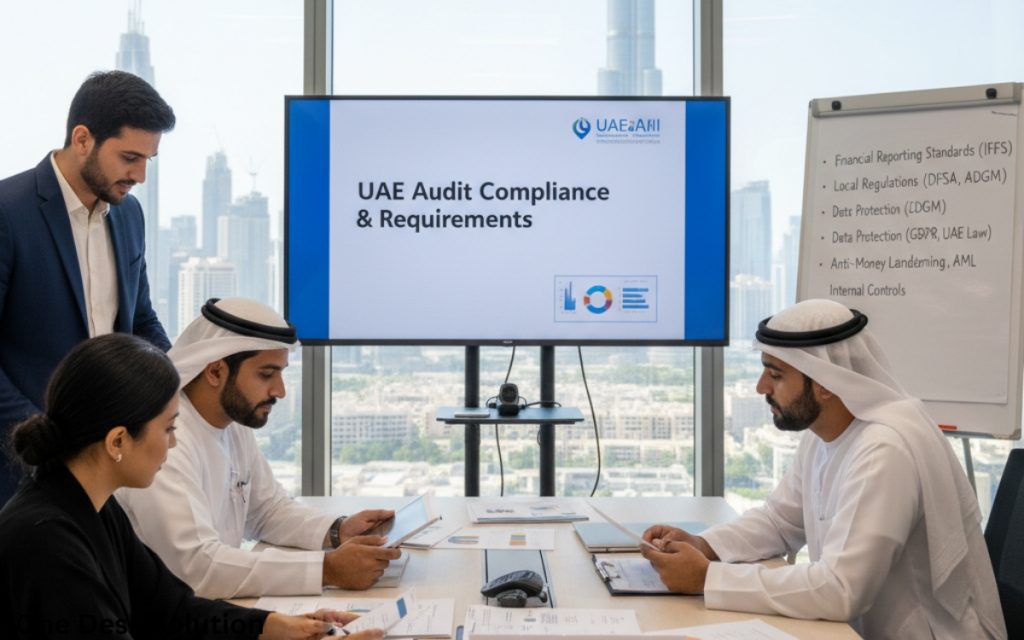
Statutory Audit Requirements for Dubai Companies 2027
Who needs an audit, mainland and free zone rules, Corporate Tax audit points, and how to prepare
Quick Summary: Mainland companies in Dubai are required to have their financial statements audited annually, free zones set their own audit rules, and Corporate Tax rules add audited-statement requirements for some taxpayers and tax groups. This guide explains who needs a statutory audit in 2027, who can audit, the process, a readiness checklist, and common mistakes.
Every Dubai company eventually faces the same question: do we need a statutory audit, and what exactly does it involve? The answer depends on whether you are on the mainland or in a free zone, how big you are, what your regulator says, and, since Corporate Tax arrived, how your tax position is structured.
Mainland companies are required to have their accounts audited annually, free zones set their own rules, and Corporate Tax rules add audited-statement requirements for some taxpayers and tax groups. Missing a requirement can delay licence renewals, create tax problems, and damage trust with banks.
This guide explains statutory audit requirements for Dubai companies in 2027: who needs an audit, mainland and free zone rules, Corporate Tax audit points, who can audit, the process, a readiness checklist, and common mistakes. Our audit and assurance team can confirm what applies to you.
Need to confirm your statutory audit duties for 2027? Speak to our team.
Table of Contents
- What Is a Statutory Audit?
- Who Needs a Statutory Audit in Dubai?
- Mainland Companies
- Free Zone Companies
- Corporate Tax and Audited Financial Statements
- Regulated and Special Sectors
- Who Can Be Your Statutory Auditor?
- Statutory Audit Process
- Audit Readiness Checklist
- IFRS and Financial Reporting
- 2027 Audit Calendar
- Risks of Non-Compliance
- Common Mistakes
- Frequently Asked Questions
- Frequently Asked Questions
1. What Is a Statutory Audit?
A statutory audit is an independent examination of a company's financial statements that is required by law, a regulator, or a licensing authority. A licensed auditor tests the accounts, assesses controls, and gives an opinion on whether the statements are fairly presented. It differs from a voluntary audit, which a company chooses for investors, banks, or its own comfort.
- Required by law or authority, not by choice
- Performed by a licensed, independent auditor
- Ends with a signed audit report
- Often needed for licence renewals, banks, and tax compliance
Please verify before relying on this: Audit duties depend on your legal form, licensing authority, free zone, regulator, revenue, and tax position, and rules can change. Confirm what applies to you for 2027 with your authority or a licensed adviser. Terms are explained in our accounting glossary.
2. Who Needs a Statutory Audit in Dubai?
| Company type | Audit position |
|---|---|
| Mainland companies | Required to have financial statements audited annually under the Commercial Companies Law (Federal Law No. 32 of 2021) |
| Free zone companies | Follow their free zone authority's rules; many require annual audited accounts |
| Taxable persons above the Corporate Tax revenue threshold | Audited financial statements may be required under Ministerial Decision No. 84 of 2025 |
| Tax groups | Required to prepare and maintain audited special purpose financial statements under the same decision |
| Regulated entities | Sector regulators may set their own audit duties |
| Other companies | May choose a voluntary audit for banks, investors, or governance |
Our audit and assurance services help you work out which of these applies. For a breakdown by company type see audit requirements by business type in Dubai.
Not sure whether your Dubai company needs a statutory audit? Speak to our team.
3. Mainland Companies
Under Federal Law No. 32 of 2021 on Commercial Companies, mainland companies are required to have their financial statements audited annually, according to a Dubai audit adviser's summary of the law. The audit must be performed by an auditor licensed by the Ministry of Economy.
- Annual financial statements must be prepared and audited
- The auditor must hold a current Ministry of Economy licence
- The audited accounts are presented to owners or shareholders as the company documents require
- Audited accounts are often requested by banks and for licence-related matters
Please verify: Appointment procedures, auditor terms, and reporting steps depend on your company type and constitutional documents. Confirm with your adviser.
4. Free Zone Companies
Free zone companies are governed by their own authority's rules, not the mainland rules. Some zones require annual audited accounts for licence renewal, some set conditions by company type or size, and some accept different filings. Do not assume that what applies in one zone applies in another.
| Question to ask your free zone | Why it matters |
|---|---|
| Is an annual audit required for licence renewal? | Sets your yearly audit duty |
| Which auditors are approved or accepted? | Avoids a rejected report |
| What is the submission deadline? | Prevents late fees or renewal delays |
| Does the rule depend on company size or type? | Some entities may be treated differently |
| What format and standards are required? | Affects reporting framework |
Compare the two models in free zone vs mainland audit requirements and see top free zones in Dubai comparison. Planning another licence? See multi-activity licence in the UAE.
5. Corporate Tax and Audited Financial Statements
UAE Corporate Tax adds a second reason to audit. Ministerial Decision No. 84 of 2025 sets audit requirements for Corporate Tax purposes.
| Point | What published summaries say |
|---|---|
| Revenue threshold | AED 50 million applies to a taxable person that is not a tax group |
| Non-resident persons | Only revenue earned through permanent establishments or nexuses in the UAE counts |
| Tax groups | Must prepare and maintain audited special purpose financial statements; further guidance was still to be issued |
| Effective date | Applies to tax periods starting on or after 1 January 2025 and repeals Ministerial Decision No. 82 of 2023 for later periods |
| Qualifying Free Zone Persons | Additional procedures may apply for certain designated zone activities; check current guidance |
Please verify: The points above come from a PwC summary of Ministerial Decision No. 84 of 2025. Thresholds and conditions can be updated, so confirm with current Ministry of Finance and FTA sources. Records and filing: tax record maintenance checklist and penalty for late filing in the UAE.
Why Dubai companies commission an audit (illustrative)
Illustrative ranking for explanation, not measured data.
6. Regulated and Special Sectors
- Financial services, funds, insurance, and similar sectors may have regulator-specific audit and reporting rules
- Entities in financial centres follow their own authority's rules
- Investment structures and funds may need specialist audits; see fund accounting audit in the UAE
- Offshore and holding companies should check audit and substance rules; see offshore holding company structure, offshore company for asset management, and offshore company for international trading
7. Who Can Be Your Statutory Auditor?
| Requirement | Summary |
|---|---|
| Licence | The audit firm and individual auditors need a current licence from the Ministry of Economy for mainland audits |
| Qualifications | Accounting degree, practical audit experience, and a recognised professional certificate, per published summaries |
| Independence | No conflicts of interest that impair objectivity |
| Acceptance | Your authority, bank, or regulator must accept the firm's report |
Read how to choose an audit firm in Dubai and cost of audit services in the UAE before you appoint.
8. Statutory Audit Process
Planning
Scope, timeline, and risks agreed with management.
Fieldwork
Auditor tests balances, transactions, and controls.
Findings
Issues raised and adjustments agreed.
Report
Signed audit report and, if agreed, a management letter.
9. Audit Readiness Checklist
| Task | Done? |
|---|---|
| Confirm whether your authority and tax position require an audit | ☐ |
| Appoint a licensed auditor well before year-end | ☐ |
| Reconcile all bank accounts and ledgers | ☐ |
| Prepare fixed asset, inventory, and payroll schedules | ☐ |
| Reconcile VAT and Corporate Tax workings to the accounts | ☐ |
| List related party transactions and agreements | ☐ |
| Organise contracts, invoices, and supporting documents | ☐ |
| Assign one person to respond to auditor queries | ☐ |
Strong books make audits faster and cheaper. See our accounting and bookkeeping services, bookkeeping requirements for UAE businesses, and how to organize financial records for Dubai accountants.
10. IFRS and Financial Reporting
- IFRS is widely used for financial statements in the UAE; a simplified version may be allowed for smaller entities
- Auditors check that statements follow the applicable framework and disclosures
- Complex areas include revenue recognition, leases, financial instruments, and impairment
- Prior-year comparatives and notes must be consistent
For framework-specific support read IFRS compliance audit services.
11. 2027 Audit Calendar
| Timing | Action |
|---|---|
| Start of year | Confirm audit requirements, appoint the auditor, and agree scope and fees |
| Mid-year | Review controls and accounting issues; consider an interim review |
| Before year-end | Plan stock counts, confirmations, and document requests |
| After year-end | Close books, prepare statements, and start fieldwork |
| After the report | Submit audited accounts to the authority or tax return as required; act on management letter points |
Please verify: Submission deadlines for audited accounts depend on your authority and tax period. Confirm dates with the relevant authority and the FTA.
12. Risks of Non-Compliance
- Licence renewal delays or restrictions in some zones
- Rejected reports if the auditor is not accepted by the authority
- Corporate Tax compliance problems if required audited statements are missing
- Bank or investor concerns about unreliable accounts
- Late filing penalties; see penalty for late filing in the UAE
Specific penalties depend on the authority and rule involved, so confirm them directly. Our tax services team can review your position.
13. Common Mistakes
- Assuming a free zone company never needs an audit
- Appointing an auditor the authority does not accept
- Leaving the audit until after the deadline
- Starting with unreconciled books
- Ignoring Corporate Tax audit rules
- Choosing an auditor on price alone
Our advisory and consultancy and business setup teams can plan audit duties from the day you set up.
Frequently Asked Questions
Is a statutory audit mandatory for companies in Dubai?
Mainland companies are required to have their financial statements audited annually under the Commercial Companies Law, and many free zones require annual audited accounts. Corporate Tax rules may also require audited statements above certain revenue levels. Check your authority's rules.
Do free zone companies in Dubai need a statutory audit?
It depends on the free zone authority. Many require annual audited accounts for licence renewal, but rules differ by zone and company type, so confirm with your free zone.
What is the Corporate Tax audit threshold in the UAE?
Per a PwC summary of Ministerial Decision No. 84 of 2025, a taxable person that is not a tax group is subject to an AED 50 million revenue threshold, and tax groups must prepare audited special purpose financial statements. Confirm current rules.
Who can perform a statutory audit in Dubai?
For mainland audits, the firm and its individual auditors must hold a current licence from the Ministry of Economy. Your authority or regulator must also accept the report.
When should I appoint an auditor for 2027?
Ideally at the start of the year or well before year-end, so scope, timeline, fees, and document needs are agreed early and the audit is not rushed.
Related Reading
Ready to meet your 2027 audit requirements with confidence? Let's talk.