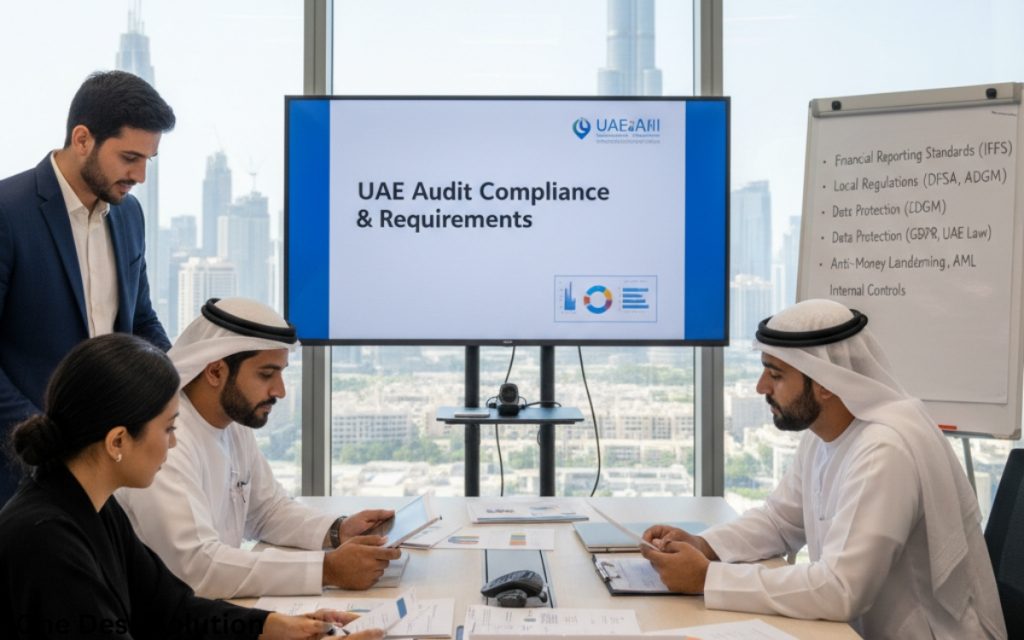
Audit Services for Engineering Consulting Firms
Dubai's Law No. 14 of 2025, WIP & PI Insurance — 2026 Guide
Quick Summary: Engineering consulting firms in Dubai now sit under Law No. 14 of 2025 — a genuinely new regulatory regime that makes it an offense to even present yourself as an engineering consultancy without both a trade license and Dubai Municipality classification, with your firm's grade capped by the qualified engineers you actually employ, not your capital. Dubai Municipality has already suspended firms under this framework for six months. Auditors reviewing an engineering consultancy also need to test project-based work-in-progress, professional indemnity insurance continuity on a claims-made basis, decennial liability exposure, and a VAT rule most firms miss entirely: engineering services tied to a UAE building generally can't be zero-rated as an export, even when billed to a client based abroad. This guide breaks down exactly what an engineering consulting firm audit in the UAE covers in 2026.
📋 Table of Contents
- Introduction to Audit Services for Engineering Consulting Firms
- Dubai's New Engineering Consultancy Law (No. 14 of 2025)
- The Two-Layer Requirement: License + DM Classification
- Classification Grades: Capped by Engineers, Not Capital
- Types of Engineering Offices Under Law 14/2025
- "Engineering Audit" vs Financial Audit
- Why Engineering Firm Audits Are Different
- Revenue Recognition & Work-in-Progress
- Professional Indemnity Insurance
- Decennial Liability: The 10-Year Exposure
- VAT on Engineering Services: The UAE Property Trap
- Subconsultant Cost Pass-Through vs Firm Margin
- Is an Audit Mandatory for Your Firm?
- Cost of an Engineering Consulting Firm Audit
- Common Audit Findings
- How One Desk Solution Can Help
- Frequently Asked Questions
- Related Resources
🏗️ Introduction to Audit Services for Engineering Consulting Firms
Engineering consulting firms in Dubai are now operating under a regulatory regime that's barely a year old. Law No. 14 of 2025, issued in October 2025, replaced a Local Order dating back to 1994 and made something explicit that used to be murkier: it's now an offense to even present your business as an engineering consultancy office without both a valid trade license and formal registration and classification by Dubai Municipality. This isn't a background compliance detail an auditor can skip past — it directly determines what projects your firm is legally allowed to bid on.
The classification system itself has a genuinely distinctive feature worth understanding before anything else: your firm's grade is capped by the qualifications and number of engineers you actually have registered under the entity, not by your paid-up capital. You can't buy a higher grade — you have to staff it. Dubai Municipality has already shown it will enforce this: in 2026, its Licensing and Professional Practice Registration Committee suspended two engineering consultancy offices for six months over regulatory and ethical violations, barring them from obtaining permits for any new projects during that period.
This guide breaks down exactly what an audit of a UAE engineering consulting firm covers in 2026 — the new licensing framework, project-based revenue recognition and work-in-progress, professional indemnity insurance, decennial liability exposure, and a VAT rule that catches out firms working on UAE real estate even when their client is based overseas. If you'd rather have specialists manage this directly, our audit & assurance team works with engineering and architectural consultancies across the UAE.
Need an Audit Firm That Understands Engineering Consultancy Compliance?
Speak to our audit specialists for a free consultation on your firm's DM classification, WIP, and VAT position.
🆕 Dubai's New Engineering Consultancy Law (No. 14 of 2025)
- Issued 5 October 2025, replacing Local Order No. 89 of 1994, regulating engineering consultancy offices — including architectural firms — across Dubai.
- Brings mainland, free zone, and DIFC-based engineering practice into one unified regulatory regime — registering in a free zone or DIFC doesn't exempt a firm from Dubai Municipality classification for work performed in Dubai.
- A DET trade license alone does not authorize engineering consultancy practice — Dubai Municipality registration and classification is a separate, mandatory second layer.
- It is now explicitly an offense to represent a business as an engineering consultancy office without both the license and DM registration in place.
- Firms may only undertake projects strictly within their classification level.
🧩 The Two-Layer Requirement: License + DM Classification
Two Approvals Required to Practice Engineering Consultancy
Managed through a Unified Electronic System linked to the "Invest in Dubai" platform.
📊 Classification Grades: Capped by Engineers, Not Capital
- Classification is based on technical expertise, financial capacity, and administrative/operational capability.
- Critically, a firm's grade is capped by the number and qualifications of its registered engineers — not by declared capital.
- Firms are permitted to work only within their classification level; taking on a project beyond that grade is a compliance breach.
- Auditors reviewing an engineering firm should confirm that active projects are genuinely within the firm's registered classification scope.
🏢 Types of Engineering Offices Under Law 14/2025
| Office Type | Description |
|---|---|
| Local Engineering Office | Standard Dubai-registered consultancy |
| UAE-Based Branch Office | Branch of a UAE-incorporated engineering firm |
| International Branch Office | Branch of a foreign firm; minimum 10 years' international experience required |
| Joint Local-International Partnership | Combined local and international ownership/expertise |
| Advisory Engineering Office ("Opinion Office") | Provides professional advice only; must be owned by engineer(s) with at least 10 years' experience |
| Engineering Audit Office | Authorized to conduct third-party technical/engineering audits of other firms' consultancy work |
🔀 "Engineering Audit" vs Financial Audit
Don't confuse the two: Law No. 14 of 2025's "Engineering Audit Office" category refers to a firm authorized to conduct technical, third-party reviews of another consultancy's engineering work — checking design quality, code compliance, and structural soundness. This is entirely separate from the financial audit services covered in this guide, which examine an engineering firm's accounts, revenue recognition, and compliance with Corporate Tax and VAT law. A firm can need both, from two entirely different specialists.
🔍 Why Engineering Firm Audits Are Different
- Regulatory classification compliance (DM grade vs actual project scope) sits alongside standard financial statement testing.
- Project-based, milestone-billed revenue needs percentage-of-completion recognition, not simple invoice-date accounting.
- Professional indemnity insurance and decennial liability create long-tail risk exposure that a standard trading company doesn't carry.
- VAT treatment of UAE real-estate-connected services has its own place-of-supply nuance, distinct from typical professional service export rules.
📋 Revenue Recognition & Work-in-Progress
- Engineering and design fees are generally recognized under IFRS 15 as the performance obligation is satisfied — typically using a percentage-of-completion or milestone-based method for multi-stage design projects.
- Work-in-progress represents design hours and costs incurred on active projects that haven't yet been invoiced — auditors test this for completeness against timesheets and project records, and for recoverability.
- Retention amounts, where a client contractually withholds a percentage of fees until final deliverable acceptance or project handover, need to be tracked separately from standard receivables.
- Subconsultant costs should be clearly distinguished between pass-through costs and the firm's own fee margin.
🛡️ Professional Indemnity Insurance
- PI insurance is mandatory for engineers and architects under Dubai Municipality's classification requirements, and is very often also required as a condition of client contracts and tenders.
- UAE PI policies are written on a claims-made basis — the policy in force when a claim is first made responds, not the policy in force when the underlying error occurred.
- This makes continuous coverage and correct retroactive dates critical — auditors should verify there are no gaps in PI coverage history, since a lapse can leave the firm exposed for work performed years earlier.
- Confirm PI coverage aligns with the firm's current DM classification grade and the scale of projects actually being undertaken.
⏳ Decennial Liability: The 10-Year Exposure
- Separately from PI insurance, engineers and architects involved in structural design carry decennial liability under the UAE Civil Code — exposure to claims for structural defects for up to 10 years after project completion.
- This is covered by a different insurance product than standard PI cover.
- Firms with a substantial portfolio of completed structural projects may need to consider a provision for potential future decennial claims, similar in principle to warranty provisioning in other sectors.
🧮 VAT on Engineering Services: The UAE Property Trap
Standard UAE engineering consultancy services are subject to 5% VAT. The nuance that catches firms out: engineering, design, and consultancy services connected to a building or property physically located in the UAE are generally treated as supplied where that property is located — meaning the service cannot be zero-rated as an export, even when the client paying for it is based entirely outside the UAE.
Is Your Engineering Service Connected to a UAE Property?
Simplified overview. Confirm each engagement's specific VAT treatment with a tax advisor.
This differs from the more familiar professional-services export rule, where B2B services to a genuinely foreign business are often zero-rated — real-estate-connected services follow the location of the property, not the location of the client. Auditors reviewing an engineering firm's VAT treatment should specifically test any zero-rated invoices issued to overseas clients for UAE-based projects, since this is a common area of misclassification.
🤝 Subconsultant Cost Pass-Through vs Firm Margin
- Clear contractual and accounting separation between subconsultant pass-through costs and the main consultancy's own fee is essential for accurate margin reporting.
- Auditors test that subconsultant invoices are matched to the underlying client billing, and that any markup applied is consistently and transparently treated.
✅ Is an Audit Mandatory for Your Firm?
- Firms with revenue exceeding AED 50 million must maintain audited financial statements under Corporate Tax rules.
- Free zone engineering consultancy entities typically need annual audited financials for license renewal.
- Banks, PI insurers, and larger corporate/government clients increasingly request audited financials as part of due diligence or tender qualification.
💰 Cost of an Engineering Consulting Firm Audit
| Firm Size | Typical Annual Audit Cost (AED) |
|---|---|
| Small consultancy/boutique practice | 15,000 – 30,000 |
| Mid-size firm (multiple disciplines, active DM classification) | 30,000 – 60,000 |
| Large multi-disciplinary firm with regional projects | 60,000 – 120,000+ |
For a full breakdown of audit pricing drivers across UAE industries, see our Guide to Audit Costs and Fees in Dubai.
🔎 Common Audit Findings
- Active projects found to be outside the firm's registered DM classification scope
- Work-in-progress not reconciled to actual timesheets, or carried at an unrealistic recoverable value
- Gaps in professional indemnity insurance continuity, particularly around policy renewal dates
- VAT zero-rating incorrectly applied to UAE real-estate-connected services billed to overseas clients
- Subconsultant pass-through costs not clearly separated from the firm's own fee margin
- No provision considered for decennial liability exposure on a firm with a substantial completed structural project portfolio
💼 How One Desk Solution Can Help
Engineering firm audits require understanding of DM classification compliance, project-based revenue recognition, and property-linked VAT rules — not a generic professional services approach. Our audit and assurance services team works directly with engineering and architectural consultancies, supported by our tax services team for VAT classification and Corporate Tax compliance, our accounting & bookkeeping services for WIP tracking and day-to-day books, and our advisory & consultancy services for structuring and classification strategy. If you're setting up a new engineering practice, our business setup team can help structure it correctly. Explore our full range on the services page.
❓ Frequently Asked Questions
Q1: Do engineering consultancy firms in Dubai need Dubai Municipality classification in addition to a trade license?
Yes. Under Law No. 14 of 2025, a DET trade license alone does not authorize a firm to practice as an engineering consultancy in Dubai. Firms must also be registered and classified by Dubai Municipality, which determines their scope of services and the grade of projects they're permitted to undertake, based on their registered technical staff's qualifications and experience. It's now an offense to even present your business as an engineering consultancy office without both approvals in place.
Q2: What is the difference between an "Engineering Audit Office" and a financial audit?
They're entirely different things. An Engineering Audit Office, a category defined under Law No. 14 of 2025, is authorized to conduct technical, third-party reviews of another firm's engineering work — checking design quality, code compliance, and structural soundness. A financial audit, by contrast, examines a company's accounts, revenue recognition, and tax compliance. An engineering consultancy might need both services, but from two completely different specialists.
Q3: Is engineering consultancy work for a UAE building VAT zero-rated if the client is based overseas?
Generally, no. Engineering, design, and consultancy services connected to a building or property physically located in the UAE are typically treated as supplied where that property is located, meaning the service can't be zero-rated as an export even when the paying client is based entirely outside the UAE. This differs from the more familiar rule for general professional services exported to a genuinely foreign business client, and it's a common area of VAT misclassification that auditors specifically check.
Q4: Do engineers and architects need professional indemnity insurance in the UAE?
Yes, generally. Professional indemnity insurance is required for engineers and architects under Dubai Municipality's classification requirements, and is very commonly also mandated as a condition of client contracts and project tenders. UAE PI policies are written on a claims-made basis, meaning the policy in force when a claim is first made responds, not the one in force when the underlying error occurred — so continuous coverage without gaps is essential.
Q5: Is an annual audit mandatory for an engineering consulting firm in the UAE?
It depends on structure and revenue. Firms with revenue exceeding AED 50 million must maintain audited financial statements under Corporate Tax rules, and free zone engineering consultancy entities typically need annual audited financials for license renewal. Even where not strictly mandatory, banks, professional indemnity insurers, and larger corporate or government clients increasingly expect audited financials as part of due diligence or tender qualification.
🔗 Related Resources
A full breakdown of audit pricing drivers across UAE industries.
Explore setup requirements for another technically-regulated UAE sector.
Compare setup requirements for another advanced-technology UAE sector.
Relevant licensing distinctions for consultancy-model businesses.
A practical UAE company structuring question for growing consultancies.
Understand the prerequisite for processing visas for your technical staff.
Explore specialist financial leadership support for another regulated UAE sector.
Get an Audit Team Built for Engineering Consultancy Compliance
From DM classification checks to VAT on UAE property work, One Desk Solution's audit specialists keep your engineering practice compliant year-round.