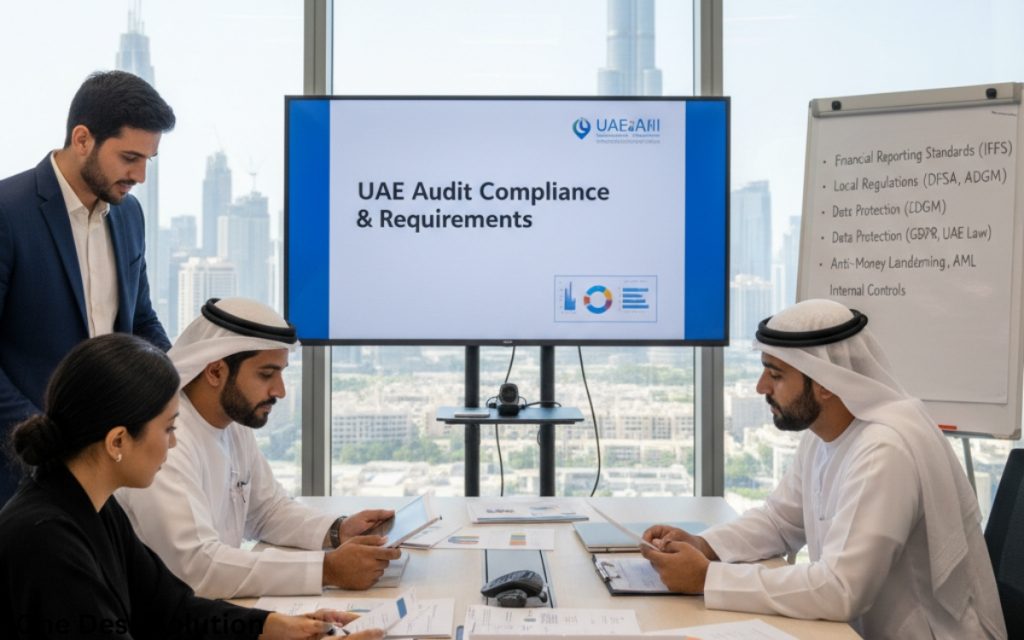
Audit Compliance Requirements for Dubai Companies, UAE
Who Must Audit, Free Zone Rules, Filing Deadlines & Penalties for Non-Compliance — 2026 Guide
Quick Summary: Audit compliance in Dubai isn't a single uniform rule — whether a company must have an audit, by when, and under what standards depends on its legal form, its free zone (if any), and whether it relies on 0% Corporate Tax as a Qualifying Free Zone Person. Free zones like DMCC, JAFZA, DIFC, and ADGM each layer their own audit submission deadlines and requirements on top of federal obligations, and missing any of them can affect license renewal, not just tax status. This guide breaks down exactly what audit compliance requirements apply to Dubai companies in 2026, by structure and free zone.
Dubai company owners often ask "do I need an audit?" as if there's one yes-or-no answer. In reality, audit compliance stacks from several directions at once: Corporate Tax law, the specific free zone authority's own rules, and general company law requirements tied to legal form. A company can be fully compliant on one front and still miss a deadline on another.
Free zones are where this gets most inconsistent. DMCC, JAFZA, DIFC, and ADGM each set their own audit submission windows and documentation standards, separate from the federal Corporate Tax filing deadline — meaning a company can file its tax return on time and still be late, or non-compliant, with its free zone authority's own audit requirement.
This guide covers who must audit, free zone-specific timelines, record retention, and penalties for Dubai companies. Our audit and assurance services team tracks these requirements across jurisdictions for our clients.
Not sure which audit deadlines apply to your Dubai company?
Table of Contents
- Who Must Have an Audit in Dubai
- Statutory Audit Triggers by Entity Type
- Free Zone-Specific Audit Requirements
- Audit Filing Deadlines & Compliance Calendar
- Record Retention Requirements
- Penalties for Non-Compliance
- Audit Report Requirements & Standards
- Common Compliance Gaps
- Choosing the Right Audit Partner
- FAQs
1. Who Must Have an Audit in Dubai
Three separate pressures determine audit obligations for most Dubai companies: the company's legal form under UAE company law, the specific free zone authority's own licensing rules (if applicable), and whether the entity relies on 0% Corporate Tax as a Qualifying Free Zone Person. Meeting one doesn't automatically mean meeting the others.
2. Statutory Audit Triggers by Entity Type
| Entity Type | Typical Audit Position |
|---|---|
| Mainland LLC | Statutory audit requirements apply depending on legal form and specific licensing authority rules |
| Public Joint Stock Company (PJSC) | Mandatory annual audit of financial statements under UAE company law |
| Free zone company (general) | Audit typically required for license renewal, independent of Corporate Tax status |
| Qualifying Free Zone Person | Audited financial statements are a mandatory condition to maintain 0% Corporate Tax treatment |
3. Free Zone-Specific Audit Requirements
Dubai's major free zones each maintain their own audit submission requirements as part of annual license renewal, generally requiring the audit to be conducted by a firm registered with the free zone's own approved auditor list.
| Free Zone | Audit Compliance Note |
|---|---|
| DMCC | Annual audited financial statements generally required for license renewal, from an approved DMCC auditor |
| JAFZA | Audited financial statements typically required annually, submitted ahead of license renewal |
| DIFC | Financial reporting and audit requirements aligned with DIFC's own regulatory framework, generally stricter for regulated entities |
| ADGM | Audit and financial reporting obligations under ADGM's companies regulations, varying by entity category |
| Dubai South / other industrial free zones | Audit requirements typically tied to license renewal, confirmed with the specific authority |
4. Audit Filing Deadlines & Compliance Calendar
| Obligation | Typical Timing |
|---|---|
| Free zone audit submission for license renewal | Ahead of the annual license expiry date, timing varies by free zone |
| Corporate Tax return filing | Within 9 months of the financial year end |
| Corporate Tax registration | Required for all taxable persons, independent of audit status |
| VAT return filing | Typically quarterly, per FTA registration terms |
5. Record Retention Requirements
Supporting financial records, invoices, and documentation generally need to be retained for a minimum period after the relevant tax period or transaction, with certain categories of records (such as those related to real estate or capital assets) subject to longer retention requirements. Retention obligations should be confirmed against both Corporate Tax/VAT rules and the specific free zone authority's own requirements, since they aren't always identical.
6. Penalties for Non-Compliance
- Missing a free zone's audit submission deadline can delay or block trade license renewal
- Failing to maintain audited financial statements can result in loss of Qualifying Free Zone Person status and the standard 9% Corporate Tax rate applying to all income
- Late Corporate Tax registration and filing carry fixed administrative penalties, separate from any free zone-level consequences
- Repeated non-compliance can affect a company's standing with its licensing authority beyond financial penalties alone
7. Audit Report Requirements & Standards
UAE statutory audits are generally conducted in accordance with International Standards on Auditing (ISA), with financial statements prepared under International Financial Reporting Standards (IFRS) or IFRS for SMEs, depending on the entity's size and reporting framework. The auditor's report should clearly state the basis of preparation, the scope of the audit, and the opinion issued, since this documentation is what licensing authorities and the FTA will review.
8. Common Compliance Gaps
- Assuming Corporate Tax filing compliance automatically satisfies free zone audit submission requirements
- Using an audit firm not on the specific free zone's approved list, invalidating the submission
- Treating audit as a once-a-year task rather than maintaining audit-ready records throughout the year
- Overlooking record retention requirements for categories like real estate or capital assets that carry longer retention periods than standard transactions
9. Choosing the Right Audit Partner
Dubai's layered compliance requirements mean an audit partner needs to track federal Corporate Tax rules alongside your specific free zone's own deadlines and approved auditor status. Pairing audit support with accounting and bookkeeping services, tax services, and advisory and consultancy services keeps every deadline tracked together rather than managed separately.
Get a free review of your company's audit compliance status.
Frequently Asked Questions
Do all Dubai companies need an audit?
Not uniformly. Requirements depend on legal form, free zone licensing rules, and whether the entity relies on Qualifying Free Zone Person status for 0% Corporate Tax — mainland and free zone companies can face different combinations of audit obligations.
Does filing a Corporate Tax return satisfy a free zone's audit requirement?
Not necessarily. Many free zones require audited financial statements as a separate condition for license renewal, independent of federal Corporate Tax filing, so both obligations need to be tracked and met separately.
Can any UAE-licensed audit firm be used for a free zone audit?
Often not. Many free zones maintain their own approved auditor lists, and using a firm outside that list can mean the submission isn't accepted for license renewal purposes, so this should be confirmed before engaging an auditor.
What happens if a free zone company misses its audit submission deadline?
Consequences can include delayed or blocked trade license renewal, and for entities relying on Qualifying Free Zone Person status, potential loss of that status and exposure to the standard 9% Corporate Tax rate on all income.
What accounting and auditing standards apply to UAE company audits?
UAE statutory audits are generally conducted under International Standards on Auditing, with financial statements prepared under IFRS or IFRS for SMEs, depending on the entity's size and applicable reporting framework.
Related Reading
Ready to get your Dubai company fully audit-compliant?
Talk to our audit team today.