Audit Services for
Dental Practices
in UAE 2026
The complete 2026 guide to financial and regulatory audits for UAE dental practices — DHA and DOH licensing audit requirements, revenue recognition for dental services, VAT on dental treatments, staff and dentist payroll compliance, dental equipment depreciation, insurance billing audit, multi-branch consolidation, and specialist UAE dental clinic audit advisory.
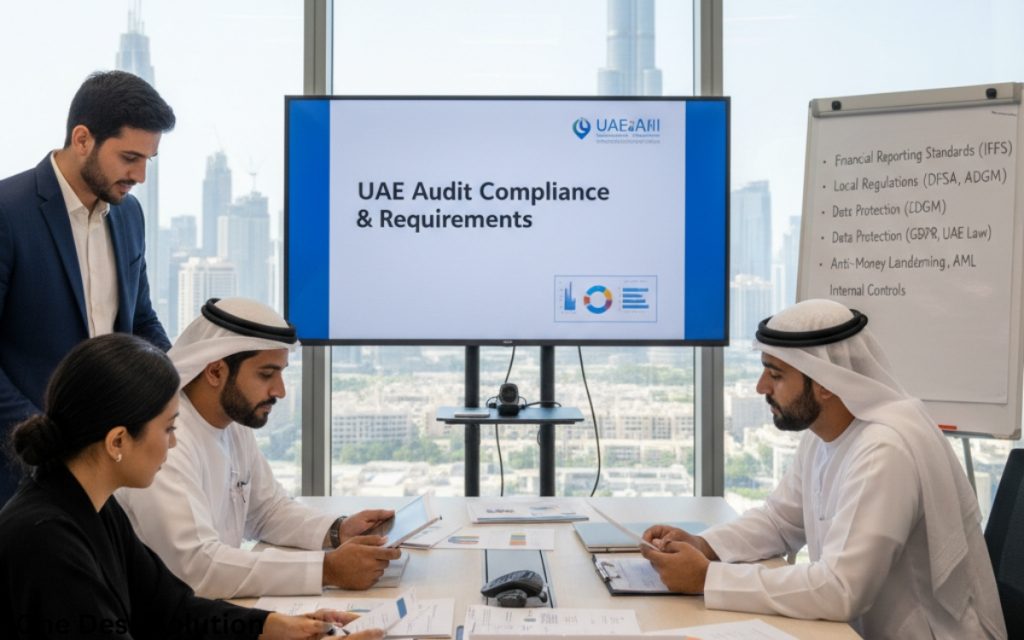
UAE dental practices — from single-chair general dentistry clinics and multi-branch cosmetic dental groups to specialist orthodontic, oral surgery, and paediatric dental centres — operate in one of the most regulated and financially complex sectors of the UAE healthcare market. Every dental practice licensed by the Dubai Health Authority (DHA), the Department of Health Abu Dhabi (DOH), or the Ministry of Health and Prevention (MoHAP) faces both mandatory regulatory audit obligations and the full suite of UAE tax compliance requirements that arrived with Corporate Tax in 2023 and have been in place since VAT in 2018. The UAE dental sector also involves unique financial audit challenges: mixed revenue streams from self-pay, insurance billing, and corporate packages; complex VAT treatment distinguishing medically necessary treatments (zero-rated) from cosmetic procedures (standard-rated 5%); dentist and specialist payroll structures including profit-sharing, per-chair fees, and specialist engagement agreements; and high-value dental equipment and technology assets requiring careful IAS 16 depreciation treatment. This comprehensive 2026 guide covers every material audit service requirement for UAE dental practices — from mandatory free zone and DHA annual audit requirements through financial statement audit, VAT audit, insurance billing audit, Corporate Tax, and staff payroll compliance — and how OneDeskSolution provides specialist UAE healthcare and dental practice audit and advisory services.
🦷1. UAE Dental Practice Regulatory Landscape 2026
The UAE dental sector is among the most dynamic and rapidly growing healthcare segments in the Emirates. Dubai and Abu Dhabi have established world-class dental markets attracting international patients for cosmetic and restorative treatments, while a growing population of UAE residents and expatriates drives strong demand for general dentistry, orthodontics, paediatric dentistry, and specialist oral surgery. The UAE dental market is characterised by a mix of independent single-chair clinics, multi-disciplinary dental centres, large commercial dental groups operating across multiple emirates, hospital-embedded dental departments, and internationally branded specialist practices.
Every dental practice operating in the UAE is subject to licensing and clinical governance oversight from one of the emirate-specific healthcare regulators: the Dubai Health Authority (DHA) for Dubai; the Department of Health Abu Dhabi (DOH, formerly HAAD) for Abu Dhabi; and the Ministry of Health and Prevention (MoHAP) for other emirates including Sharjah, Ajman, Ras Al Khaimah, Umm Al Quwain, and Fujairah. These regulators impose facility licensing requirements, mandatory professional licensing for all dentists and dental support staff, clinical standards obligations, and — critically for this guide — annual financial and compliance audit requirements that are directly tied to licence renewal.
Since the introduction of UAE VAT in 2018 and Corporate Tax in 2023, dental practices have faced a materially more complex financial compliance environment. The VAT treatment of dental services — where the distinction between zero-rated "necessary medical services" and standard-rated cosmetic or aesthetic procedures creates a mixed-supply position for most clinics — is one of the UAE VAT system's most technically demanding applications in the healthcare sector. Combined with insurance billing reconciliation, specialist employment structures, high-value equipment depreciation, and supply chain management for dental consumables and materials, the financial audit of a UAE dental practice is a genuinely specialist exercise that requires both healthcare sector knowledge and UAE-specific accounting and tax expertise.
Specialist Audit Services for UAE Dental Practices
OneDeskSolution provides expert audit and assurance services for UAE dental clinics — DHA and DOH licence audit, financial statement audit, VAT on dental services, insurance billing audit, dentist payroll compliance, equipment depreciation, and Corporate Tax. Get a free consultation today.
🏥2. Types of Dental Practices & Their Audit Profile
General Dental Clinic
Single or multi-chair; general dentistry; extraction, fillings, root canal; self-pay + insurance; DHA/DOH licensed
Cosmetic Dental Centre
Veneers, whitening, smile design; primarily 5% VAT; high revenue per treatment; mostly self-pay; high equipment value
Orthodontic Practice
Braces, Invisalign, aligners; long treatment plans spanning months; complex revenue recognition; mixed medical/cosmetic VAT
Paediatric Dental Clinic
Children's dentistry; sedation services; fully zero-rated medically necessary treatments; insurance-heavy billing
Multi-Specialty Dental Group
General + specialist + cosmetic under one brand; multiple branches; complex group audit; consolidation required
Hospital Dental Department
Embedded in private hospital; oral surgery; maxillofacial; anaesthesiology involvement; complex cost allocation within hospital
| Practice Type | Audit Complexity | Key Audit Focus | VAT Profile |
|---|---|---|---|
| General Dental Clinic | Low-Medium | Revenue completeness; insurance billing; consumables inventory | Mostly 0% zero-rated — medically necessary treatments |
| Cosmetic Dental Centre | Medium-High | VAT on cosmetic services; revenue recognition for treatment plans; high-value equipment depreciation | Mostly 5% VAT — cosmetic not medically necessary |
| Orthodontic Practice | High | Long-term treatment plan revenue recognition (IFRS 15); deposit accounting; VAT allocation per treatment type | Mixed — orthodontics for malocclusion (0%) vs. cosmetic alignment (5%) |
| Paediatric Dental | Low-Medium | Insurance claims audit; sedation billing; DHA paediatric facility standards | Predominantly 0% — medically necessary children's dental care |
| Multi-Specialty Group | Very High | Group consolidation; intercompany transactions; allocation of central costs; branch profitability; transfer pricing | Complex mixed — 0% and 5% across branches and specialties |
📋3. Mandatory Audit Requirements for UAE Dental Clinics
| Requirement | Who Requires It | Frequency | What Is Audited | Consequences of Non-Compliance |
|---|---|---|---|---|
| Annual financial statement audit (DHA Dubai) | Dubai Health Authority — required for private dental facility licence renewal | Annual | Full IFRS financial statements: P&L, Balance Sheet, Cash Flow; auditor's report | DHA licence renewal blocked; practice cannot operate legally |
| Annual financial statement audit (DOH Abu Dhabi) | Department of Health Abu Dhabi — all licensed private dental facilities | Annual | IFRS audited accounts; compliance certification | DOH facility licence suspended or not renewed |
| Free zone company annual audit | Free zone authority (DMCC, DHCC, Dubai Healthcare City Authority, etc.) if dental clinic is registered in a free zone | Annual | IFRS financial statements; audited accounts submission for free zone licence renewal | Free zone licence renewal blocked |
| FTA VAT audit | Federal Tax Authority — may audit any VAT-registered dental practice | FTA-initiated; no fixed schedule | VAT 201 returns; medical vs. cosmetic VAT treatment; insurance billing; input VAT recovery | VAT assessment; penalties up to 50% of underdeclared VAT; possible Tax Group impact |
| Corporate Tax CT 201 filing | Federal Tax Authority — all UAE-registered dental practices | Annual | CT 201 return filed via EmaraTax; audited financials supporting CT computation | Late/incorrect CT 201 penalties; AED 10,000 registration failure penalty |
DHA Audit Is Not Optional — It Determines Your Right to Operate: The most critical distinction in UAE dental practice audit is that the DHA (Dubai) and DOH (Abu Dhabi) annual financial audit is not a voluntary transparency exercise — it is a mandatory regulatory requirement directly tied to facility licence renewal. A dental practice in Dubai that fails to submit audited financial statements to DHA will not have its facility licence renewed, and operating without a valid DHA facility licence is a serious regulatory violation that can result in clinic closure, fines, and reputational damage. Every dental practice owner should treat the annual audit timeline as a non-negotiable business obligation, beginning the audit process at least 3–4 months before their licence renewal date.
📊4. Revenue Recognition Audit for Dental Practices
| Revenue Type | IFRS 15 Treatment | Audit Risk | Key Audit Procedure |
|---|---|---|---|
| Single-visit treatments (extraction, filling, scaling) | Revenue recognised at the point of service delivery — when the dental procedure is completed in the chair | Low — clear single performance obligation with immediate delivery | Agree daily appointment records to billing system; test completeness of daily fee income capture |
| Multi-visit treatment plans (root canal, crown, bridge) | Single performance obligation (delivering the completed treatment) or multiple distinct POs (each visit) — analyse treatment contract. Revenue recognised as each distinct service component is delivered | Medium — risk that revenue for the whole plan is front-loaded at sign-up or back-loaded at final visit | Review treatment plan contracts; confirm revenue recognition aligns to services delivered per visit; test deferred income balance for multi-visit plans |
| Orthodontic treatment (braces, Invisalign) — 12–24 month plans | If the entire orthodontic service is a single PO delivered over time: recognise revenue progressively over the treatment period (straight-line or aligned to appointment milestones). Patient deposits: recognise as deferred revenue until treatment commences | High — risk of under-deferral (revenue recognised upfront) or over-deferral (revenue deferred beyond when services are rendered) | Obtain schedule of all open orthodontic treatment plans; verify deferred revenue/contract liability balance per IFRS 15; agree to individual patient records |
| Advance deposits / initial payments | Not revenue until the service obligation begins. Record as a contract liability / deferred revenue on the balance sheet | Medium — deposits are commonly misclassified as immediate income at the time of receipt | Test the deposit ledger; confirm that deposits received but not yet allocated to completed treatments are held as deferred revenue |
| Insurance-billed revenue | Recognise revenue when service is delivered; the insurance claim is a receivable. Revenue is the gross amount billed to the insurer, not the net cash received after co-pay | High — insurance claims are often the most difficult area to audit correctly; disputes, rejections, and co-pay netting are common | Obtain insurance claims ageing schedule; agree to DHA/DOH eClaim submissions; test claims reversal/rejection rate; verify revenue is gross billings not net cash |
| Corporate wellness / dental package revenue | Bulk dental packages sold to corporations: recognise revenue as individual appointments are used; unused portions: deferred revenue | Medium — risk of recognising bulk package income upfront rather than as appointments are consumed | Obtain corporate package contracts; verify usage tracking against billings; confirm deferred portion calculation |
💰5. VAT Audit — Medical vs. Cosmetic Dental Services
The UAE VAT treatment of dental services is the single most important and most technically demanding tax issue for UAE dental practices. The distinction between zero-rated medically necessary dental services and standard-rated cosmetic dental procedures determines the VAT position on every treatment — and getting it wrong, in either direction, creates FTA audit risk and either financial cost (overclaimed cosmetic procedures) or excess VAT payments (over-applying VAT to zero-rated medical services).
| Dental Service | VAT Treatment | Rate | Rationale & Key Condition |
|---|---|---|---|
| Dental extraction (medically indicated) | Zero-Rated | 0% | Necessary medical treatment to address pain, infection, or pathological condition. Full input VAT recovery on related clinic costs. |
| Root canal treatment | Zero-Rated | 0% | Medically necessary treatment to preserve a tooth with infected or dead pulp. Zero-rated. |
| Dental fillings (caries restoration) | Zero-Rated | 0% | Treating tooth decay (caries) is medically necessary — zero-rated regardless of material used (amalgam or composite). |
| Scaling and teeth cleaning (preventive / therapeutic) | Zero-Rated | 0% | Preventive and therapeutic dental hygiene services are generally zero-rated as part of necessary healthcare. |
| Dental crown (to restore a damaged tooth) | Zero-Rated | 0% | Crown to restore function after root canal or tooth damage: zero-rated. Crown purely for appearance with no functional need: may be 5%. |
| Orthodontic treatment (medically necessary — severe malocclusion) | Zero-Rated | 0% | Orthodontic treatment recommended by a licensed dental professional to correct a clinically significant malocclusion: zero-rated. |
| Orthodontic treatment (cosmetic alignment only) | Standard-Rated | 5% | Where orthodontic treatment is sought purely for cosmetic alignment with no clinical necessity: 5% VAT applies. |
| Teeth whitening / bleaching | Standard-Rated | 5% | Cosmetic dental procedure with no medical necessity — clearly standard-rated at 5% VAT. |
| Dental veneers | Standard-Rated | 5% | Veneers for aesthetic improvement: 5% VAT. Veneers to restore damaged or fractured teeth where medically necessary: may be zero-rated — requires clinical documentation. |
| Cosmetic smile design | Standard-Rated | 5% | Full smile makeover packages combining cosmetic treatments: 5% VAT on entire package. Separate any medically necessary components if clinically documented and separately billed. |
| Dental implants (replacing missing teeth) | Mixed — analyse | 0% or 5% | Implants to restore function (chewing, speech) for missing teeth: arguments exist for zero-rating as medically necessary. Implants primarily for aesthetic tooth replacement: may be 5%. Obtain and retain the clinical necessity documentation. |
| Dental X-rays and diagnostic services | Zero-Rated | 0% | Diagnostic imaging provided as part of dental treatment: zero-rated as a component of necessary healthcare. |
Clinical Documentation Is the Foundation of Zero-Rating — Retain It All: The single most important risk management action for UAE dental practice VAT compliance is maintaining comprehensive clinical documentation for every treatment classified as zero-rated. The FTA, in a VAT audit of a dental practice, will request the clinical justification for zero-rated treatments — particularly for higher-value procedures like crowns, implants, and orthodontic treatment where the medical vs. cosmetic determination is not self-evident. A clinician's note confirming the clinical indication (pain, infection, functional impairment, clinical malocclusion) is the evidence that supports zero-rating. Without it, the FTA may reclassify the treatment as cosmetic (5% VAT) and issue an assessment for the unpaid VAT plus penalties.
🏦6. Insurance Billing & Receivables Audit
- Insurance revenue is the highest-risk area in a dental practice audit: For dental clinics where 30–70% of revenue is billed through insurance companies (whether government schemes like Thiqa/Daman or private insurers including AXA, Oman Insurance, AIG, and others), the audit of insurance receivables is typically the most complex and highest-risk area of the financial audit. Key risks: timing differences between services rendered and insurance claim submission; claim rejections and disputes reducing billed revenue; co-pay collections that may or may not be recorded; ageing receivables from insurance companies that may never be collected; and the DHA eClaim system requirements that create a parallel record of claims independent of the clinic's billing system.
- Gross billing vs. net cash — the fundamental insurance revenue principle: Revenue must be recognised at the gross amount billed to the insurer — not the net cash received after the insurer's payment minus any rejected amounts. The difference between the gross billed amount and the actual cash collected is either an insurance receivable (amounts still expected to be paid) or an adjustment for claim rejections/write-offs (recognised as an expense when rejections are confirmed). Many dental practices net these figures and declare the net cash received as revenue — this understates both revenue and the write-off expense, distorting the financial statements.
- Claim rejection rate — a key audit metric: The auditor should obtain the practice's insurance claim rejection rate by insurer and by treatment type. A high or increasing rejection rate signals either: billing compliance issues (claims submitted for treatments not covered by the patient's policy); clinical documentation gaps; or coding errors in the DHA eClaim system. A rejection rate above 8–10% warrants detailed investigation.
- Insurance receivables ageing — provisions for doubtful debts: Insurance receivables outstanding for more than 90 days should be specifically reviewed. Receivables outstanding for more than 180 days from established insurers are unusual and warrant provision. Outstanding receivables from smaller or less financially secure insurers should be evaluated for recoverability and provided if the likelihood of collection is doubtful. Failing to provision genuinely doubtful insurance receivables overstates assets and understates expenses — and therefore overstates Corporate Tax.
- DHA eClaim system reconciliation — a unique audit procedure: The DHA eClaim system maintains an independent record of all insurance claims submitted by DHA-licensed facilities. The auditor should reconcile the clinic's internal billing system claims data to the DHA eClaim portal submission data. Discrepancies — claims submitted to the insurer but not through the eClaim system, or vice versa — indicate either system errors or potential billing irregularities. This reconciliation is unique to UAE dental practice auditing and requires familiarity with DHA's health claims architecture.
🔧7. Dental Equipment & IAS 16 Depreciation Audit
| Asset Category | Typical Useful Life | Depreciation Method | Key Audit Point |
|---|---|---|---|
| Dental chair & patient unit | 8–12 years | Straight-line recommended for consistency | High unit value (AED 30,000–100,000 per chair); confirm capitalisation vs. expense threshold; trace to asset register |
| Digital X-ray / OPG / CBCT machine | 7–12 years | Straight-line | CBCT units are often AED 150,000–400,000; confirm IAS 16 capitalisation; verify useful life matches manufacturer specs and usage intensity |
| Dental laser (hard/soft tissue) | 7–10 years | Straight-line | High-value specialist equipment; confirm capitalisation; check if separate service contract cost is expensed vs. capitalised |
| CAD/CAM system (CEREC / in-house milling) | 6–8 years | Straight-line | Complete CAD/CAM systems: AED 100,000–250,000; confirm bundled hardware + software depreciation treatment; IFRS 16 if leased |
| Sterilisation equipment (autoclave) | 8–12 years | Straight-line | Medically essential; confirm capitalisation; track maintenance cycle records — ageing autoclaves may require IAS 36 impairment assessment |
| Clinic fit-out & interior works | 5–7 years (or lease term) | Straight-line over shorter of useful life or lease term | Major initial fit-out: AED 150,000–500,000+; confirm it is capitalised not expensed; confirm depreciation period reflects the actual lease commitment |
| IFRS 16 right-of-use (clinic lease) | Per lease term (typically 3–7 years) | Straight-line depreciation on ROU asset + finance charge on lease liability | Confirm IFRS 16 adoption for all dental clinic leases; verify lease liability and ROU asset are correctly recognised on balance sheet |
Dental Equipment — The Most Capital-Intensive Area of the Dental Practice Balance Sheet: A well-equipped multi-chair dental practice can carry AED 500,000 to AED 2M+ of dental equipment on its balance sheet — digital X-ray units, CBCT scanners, CAD/CAM systems, laser equipment, multiple dental chair units, sterilisation systems, and IT hardware. The IAS 16 fixed asset register must be meticulously maintained: every asset individually listed with cost date, supplier invoice, useful life, depreciation method, accumulated depreciation, and net book value. The auditor will physically verify a sample of assets — particularly the high-value equipment items — against the register and the physical location in the clinic. Dental practices that have not maintained a dedicated asset register often discover significant accumulated depreciation errors at audit time.
👨⚕️8. Dentist Payroll & Staff Compliance Audit
| Staff Category | Employment Structure | Key Payroll Audit Point | Compliance Requirement |
|---|---|---|---|
| Employed general dentist | Fixed employment contract; WPS payroll; EOSB accrual; health insurance | Confirm WPS monthly payments match contract salary; EOSB accrual per UAE Labour Law; health insurance coverage verified | WPS mandatory; EOSB monthly accrual: 21 days per year (first 5 years); DHA practitioner licence current |
| Specialist dentist (orthodontist, implantologist) | Employment or Revenue-Sharing Agreement (% of collections); sometimes hourly session rate | If revenue-sharing: confirm correct gross revenue basis; timing of payment aligned to collection; employer-side costs correctly calculated. Session rates: confirm number of sessions × rate matches payments made | Revenue-sharing vs. employment: if working exclusively and following clinic direction — likely employment, not independent contractor. Misclassification is a MoHRE risk |
| Dental nurse / dental assistant | Employment; WPS; DHA health card mandatory | DHA licensed scope of practice confirmed; health card renewal dates tracked; WPS payments verified | DHA clinical support staff licensing mandatory; health card renewed annually |
| Dental hygienist | Employment or sessional; DHA licence required | Confirm DHA practitioner licence; WPS payroll if employed; hourly rates if sessional (time-and-attendance records) | DHA practitioner licence for all hygienists; scope of practice within UAE dental hygienist regulations |
| Receptionist / administrative staff | Employment; WPS; general health insurance | WPS compliance; EOSB accrual; confirm headcount matches payroll roll | Standard MoHRE employment requirements; health insurance mandatory in Dubai |
| Visiting / locum dentist | Independent contractor with own DHA licence; sessional fees; typically not employment | Confirm independent contractor status; self-employed vs. employee classification criteria; tax invoice if VAT-registered; no WPS obligation for genuine independent contractors | Visiting dentist must hold own DHA practitioner licence; clinic must verify licence status before each working session |
Revenue-Sharing Dentists — The Most Complex Payroll Audit Area: Many UAE dental practices engage specialist dentists on a revenue-sharing basis — where the dentist receives a percentage (commonly 30–50%) of the collections from their specific chair or patient caseload. This arrangement creates several audit complexities: (1) The revenue base must be correctly determined (gross collections or net after lab costs?); (2) The timing of payment must align to when collections are received (not just when treatments are invoiced); (3) The arrangement may legally constitute employment rather than self-employment if the dentist works exclusively at the clinic, uses clinic equipment, and follows clinic direction — triggering WPS and EOSB obligations; and (4) If the dentist is treated as an independent contractor, the clinic should not be withholding their income, and the dentist should be VAT-registered and issuing their own tax invoices. An audit finding that a large portion of revenue-sharing dentists should have been on payroll can create significant retrospective MoHRE and FTA liability.
UAE Dental Practice Audit — Healthcare Specialists Ready
OneDeskSolution's audit team combines healthcare sector expertise with UAE accounting and tax knowledge — DHA licence audit, revenue recognition, VAT on dental services, insurance billing, equipment depreciation, and dentist payroll compliance. Contact us for a free audit assessment today.
🏛️9. Corporate Tax for Dental Practices
| Practice Profile | CT Position | Key CT Strategy | Priority Action |
|---|---|---|---|
| Single-chair solo practice (<AED 3M revenue) | 0% SBR likely | Elect Small Business Relief annually in CT 201; accurate P&L; EOSB accrual | CT registration; SBR election; basic IFRS accounts; DHA audit |
| Growing dental clinic (AED 3M–15M) | 9% CT on profits above AED 375K | Equipment depreciation; dentist payroll deductions; rent; EOSB; insurance provisions; orthodontic deferred revenue | Annual CT 201; quarterly management accounts; full IFRS; DHA audit |
| Multi-branch dental group | 9% CT — significant; group structure may qualify for CT Group | CT Group election if conditions met; intragroup management fee deductions; consolidation; transfer pricing | CT Advisory; group audit; consolidation; TP Disclosure Form |
| Free zone dental clinic (DHCC / Dubai Healthcare City) | QFZP analysis — healthcare income typically domestic; 9% on UAE patient revenue | QFZP substance maintained; healthcare revenue analysis — most DHCC dental income is UAE-sourced and 9% CT | QFZP eligibility review; DHCC annual audit; DHA licensing audit |
📊 Key CT Deductions for Dental Practices
📦10. Dental Consumables & Inventory Audit
- Dental consumables — high-value, small-volume inventory: Dental consumables — impression materials, composite resins, bonding agents, cements, endodontic files and instruments, implant components, orthodontic brackets and wires, anaesthetic cartridges, gloves, masks, and sterilisation pouches — represent a significant cost for any dental practice. For audit purposes, the key issues are: completeness of purchase recording; correct allocation between cost of sales (consumed) and closing inventory (held); and whether controlled drugs (anaesthetic) are subject to the separate MOH controlled drug register requirement.
- Dental laboratory fees — a major cost requiring detailed audit: External dental laboratory fees (for crowns, bridges, dentures, night guards, orthodontic retainers, and custom implant components) are typically the largest single category of dental practice cost after payroll. Lab fees must be matched to completed treatment and revenue in the same period. Outstanding lab invoices at year end must be accrued. The auditor should obtain the lab fee schedule and compare rates to industry benchmarks — a dental practice paying significantly above-market lab fees to a related laboratory is a transfer pricing concern.
- Implant components — track serial numbers and patient allocations: Dental implant components (fixtures, abutments, prosthetic components) are typically the highest-value consumable item in an implant-active dental practice, with individual implant component kits costing AED 1,000–5,000+. The auditor should verify that implant component purchases are matched to specific patient treatment records and billing entries. Unmatched implant purchases with no corresponding patient billing entry indicate either unbilled procedures (revenue loss) or inventory misappropriation.
- IAS 2 inventory valuation at year end: Dental supply inventory at the year-end balance sheet date should be physically counted, valued at the lower of cost and net realisable value (IAS 2), and any expired or unusable materials written off. Dental materials have expiry dates — expired materials cannot be used and must be removed from inventory. The auditor should request the physical stock count records and verify that the closing inventory balance reflects only usable, within-date materials.
🏢11. Multi-Branch & Group Dental Practice Audit
| Group Audit Area | Key Issue | Audit Procedure |
|---|---|---|
| Branch-level financial statements | Each branch must have standalone P&L to assess individual branch profitability; underperforming branches may need IAS 36 impairment assessment on fit-out and equipment | Obtain branch-level management accounts; verify revenue and cost allocation per branch; reconcile to group total |
| Intercompany management fees | Central group charges management fees to branch entities for branding, central clinical governance, HR, marketing, and administration. Must be at arm's length under UAE TP rules | Verify management fee agreements; confirm service delivery; benchmark fee rates against comparable professional services management fees; confirm TP Disclosure Form filed if >AED 3M |
| Shared central costs allocation | Central laboratory; shared radiology (CBCT); group insurance; central procurement — allocation basis between branches must be consistent and documented | Review allocation methodology; confirm consistency across periods; test the reasonableness of allocation keys (revenue split, patient volumes, or direct usage) |
| Group-level consolidated accounts | IFRS 10 consolidated financial statements for the group required if one entity controls another. Intercompany eliminations must remove intercompany revenue, costs, receivables, and payables | Prepare or verify consolidation workpaper; confirm all intercompany balances eliminate; verify no profits on intercompany transactions remain in consolidated inventory or assets |
| Group VAT position | A group of related dental practice entities may qualify for a UAE VAT Group registration if under common control and operating as a single business. VAT Group eliminates VAT on intercompany transactions | Assess VAT Group eligibility; confirm intercompany transactions are correctly treated; verify that VAT Group designation is reflected in current FTA registrations |
🔍12. FTA Audit Readiness for Dental Clinics
- VAT return reconciliation to billing system — critical for mixed-supply practices: Dental practices with both zero-rated and standard-rated supplies must be able to reconcile their VAT 201 returns — specifically Box 2 (zero-rated supplies) and Box 1 (standard-rated supplies) — to their billing system, broken down by treatment category. FTA auditors specifically test whether the zero-rated medical vs. 5% cosmetic allocation in the VAT return is supported by treatment-level records. Practices that declare all dental income as zero-rated without maintaining treatment-level classification records are highly exposed in an FTA audit.
- Clinical documentation supporting zero-rating — keep it organised: Every treatment classified as zero-rated for VAT purposes should have a corresponding clinical record confirming the medical indication. Patient files should be organised and accessible for FTA audit requests. Prepare a sample response pack containing: example patient treatment note, diagnosis code, billing entry, VAT treatment, and the clinical justification supporting zero-rating.
- Insurance billing reconciliation: FTA auditors cross-reference insurance billing totals against VAT-declared revenue. The gross insurance billing amount should reconcile to the zero-rated supply figures in the VAT 201 (where treatments are medically necessary). Any discrepancy between billed insurance amounts and declared zero-rated revenue without explanation is a significant FTA audit finding.
- Input VAT on cosmetic dental equipment and supplies — correctly claimed: A dental practice operating exclusively or predominantly in cosmetic procedures (primarily 5% VAT supplies) can recover 100% input VAT on all clinic costs — rent, dental chair purchases, equipment, consumables, and laboratory fees — because all supplies are taxable. A mixed practice must apportion input VAT on shared costs between zero-rated (100% recoverable) and any exempt supplies (if any). Confirm the input VAT recovery methodology is documented and consistently applied across all VAT 201 returns.
✅13. Annual Audit Preparation Checklist for Dental Practices
Engage a DHA-recognised, experienced audit firm. Provide them with the prior year financial statements, chart of accounts, trial balance, and a list of any accounting policy changes since the last audit. Healthcare sector audit experience is essential — not a generalist audit firm.
Ensure all year-end adjustments are posted: EOSB accrual per each employee; depreciation run for all assets per the asset register; insurance receivable provisioning based on ageing analysis; deferred revenue for multi-visit and orthodontic treatment plans; dental supply inventory count; accruals for outstanding laboratory fees.
Trial balance; management accounts for 12 months; general ledger; bank statements and reconciliations for all accounts; insurance claims ageing schedule; outstanding payables listing; fixed asset register with additions and disposals; payroll summary and WPS records; DHA eClaim system printout.
Patient billing summary by treatment category (medical vs. cosmetic); insurance claims by insurer with rejection rate analysis; implant component serial number log matched to patient billing; laboratory fee schedule and outstanding lab invoices; dental supply inventory count sheets; DHA practitioner licence register for all clinical staff.
The practice manager or financial controller should be available throughout the audit fieldwork period. Immediate access to patient records, billing system, bank accounts, insurance correspondence, and employment contracts should be arranged in advance. Audit delays caused by missing documents extend timelines and increase audit costs.
Once the audit report and audited financial statements are finalised, submit to DHA / DOH as part of the licence renewal package. Update EmaraTax with the audited financial data for the CT 201 filing. Retain the audited financial statements and all audit working papers for a minimum of 7 years.
🏆14. Our Dental Practice Audit & Advisory Services
Statutory Financial Audit
DHA/DOH licence annual audit; IFRS financial statements; auditor's report; free zone dental clinic audit; DHCC audit
VAT Compliance
Medical vs. cosmetic VAT classification; quarterly VAT 201; input VAT recovery; FTA audit defence; VAT Group analysis
Insurance Billing Audit
Claims ageing; rejection rate analysis; DHA eClaim reconciliation; receivable provisioning; gross billing verification
Corporate Tax
Annual CT 201; SBR election; equipment depreciation; group CT; dentist payroll deductions; IAS 37 warranty provisions
Payroll & HR Compliance
WPS audit; EOSB liability; revenue-sharing dentist employment analysis; DHA licence verification; MoHRE compliance
Management Accounts
Monthly branch P&L; chair utilisation reporting; treatment revenue by category; lab cost tracking; KPI dashboards
❓15. Frequently Asked Questions
🔗16. Related Resources
Complete Audit & Advisory Services for UAE Dental Practices
From DHA and DOH annual financial audit through VAT on medical vs. cosmetic dental services, insurance billing audit, dentist payroll compliance, dental equipment depreciation, orthodontic revenue recognition, multi-branch consolidation, Corporate Tax filing, and FTA audit readiness — OneDeskSolution provides specialist audit and advisory services for UAE dental clinics of every type and scale. Contact us for a free consultation today.