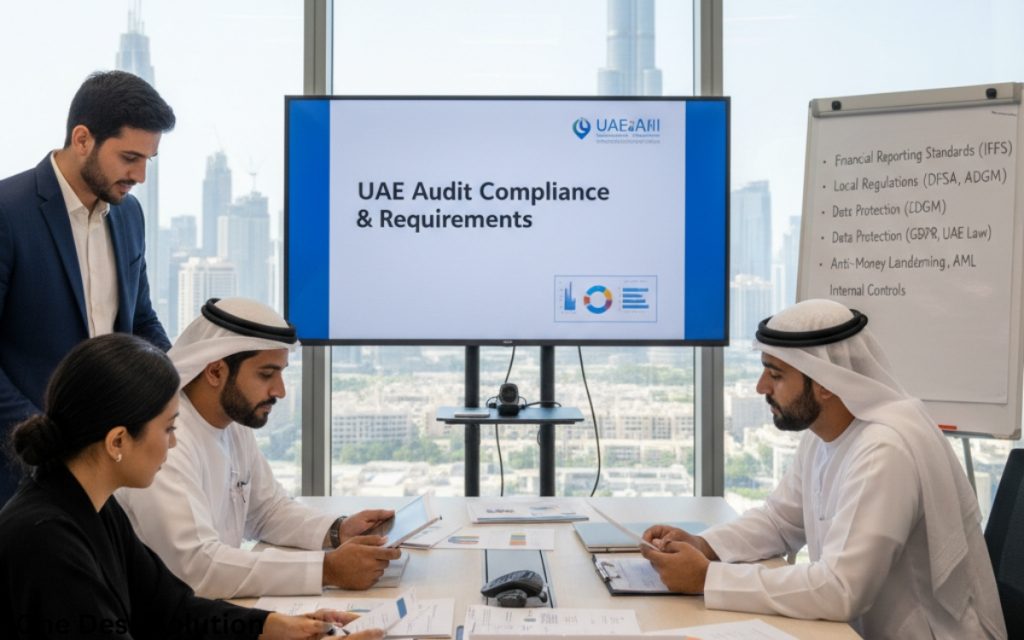
Audit Services for Property Management Companies UAE 2026
📅 Last updated: July 2026 | Reviewed by the OneDesk Solution Audit & Assurance Team
Dubai and the wider UAE property management sector has scaled fast — from boutique holiday-home operators to firms managing thousands of units across master communities. Every unit under management, whether a single serviced apartment or a tower in a mixed-use community, ties the property manager to owners, developers, tenants, and regulators simultaneously. An independent audit isn't paperwork for its own sake — it's the proof that service charges were spent as budgeted, that escrow or trust funds were never touched improperly, and that the financial statements are reliable enough for a bank, investor, or the Dubai Land Department (DLD) to depend on.
2026 has raised the bar. The DLD's Mollak platform now digitises every service-charge collection and audit submission for Jointly Owned Property, Federal Tax Authority (FTA) enforcement of Corporate Tax has moved from a registration drive into active review of filed returns, and audited special-purpose financial statements are now mandatory for every tax group regardless of size. A property management company juggling RERA, Mollak, escrow, VAT, and Corporate Tax obligations at the same time needs one audit partner who understands where these frameworks overlap — not four different consultants giving four different answers.
This guide walks through exactly which audits apply to a UAE property management company in 2026, what each one checks, the deadlines that matter, and the findings that trigger regulatory scrutiny. Whether you manage owners' associations, serviced residences, or a mixed portfolio anywhere in the UAE, use it to benchmark your own compliance position — or bring it straight to our team for a scoped review through our full range of services.
📞 Talk to a RERA-experienced auditor before your next Mollak or Corporate Tax deadline.
📑 Table of Contents
- Why Property Management Companies Need Specialised Audits
- UAE Regulatory Framework Governing Property Management Audits
- Types of Audits a UAE Property Management Company May Need
- Scope of a Property Management Audit (Chart)
- The Audit Process, Step by Step
- 2026 Compliance Calendar
- Common Red Flags & Audit Findings
- Corporate Tax & VAT Considerations for 2026
- Benefits of Outsourcing Your Audit
- Choosing the Right Audit Partner
- Why OneDesk Solution
- FAQs
- Related Reads
1. Why Property Management Companies Need Specialised Audits
Property management is not a standard trading business, and a generic audit approach misses the risks that actually matter in this sector:
- Trust money, not company money: Service charges and escrow balances belong to owners and buyers, not the management company — auditors must verify segregation, not just totals.
- Multiple stakeholders: Developers, owners' associations, individual unit owners, tenants, and lenders all rely on the same set of audited numbers for different decisions.
- High transaction volume, low average value: Thousands of small maintenance, cleaning, and utility invoices create more room for miscoding or duplicate payment than a typical SME.
- License and reputational exposure: A qualified or late audit under RERA/Mollak can delay next year's service-charge budget approval and trigger disciplinary review of the management license.
2. UAE Regulatory Framework Governing Property Management Audits
A UAE property management company can be answerable to several regulators at once, depending on emirate, license type, and whether it also handles developer escrow. The table below summarises the core pieces of the 2026 framework.
| Law / Framework | Regulator | What It Covers | Applies To |
|---|---|---|---|
| Law No. 6 of 2019 (Jointly Owned Property Law) | RERA / Dubai Land Department | Owners' associations, common-area management, service-charge governance | OA managers & property management companies |
| Law No. 8 of 2007 (Escrow Accounts Law) | RERA / DLD | Escrow accounts holding off-plan buyer funds for construction | Developers and firms acting as escrow trustee/manager |
| Mollak Platform | Dubai Land Department | Digital budgeting, service-charge collection, and audit report submission | All RERA-licensed OA managers in Dubai |
| Federal Decree-Law No. 47 of 2022 | Federal Tax Authority (FTA) | 9% Corporate Tax on adjusted profit above AED 375,000 | All UAE mainland & free zone entities, including PM companies |
| Federal Decree-Law No. 8 of 2017 | Federal Tax Authority | 5% VAT on taxable supplies | PM companies above the AED 375,000 mandatory threshold |
| Economic Substance Regulations (ESR) | Ministry of Finance | Substance tests for defined "relevant activities" | Group structures with lease-finance/holding activities |
Our advisory and consultancy team regularly maps this framework against a client's actual license and portfolio before an audit even begins, so nothing is discovered late.
3. Types of Audits a UAE Property Management Company May Need
- Statutory financial audit — the annual audit of the company's own books, needed for trade-licence renewal, banking, and Corporate Tax purposes. This is where clean bookkeeping throughout the year pays off.
- Mollak / RERA service-charge audit — the annual, RERA-approved-auditor review of an owners' association's service-charge collections, expenses, and reserve fund, submitted through Mollak.
- Escrow account audit — applies only where the company also manages or holds developer escrow funds under Law No. 8 of 2007; covers milestone-linked fund releases.
- Corporate Tax audit-readiness review — confirms audited (or audited special-purpose) financial statements are in place where mandated, especially for tax groups and Qualifying Free Zone Persons.
- Internal control & vendor audit — a non-statutory but highly recommended review of maintenance contracts, vendor payment approval, and procurement controls.
4. Scope of a Property Management Audit
Illustrative breakdown of where a property management audit typically focuses its testing effort.
5. The Audit Process, Step by Step
| Step | What Happens |
|---|---|
| 1. Planning & scoping | Review portfolio, OA structure, license type, and which audits (statutory, Mollak, escrow) are required. |
| 2. Document collection | Mollak reports, bank statements, lease agreements, vendor contracts, service-charge budgets, and prior-year audit reports. |
| 3. Fieldwork & testing | Bank reconciliations, service-charge allocation testing per unit share, vendor invoice sampling, reserve-fund verification. |
| 4. Compliance cross-check | Alignment against RERA/Mollak rules, escrow requirements, VAT treatment, and Corporate Tax positions. |
| 5. Draft report & discussion | Findings, exceptions, and management responses discussed before finalisation — no surprises at submission. |
| 6. Final submission | Signed report filed via Mollak, DLD, or the FTA's EmaraTax portal within the applicable deadline. |
💬 Not sure which of these audits applies to your portfolio? Send us your license type and community list — we'll map it in one call.
6. 2026 Compliance Calendar
| Obligation | Typical 2026 Deadline |
|---|---|
| Mollak service-charge / OA audit report | By 31 March of the following financial year |
| Escrow account audit | Per RERA project milestone schedule; can also be requested on demand |
| VAT return | Monthly or quarterly, per FTA registration category |
| Corporate Tax return & payment | Within 9 months of financial year-end (e.g. FY ending 31 Dec 2025 → due 30 Sep 2026) |
| ESR notification | Within 6 months of financial year-end |
| ESR report (if applicable) | Within 12 months of financial year-end |
Tip Build your internal document-collection calendar around these dates rather than the audit start date — most delays happen because supporting invoices weren't organised in advance.
7. Common Red Flags & Audit Findings
- Expenses unrelated to common areas charged against the service-charge account
- Co-mingling of developer, escrow, and owners' association funds
- Insufficient reserve-fund allocation for major repairs and replacements
- Missing supporting documentation for vendor and contractor payments
- Late or incomplete Mollak submissions
- Free-zone Qualifying Free Zone Person (QFZP) conditions breached, putting the 0% Corporate Tax rate at risk
8. Corporate Tax & VAT Considerations for 2026
Property management income sits inside the standard federal tax net, and 2026 has tightened enforcement on both fronts:
- Corporate Tax: 9% applies on adjusted profit above AED 375,000; businesses under AED 3 million revenue may elect Small Business Relief, but filing remains mandatory even at zero tax due.
- Audited financial statements: Now required for all tax groups (the previous AED 50 million threshold has been removed) and for any entity claiming Qualifying Free Zone Person status.
- VAT: 5% on taxable supplies once turnover passes AED 375,000; many management and service fees are standard-rated, so contract wording matters.
- E-invoicing transition: The UAE is moving toward a Peppol-based e-invoicing model, which will affect how service-charge and management-fee invoices are issued going forward.
Our dedicated tax services team handles Corporate Tax registration, VAT filing, and FTA correspondence alongside the audit, so the two workstreams stay reconciled rather than contradicting each other.
9. Benefits of Outsourcing Your Audit to a Specialised Firm
- One point of contact across RERA, Mollak, escrow, VAT, and Corporate Tax — no conflicting advice
- Faster Mollak budget approval for the following service-charge year
- Stronger credibility with owners' associations, developers, and lenders
- Early detection of vendor overbilling or reserve-fund shortfalls
- Reduced exposure to fines, license review, or escrow disputes
10. Choosing the Right Audit Partner
- Confirm the firm is on the Dubai Land Department's RERA-approved auditor list
- Ask for prior experience with Mollak submissions and escrow audits specifically, not general SME audits
- Check they also cover Corporate Tax and VAT, so your audited statements and tax filings align
- Look for a firm that offers business setup and restructuring advice too, in case portfolio growth changes your entity structure
- Ask how findings are communicated — a good auditor flags issues early, not only in the final report
11. Why OneDesk Solution
OneDesk Solution supports UAE property management companies, owners' associations, and developers with a single integrated team covering audit and assurance, accounting and bookkeeping, tax services, and advisory and consultancy — so your service-charge audit, escrow position, VAT return, and Corporate Tax filing are always looking at the same numbers. Explore our full services to see how we can support your portfolio in 2026.
✅ Ready for a compliant, stress-free audit season? Speak to our team today.
12. Frequently Asked Questions
Do property management companies in Dubai need a RERA-approved auditor?
Yes. If your company manages an owners' association's service charges under Mollak, the annual audit must be carried out by an auditor on the Dubai Land Department's RERA-approved list — a standard, non-approved audit firm cannot file that report through Mollak.
What is the deadline for Mollak / RERA service-charge audits in 2026?
The audited service-charge report is typically due by 31 March of the following financial year. Escrow account audits for developer projects follow separate, milestone-linked schedules that RERA sets per project.
Is an escrow account audit different from a service-charge audit?
Yes. Escrow audits under Law No. 8 of 2007 cover developer funds collected from off-plan buyers for construction, while service-charge/OA audits under Law No. 6 of 2019 (via Mollak) cover common-area maintenance funds collected from unit owners. A company performing both roles needs both audits.
Do UAE property management companies have to pay Corporate Tax?
Yes, if annual taxable income exceeds AED 375,000, the 9% Corporate Tax rate applies (subject to Small Business Relief election for revenue under AED 3 million). Both mainland and free zone property management companies must register and file a return even where no tax is ultimately due.
What happens if a property management company misses its RERA or Mollak audit deadline?
Late or missing submissions can lead to DLD/RERA fines, delayed approval of the next year's service-charge budget, disciplinary review of the OA management license, and — in serious escrow cases — criminal liability for fund misappropriation under Law No. 8 of 2007.
13. Related Reads
📍 Managing owners' associations, serviced residences, or developer escrow in the UAE? Let's get your 2026 audit sorted — before the deadline sorts you.