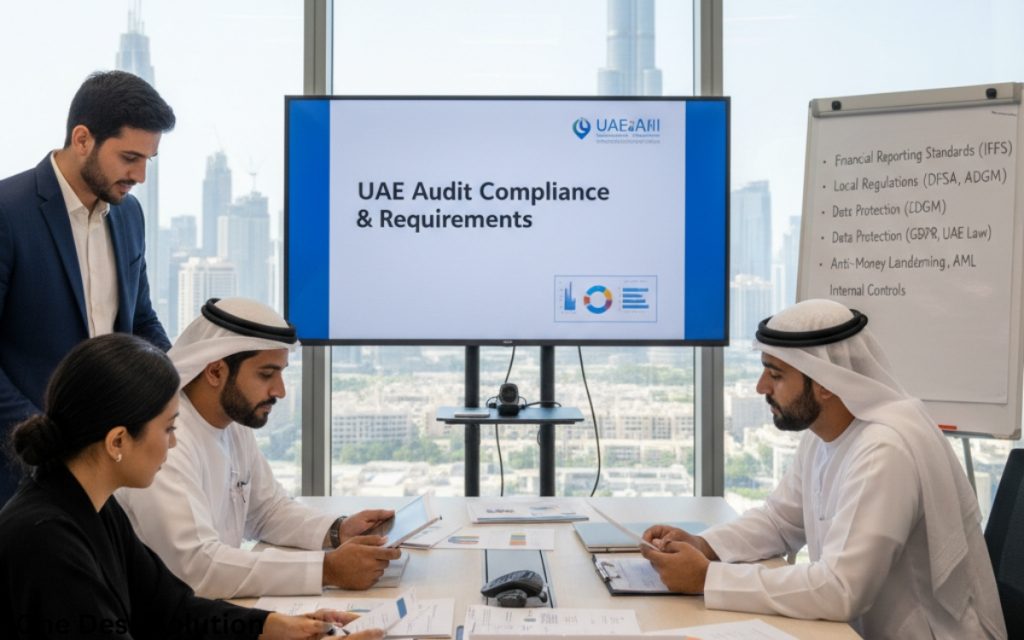
Audit Services for Real Estate Investment Trusts UAE
CMA/DFSA Regulation, Property Valuation & Tax Exemption — 2026 Guide
Quick Summary: UAE REITs sit under a genuinely distinct audit regime — regulated by the CMA (which replaced the SCA on 1 January 2026), DFSA, or FSRA depending on jurisdiction, and required to distribute at least 80% of net income, hold real estate assets exceeding AED 100 million, and keep at least 70% of assets in income-generating property to qualify for Corporate Tax exemption as a Qualifying Investment Fund under Cabinet Decision No. 34 of 2025. With Dubai Residential REIT's 2025 IPO — a AED 23 billion portfolio of 35,000+ homes — bringing fresh scale and scrutiny to the sector, REIT auditors now verify fair-value property accounting, two overlapping 80% distribution tests, gearing limits, and related-party dealings with the REIT manager. This guide breaks down exactly what a UAE REIT audit covers in 2026.
📋 Table of Contents
- Introduction to Audit Services for UAE REITs
- UAE REIT Regulatory Landscape: CMA, DFSA & FSRA
- Why REIT Audits Differ From Standard Company Audits
- The UAE REIT Market in 2026
- Structural Requirements Auditors Verify
- Property Valuation & Fair Value Accounting
- The 80% Distribution Test — Two Rules to Reconcile
- Corporate Tax Exemption: Qualifying Investment Fund Conditions
- Gearing/Leverage Ratio Compliance
- Related-Party Transactions With the REIT Manager
- NAV Calculation & Reporting
- Custodian, Trustee & Independent Oversight
- VAT Treatment for REIT Property Portfolios
- Cost of a REIT Audit in the UAE
- Common Audit Findings in UAE REITs
- How One Desk Solution Can Help
- Frequently Asked Questions
- Related Resources
🏢 Introduction to Audit Services for UAE REITs
Auditing a Real Estate Investment Trust in the UAE bears only a passing resemblance to auditing a standard property company. REITs sit under their own regulatory regime — the CMA (Capital Markets Authority, which replaced the SCA on 1 January 2026), the DFSA in the DIFC, or the FSRA in ADGM — with structural rules a normal company never has to meet: minimum real estate holdings, a mandatory income distribution ratio, and gearing limits that cap how much debt the fund can carry against its property portfolio.
The stakes for getting this right have grown. Dubai Residential REIT's May 2025 IPO — the largest Dubai listing of the year, built around a AED 23 billion portfolio of more than 35,000 homes — brought fresh capital and fresh scrutiny to the sector. And since Cabinet Decision No. 34 of 2025 replaced the previous framework, REITs seeking Corporate Tax exemption as a Qualifying Investment Fund now face a more codified set of conditions: a AED 100 million minimum real estate asset value, a 70% income-generating asset test, and an 80% distribution requirement that runs alongside, but isn't identical to, the regulator's own distribution rule.
This guide breaks down exactly what a UAE REIT audit covers in 2026 — the regulatory structure, property valuation and fair-value accounting, the overlapping distribution tests, gearing compliance, related-party transaction scrutiny, and Corporate Tax exemption conditions. If you'd rather have specialists manage this directly, our audit & assurance team works with real estate funds and REIT managers across the UAE.
Need a REIT Audit Team That Understands the Regulatory Detail?
Speak to our audit specialists for a free consultation on your REIT's compliance and audit requirements.
🏛️ UAE REIT Regulatory Landscape: CMA, DFSA & FSRA
| Regulator | Jurisdiction | Role |
|---|---|---|
| CMA (Capital Markets Authority) | UAE mainland — replaced SCA on 1 January 2026 | Licensing, listing, and distribution rules for mainland REITs |
| DFSA (Dubai Financial Services Authority) | DIFC | Regulates DIFC-domiciled REITs under the Collective Investment Rules (CIR) |
| FSRA (Financial Services Regulatory Authority) | ADGM | Regulates ADGM-domiciled REITs |
| FTA (Federal Tax Authority) | Federal | Administers Corporate Tax registration and QIF/REIT exemption approval |
🔍 Why REIT Audits Differ From Standard Company Audits
- Fair-value property accounting under IAS 40 replaces standard cost-based fixed asset accounting.
- Structural compliance testing — asset value, asset composition, distribution ratio, gearing — sits alongside standard financial statement audit work.
- Corporate Tax exemption is conditional and must be actively maintained and evidenced every year, not assumed.
- Related-party transactions with the REIT manager require specific scrutiny and, in many cases, shareholder approval above certain thresholds.
- Independent property valuations feed directly into the financial statements, so valuer independence and methodology become part of the audit.
📈 The UAE REIT Market in 2026
- Dubai Residential REIT — IPO'd May 2025 (the largest Dubai listing of the year), managed by DHAM REIT Management, with more than 35,000 homes across Dubai including Palm Jumeirah, 98% occupancy, AED 23 billion gross asset value (up 7% since December 2024), H1 2025 net profit of AED 622 million, and an interim dividend of AED 550 million.
- Emirates REIT — the UAE's first REIT, DFSA-regulated, listed on NASDAQ Dubai, with a diversified commercial, education, and residential portfolio.
- ENBD REIT — managed by Emirates NBD Asset Management, DIFC-based, focused on income-producing Dubai properties, listed on NASDAQ Dubai.
✅ Structural Requirements Auditors Verify
| Requirement | Threshold | What Auditors Test |
|---|---|---|
| Minimum real estate asset value | AED 100 million (excluding land) | Verify portfolio valuation supports the threshold |
| Income-generating asset ratio | At least 70% of assets by value | Test asset classification and valuation basis |
| Public float / institutional ownership | At least 20% publicly traded or held by 2+ institutional investors | Review shareholder register and trading records |
| Distribution ratio (regulatory) | At least 80% of audited annual net income | Verify calculation and actual distribution |
| Distribution ratio (tax exemption) | At least 80% of Immovable Property Income, within 9 months of year-end | Reconcile against the regulatory distribution test |
Four Conditions for REIT Corporate Tax Exemption
*Subject to FTA application and approval under Cabinet Decision No. 34 of 2025. All four conditions must be met and maintained.
🏗️ Property Valuation & Fair Value Accounting
- Investment properties are measured at fair value under IAS 40, with changes in fair value recognized in profit or loss — a fundamentally different accounting model from cost-based fixed assets.
- DFSA rules require valuation by an approved independent valuer at least once a year; many REITs value more frequently to support quarterly or semi-annual NAV reporting.
- Auditors review valuer independence, rotation, methodology, and the reasonableness of key inputs — capitalization rates, comparable transactions, and discount rates.
- Valuation movements directly affect reported net income, which in turn affects the distribution test calculations.
📊 The 80% Distribution Test — Two Rules to Reconcile
- Regulatory distribution rule (DFSA/CMA): at least 80% of audited annual net income must be distributed to unitholders.
- Tax exemption distribution rule (Cabinet Decision No. 34 of 2025): at least 80% of Immovable Property Income specifically must be distributed within nine months of the financial year end to maintain Qualifying Investment Fund status.
These are not automatically the same figure. "Net income" for regulatory purposes and "Immovable Property Income" for tax purposes can diverge, particularly where a REIT has non-property income streams or timing differences in fair-value gains. Auditors need to test both calculations separately and reconcile any difference — failing either test carries different consequences: regulatory breach versus loss of Corporate Tax exemption.
🧾 Corporate Tax Exemption: Qualifying Investment Fund Conditions
- REITs can apply to the FTA for exemption from Corporate Tax as a Qualifying Investment Fund (QIF) under Cabinet Decision No. 34 of 2025, which replaced Cabinet Decision No. 81 of 2023.
- General conditions: the fund or its manager must be regulated by a competent UAE or recognized foreign authority; interests must be publicly traded or sufficiently widely marketed; the fund's main purpose must not be Corporate Tax avoidance.
- REIT-specific conditions: real estate assets (excluding land) exceeding AED 100 million; at least 70% of assets (by value) in income-generating rental property; at least 20% of share capital publicly traded or held by two or more institutional investors; at least 80% of Immovable Property Income distributed within nine months of year-end.
- The exemption operates at fund level only — investors are not automatically exempt.
- Corporate (juridical) investors must include 80% of their prorated share of the REIT's Immovable Property Income in their own taxable income, unless the REIT distributes that income within the nine-month window.
- Even with exemption approved, the REIT must still register for Corporate Tax and file an annual return — exemption is not a filing exemption.
⚖️ Gearing/Leverage Ratio Compliance
Typical DFSA Gearing Cap: Debt as a % of Gross Asset Value
Exact limits vary by fund constitution and regulator approval — auditors test the actual calculation against the specific limit set for that REIT.
- DFSA rules typically cap REIT gearing in the range of 65–70% of gross asset value, depending on the specific fund's constitution and regulatory approval.
- Auditors test the gearing ratio calculation against the regulatory limit at each reporting date.
- Breaching the gearing cap is a regulatory compliance failure, separate from any Corporate Tax exemption conditions.
🤝 Related-Party Transactions With the REIT Manager
- REIT managers, and their affiliated entities, frequently transact with the REIT itself — acquisitions, disposals, and management fee arrangements.
- DFSA rules require shareholder approval for related-party transactions exceeding 5% of the REIT's value.
- Auditors test that related-party transactions are conducted at arm's length, supported by independent third-party valuations, and properly disclosed in the financial statements.
🧮 NAV Calculation & Reporting
- REITs typically report Net Asset Value on a periodic basis (often quarterly or semi-annually), directly reflecting property valuation movements.
- Auditors verify the NAV calculation methodology is applied consistently and reconciles to the underlying valuations and financial statements.
🔐 Custodian, Trustee & Independent Oversight
- REITs must appoint an independent custodian to safeguard fund assets, plus a trustee in many structures.
- Board composition typically requires independent directors.
- Auditors confirm custody arrangements are in place and functioning, and that governance requirements are met.
🧮 VAT Treatment for REIT Property Portfolios
- Standard UAE real estate VAT rules apply: commercial property income is standard-rated at 5%; the first supply of qualifying residential property within 3 years of completion is zero-rated; subsequent residential supplies are exempt.
- Mixed-use portfolios, common for diversified REITs, require input VAT apportionment between taxable and exempt activities.
- Auditors review the VAT classification of each property in the portfolio against its actual use.
💰 Cost of a REIT Audit in the UAE
| REIT Size / Complexity | Typical Annual Audit Fee (AED, indicative) |
|---|---|
| Small/single-jurisdiction REIT (<AED 500M GAV) | 75,000 – 150,000 |
| Mid-size REIT (AED 500M – 5B GAV) | 150,000 – 350,000 |
| Large, listed, diversified REIT (>AED 5B GAV) | 350,000+ |
REIT audit fees scale heavily with gross asset value, portfolio diversity, and the number of jurisdictions involved — these ranges are indicative. For a full breakdown of audit pricing drivers across UAE industries, see our Guide to Audit Costs and Fees in Dubai, or get a bespoke quote from our audit & assurance team.
🔎 Common Audit Findings in UAE REITs
- Related-party transactions with the REIT manager lacking sufficient independent valuation support
- Divergence between the regulatory 80% distribution test and the tax exemption's 80% Immovable Property Income test going unreconciled
- Valuer independence or rotation gaps
- Gearing ratio calculations excluding items that should be captured under the regulatory definition of gross asset value
- VAT misclassification on mixed-use or recently completed residential assets within a portfolio
- Incomplete evidence supporting the 70% income-generating asset test at period end
💼 How One Desk Solution Can Help
REIT audits require specialist knowledge of fair-value property accounting, overlapping regulatory and tax distribution tests, and related-party transaction scrutiny — not a generic corporate audit approach. Our audit and assurance services team works directly with REIT managers and real estate funds, supported by our tax services team for Corporate Tax exemption applications and Qualifying Investment Fund compliance, our accounting & bookkeeping services for day-to-day fund accounting, and our advisory & consultancy services for fund structuring and governance. If you're setting up a new fund vehicle, our business setup team can help structure it correctly from day one. Explore our full range on the services page.
❓ Frequently Asked Questions
Q1: Are UAE REITs exempt from corporate tax?
They can be, but the exemption is conditional, not automatic. Under Cabinet Decision No. 34 of 2025, a REIT can apply to the FTA for exemption from Corporate Tax as a Qualifying Investment Fund if it meets specific conditions — including holding real estate assets (excluding land) worth more than AED 100 million, keeping at least 70% of its assets in income-generating rental property, having at least 20% of its share capital publicly traded or institutionally owned, and distributing at least 80% of its Immovable Property Income within nine months of the financial year end. Even once approved, the REIT must still register for Corporate Tax and file an annual return.
Q2: What is the minimum distribution requirement for a UAE REIT?
There are actually two overlapping 80% rules. The regulatory rule, set by the DFSA or CMA, requires at least 80% of audited annual net income to be distributed to unitholders. Separately, the Corporate Tax exemption rule under Cabinet Decision No. 34 of 2025 requires at least 80% of Immovable Property Income specifically to be distributed within nine months of year-end to maintain Qualifying Investment Fund status. These figures can diverge, so auditors typically test both calculations independently.
Q3: Who regulates REITs in the UAE?
It depends on where the REIT is domiciled. Mainland UAE REITs are regulated by the CMA (Capital Markets Authority), which replaced the SCA (Securities and Commodities Authority) on 1 January 2026. REITs established in the DIFC are regulated by the DFSA under its Collective Investment Rules, and REITs in ADGM fall under the FSRA. All UAE REITs must additionally register with the FTA for Corporate Tax purposes.
Q4: What is the minimum property value required for a UAE REIT?
To qualify for Corporate Tax exemption as a Qualifying Investment Fund, a REIT's real estate assets, excluding land, must exceed AED 100 million in value under Cabinet Decision No. 34 of 2025. Separately, at least 70% of the fund's total assets by value must be income-generating rental property. These are minimum thresholds tied to the tax exemption, not a general licensing requirement for operating as a REIT.
Q5: Do REIT investors pay tax even if the REIT itself is exempt?
Often, yes, at least partially. The Corporate Tax exemption for a qualifying REIT applies at the fund level, not automatically to investors. A corporate (juridical) investor must include 80% of its prorated share of the REIT's Immovable Property Income in its own taxable income, unless the REIT distributes that income within nine months of the financial year end. Non-resident investors generally aren't treated as having a taxable presence in the UAE purely from investing in a compliant REIT, provided the fund maintains its qualifying conditions.
🔗 Related Resources
A full breakdown of audit pricing drivers across UAE industries.
Explore another specialized UAE sector setup guide.
Compare setup requirements for another regulated UAE sector.
Relevant for REIT managers establishing a UAE office presence.
Explore another industry-specific UAE business setup guide.
Relevant for REITs holding industrial or logistics real estate.
Sector-specific tax guidance for another growing UAE industry.
Compare free zone incorporation options across UAE sectors.
Manage billing efficiently for fund management and advisory work.
Get a REIT Audit Team Built for the Regulatory Detail
From distribution testing to Corporate Tax exemption compliance, One Desk Solution's audit specialists keep your REIT fully compliant year-round.