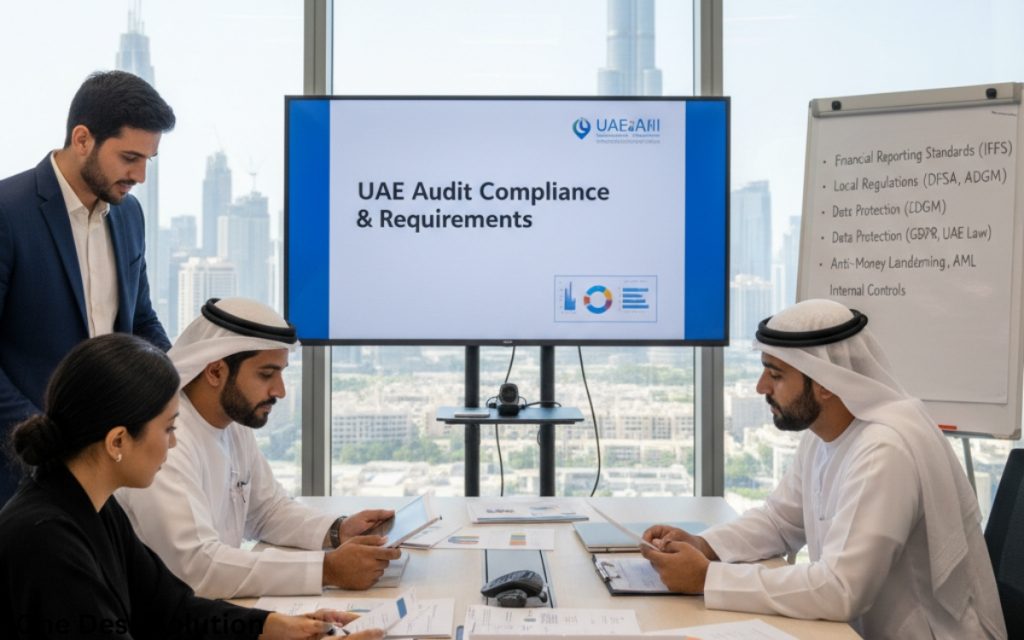
How to Prepare for Your
Annual Audit in UAE
The complete 2026 step-by-step guide — IFRS financial statements, free zone submission deadlines, the full documentation checklist, common audit pitfalls, how to select your auditor, and expert audit support for every UAE company.
The annual statutory audit is one of the most critical financial compliance obligations for UAE businesses — yet it is consistently the most under-prepared for, with the majority of companies beginning serious preparation only weeks before their free zone submission deadline. For free zone companies (where audit submission is mandatory for licence renewal), for DIFC and ADGM entities, and for mainland businesses seeking banking facilities or investor relationships, audit preparation is not a once-a-year scramble — it is the natural result of sound, year-round bookkeeping. This comprehensive 2026 guide walks UAE business owners and finance managers through every element of preparing for a UAE annual audit: who is required to audit, free zone submission deadlines, the four phases of preparation, the complete documentation checklist auditors will request, how to prepare IFRS-compliant financial statements, the most common audit findings and how to prevent them, and how to select a UAE Ministry of Economy licensed auditor. Whether you are preparing your first UAE audit or looking to reduce audit fees and avoid a qualified opinion, this guide provides the definitive reference — supported by OneDeskSolution's audit preparation and assurance services for UAE companies.
🏢1. Who Needs a UAE Annual Audit?
Audit obligations in the UAE arise from multiple regulatory frameworks depending on business structure and licensing jurisdiction. There is no single UAE-wide mandatory audit law covering all entities — but for the vast majority of established UAE businesses, an annual statutory audit is either legally required or commercially essential.
| Business Structure | Audit Required? | Legal Basis | Deadline | Consequence of Non-Compliance |
|---|---|---|---|---|
| Free Zone Company (all free zones) | Mandatory | Individual free zone authority regulations | 90 days after financial year end | Licence renewal blocked; visa renewal prevented; financial penalties |
| DIFC Entity | Mandatory | DIFC Companies Law; DFSA regulations | 6 months after year end | DFSA enforcement action; licence suspension risk |
| ADGM Entity | Mandatory | ADGM Companies Regulations (FSRA) | 6 months after year end | FSRA enforcement action; regulatory sanctions |
| Public Joint Stock Company (PJSC) | Mandatory | UAE CCL; SCA (Securities & Commodities Authority) | Specific SCA deadlines for listed entities | SCA penalty; stock exchange suspension |
| Mainland LLC | Not universally mandated — but practically required | UAE Commercial Companies Law (accounting records required) | No fixed regulatory deadline | Bank facility rejection; government tender exclusion; investor due diligence failure |
| Branch of foreign company | Typically required by parent and DED | Parent company requirement; DED conditions | Aligned to parent or DED requirements | Branch licence renewal complications; parent company compliance gap |
Your Audit Deadline is Closer Than You Think
OneDeskSolution prepares UAE companies for annual audit — IFRS financial statements, complete PBC documentation, EOSB provisions, fixed assets registers, and free zone submission management. Start preparation early. Contact us today.
📅2. Free Zone Audit Submission Deadlines 2026
For December 31 financial year-end companies — the most common year-end in the UAE — the audit submission window runs from January 1 to March 31. Miss this window and your licence renewal is blocked. The table below shows the key details for the most common UAE free zones.
- Year End
- 31 Dec
- Deadline
- 31 Mar
- Period
- 90 days
- Late Fee
- AED 5,000
- Year End
- 31 Dec
- Deadline
- 31 Mar
- Period
- 90 days
- Late Fee
- Licence block
- Year End
- 31 Dec
- Deadline
- 31 Mar
- Period
- 90 days
- Late Fee
- Licence block
- Year End
- 31 Dec
- Deadline
- 31 Mar
- Period
- 90 days
- Late Fee
- Licence block
- Year End
- 31 Dec
- Deadline
- 31 Mar
- Period
- 90 days
- Late Fee
- Licence block
- Year End
- 31 Dec
- Deadline
- 31 Mar
- Period
- 90 days
- Late Fee
- Licence block
- Year End
- 31 Dec
- Deadline
- 30 Jun
- Period
- 6 months
- Late Fee
- DFSA action
- Year End
- 31 Dec
- Deadline
- 30 Jun
- Period
- 6 months
- Late Fee
- FSRA action
The Licence Renewal Domino Effect: When a free zone company's licence is blocked for non-submission of audited accounts, the consequences cascade rapidly. Employee UAE residency visas cannot be renewed when they expire. New employment visas cannot be issued. The company cannot conduct official government transactions. Existing bank account relationships may be flagged. If the licence lapses entirely through prolonged non-renewal, reinstating it involves significant legal and administrative costs. The remedy is straightforward: engage your auditor by October/November, close your books by mid-January, and target audit completion by late February — building a 4-week buffer before the March 31 deadline.
🔄3. The UAE Audit Process — From Start to Finish
| Stage | What Happens | Timeline | Client Action Required |
|---|---|---|---|
| 1 — Auditor Engagement | Shareholder resolution; engagement letter signed; prior year accounts and trial balance provided to new auditor | Oct–Nov (for Dec YE) | Pass shareholder resolution; sign engagement letter; provide prior year financials |
| 2 — Planning & Risk Assessment | Auditor assesses business risk; identifies key audit areas; establishes materiality; issues PBC (Prepared by Client) list | Jan (after year end) | Meet with auditor; answer preliminary questions; confirm financial year end closing dates |
| 3 — Document Submission | Client provides complete documentation pack responding to PBC list — accounts, bank statements, invoices, contracts, payroll records | Jan–Feb | Submit all PBC items promptly; target completion within 2 weeks of PBC receipt |
| 4 — Audit Fieldwork | Auditor tests transactions; verifies balances; performs bank confirmations; reviews IFRS compliance; raises queries | Feb | Respond to all auditor queries within 24–48 hours; provide additional documents requested |
| 5 — Findings & Management Letter | Auditor communicates findings; draft audit opinion shared; management letter issued with recommendations | Feb–Mar | Review findings; agree or provide management response; correct material misstatements |
| 6 — Report Signing & Submission | Audit report signed; management representation letter signed; accounts finalised and signed by directors | Before 31 Mar | Sign management representation letter; sign annual accounts; submit to free zone authority |
📊 Understanding Audit Report Types
| Report Type | What It Means | Cause | Impact on Free Zone Submission |
|---|---|---|---|
| ✅ Unqualified (Clean) | Financial statements give a true and fair view — the best possible outcome | Well-prepared, IFRS-compliant accounts with complete documentation | Accepted by all free zones and regulators; no issues |
| ⚠️ Qualified Opinion | True and fair EXCEPT for specific, described matter(s) | Scope limitation; isolated IFRS non-compliance; missing documentation on a specific item | Most free zones accept a qualified opinion but flag it; requires corrective action |
| ❌ Adverse Opinion | Financial statements do NOT give a true and fair view | Pervasive IFRS non-compliance; material misstatement affecting overall accounts | Serious — free zone may reject; immediate corrective action required; re-audit may be needed |
| 🚫 Disclaimer of Opinion | Auditor cannot form any opinion — scope too severely limited | Inadequate records; auditor unable to complete necessary procedures | Most serious outcome — effectively means financial position cannot be demonstrated |
📊4. Four Phases of UAE Audit Preparation
Year-Round Bookkeeping
Jan–Dec: Maintain IFRS-compliant monthly books throughout the year. Monthly bank reconciliations, VAT records, EOSB accruals. The single most impactful audit preparation action.
Year-End Close (4–8 Weeks Before)
Oct–Nov: Review all open items; assess provisions; calculate final EOSB for all staff; update fixed assets register; ensure all accruals posted; review expense categorisation.
Account Preparation (Weeks 1–6 After YE)
Jan–Feb: Close the year's books. Prepare draft IFRS financial statements. Complete all reconciliations. Compile PBC file in advance of auditor request. Resolve accounting issues before fieldwork begins.
Active Audit Support (Weeks 6–12)
Feb–Mar: 24–48 hour response to all auditor queries. Provide documentation from organised records. Review draft audit report. Sign management letter. Submit to free zone before deadline.
The Key Insight: Companies that maintain proper books year-round complete audit fieldwork in 2–3 weeks and pay 20–40% less in audit fees than companies that start preparing from scratch after year end. Audit preparation is not a seasonal activity — it is the result of consistent, professional bookkeeping throughout the year. Every hour invested in monthly reconciliations saves 3–4 audit hours in February.
📋5. Complete Audit Documentation Checklist
The following is the comprehensive PBC (Prepared by Client) documentation package that UAE auditors request. Having all items ready before fieldwork begins is the single greatest driver of audit efficiency and fee control.
- Draft IFRS financial statements — income statement, balance sheet, cash flow, statement of changes in equity, and all notes to accounts
- General ledger trial balance at financial year end — with full transaction detail accessible for auditor testing
- Chart of Accounts used during the period — with description of each account
- Comparative prior year figures — from prior year audited accounts or management accounts
- Monthly management accounts for the full financial year
- Complete bank statements for ALL accounts for the full financial year (every month)
- Bank reconciliation at financial year end — reconciling bank statement balance to GL cash balance
- Bank confirmation letters — auditors typically write directly to your banks to confirm year-end balances independently
- Cheque book stubs; online payment confirmations; credit card statements
- Petty cash count at year end and petty cash reconciliation to GL
- Aged debtor listing at year end — every outstanding invoice by customer, invoice date, and aging bucket (0–30, 31–60, 61–90, 90+ days)
- Customer statement reconciliations for your top 10 debtors by balance — confirming the balance each customer owes
- Bad debt provision details — the basis and calculation for any ECL (Expected Credit Loss) provision under IFRS 9
- Copies of outstanding sales invoices above the auditor's materiality threshold
- Evidence of post-year-end collections — proves debtors have been recovered after year end
- Aged creditor listing at year end — every outstanding supplier invoice
- Supplier statement reconciliations for top 10 creditors — comparing your GL to supplier's statement
- Outstanding purchase invoices and goods received notes for items not yet invoiced
- Any disputed supplier balances — document the nature and status of each dispute
- Fixed assets register at year end — every asset: description, purchase date, cost, depreciation rate, accumulated depreciation, net book value
- Purchase invoices for all assets acquired during the year
- Disposal documentation for any assets sold, scrapped, or written off
- Depreciation policy — rates applied to each asset class, consistent with prior year
- Physical verification evidence — particularly for high-value items (vehicles, equipment, computers, leasehold improvements)
- Monthly payroll register for the full financial year — salary, allowances, deductions for each employee
- EOSB provision calculation at year end — employee name, start date, basic salary, years of service, calculated provision
- EOSB payments made during the year to departed employees — settlement documentation
- Employment contracts for key management and significantly-paid employees
- WPS payment confirmations for each month
- Employee headcount list at year start and year end — to reconcile joiner and leaver movements
- All quarterly VAT 201 returns filed during the financial year
- VAT reconciliation — total output VAT per returns agrees to revenue per accounts; input VAT per returns agrees to purchases
- FTA payment confirmations for each quarterly VAT payment
- Any FTA correspondence, audit notifications, or voluntary disclosures filed during the year
- UAE CT registration confirmation from EmaraTax
- CT 201 return filed (if applicable for the financial year)
- Valid trade licence (current)
- Memorandum of Association (MOA) / Articles of Association
- Shareholder resolutions and board minutes for any significant transactions during the year
- Lease agreements for premises and equipment (particularly for IFRS 16 right-of-use asset assessment)
- Material contracts — significant long-term supplier or customer agreements
📊6. Preparing Your IFRS Financial Statements for Audit
| Financial Statement | Key UAE-Specific Components | Primary Audit Focus |
|---|---|---|
| Income Statement (P&L) | Revenue by category (standard-rated/zero-rated); cost of sales; gross profit; operating expenses by type; EOSB expense (separate line); depreciation; finance costs; profit before tax; CT charge; profit after tax | Revenue recognition (IFRS 15); EOSB expense accrual accuracy; entertainment expense classification (50% CT non-deductible); correct depreciation charges under IAS 16 |
| Balance Sheet | Fixed assets net of depreciation; right-of-use assets (IFRS 16); trade receivables net of ECL; VAT recoverable; prepayments; trade payables; EOSB provision (current and non-current); lease liabilities (IFRS 16); share capital per MOA | EOSB provision adequacy and calculation method; IFRS 9 ECL provision on debtors; IFRS 16 right-of-use recognition; share capital matching the MOA |
| Cash Flow Statement | Operating cash flows (customer receipts, supplier/staff payments); investing (asset purchases/disposals); financing (loans, capital, distributions) | Reconciliation to opening and closing cash per balance sheet; classification of items as operating vs. investing vs. financing |
| Statement of Changes in Equity | Opening equity; profit for the year; any dividends paid (backed by shareholder resolution); capital contributions or withdrawals; closing equity | Dividends supported by shareholder resolution; owner withdrawals classified correctly (not expensed as business costs) |
| Notes to Financial Statements | Accounting policies; significant estimates and judgements; breakdown of P&L and balance sheet lines; related party disclosures; contingent liabilities; events after reporting date | Related party transaction disclosures — all transactions with shareholders, directors, and connected parties; going concern assessment; post-year-end material events; CT position disclosure |
💼7. EOSB Provision & Fixed Assets Register
📋 EOSB Provision — The Most Audited Item in UAE
In virtually every UAE company audit, the End of Service Benefit provision is subject to detailed auditor scrutiny — because it is the largest employee-related liability for most UAE businesses and is frequently calculated incorrectly.
| EOSB Element | Correct Treatment | Common Error | Audit Impact |
|---|---|---|---|
| Calculation basis | Based on basic salary only — not total package including housing allowance, transport, or other allowances | Calculating on total package — overstates the provision (but may also create incorrect expectations for employees) | Auditor recalculates on basic salary — any difference raised as an audit finding |
| Rate — first 5 years | 21 calendar days of basic salary per year of service | Using 30 days for the first 5 years — overstates provision | Immaterial if small; material if significant number of employees |
| Rate — beyond 5 years | 30 calendar days of basic salary per year of service (beyond year 5) | Continuing to use 21 days beyond 5 years — understates provision for long-serving employees | Material underprovision — audit finding and balance sheet restatement required |
| Monthly accrual | Accrued monthly throughout the year (DR EOSB Expense; CR EOSB Provision) | Only recognising EOSB when employee actually leaves — cash basis, IFRS non-compliant | Major audit finding — balance sheet understated; P&L expenses understated in employment years |
| New joiners | Begin accruing from the first day of employment, prorated for partial months | Only accruing after the probation period ends | Minor finding — small understatement for new joiners |
🖥️ Fixed Assets Register — What Auditors Look For
- Complete and current register: Every asset the company owns must be in the register — from computers and phones to office furniture, vehicles, leasehold improvements, and major equipment. Assets purchased but never added to the register is the most common FAR deficiency
- Correct depreciation rates: Apply consistent depreciation rates per your accounting policy — computers typically 3–5 years; office furniture 5–10 years; vehicles 3–5 years; leasehold improvements over lease term. Changing depreciation rates without disclosure is an accounting policy change under IAS 8 requiring justification
- Disposals properly recorded: Any asset sold, scrapped, or written off during the year must be removed from the register and a disposal gain/loss calculated (proceeds minus net book value at disposal date)
- Physical verification: Auditors may physically inspect a sample of assets — particularly high-value items. Ensure assets on the register actually exist and are where they are recorded to be
- IFRS 16 Right-of-Use Assets: All leases with terms exceeding 12 months (office leases, equipment leases, vehicle leases) must be recognised as right-of-use assets with corresponding lease liabilities on the balance sheet. Many UAE SMEs still expense all lease payments — this is IFRS 16 non-compliance and a consistent audit finding
⚠️8. Common Audit Findings & How to Prevent Them
| Audit Finding | Root Cause | Prevention | Severity |
|---|---|---|---|
| EOSB provision understated or missing | EOSB not accrued monthly; calculated on total package not basic salary; new hires omitted | Monthly EOSB accrual journal for every employee; quarterly provision review | High |
| Bank accounts not reconciled | Reconciliation done annually at year end only; outstanding items months old | Monthly bank reconciliation within 10 working days of month end, every account | High |
| Missing fixed assets register | Assets purchased but register not updated; no depreciation tracking | Update FAR on every asset purchase; annual physical count | Medium-High |
| IFRS 16 right-of-use assets not recognised | Office and equipment leases fully expensed; IFRS 16 not applied | Identify all leases exceeding 12 months; calculate ROU and lease liability at lease commencement | Medium-High |
| Revenue recognition errors | Cash basis used; advance payments recognised immediately; agent/principal incorrectly determined | IFRS 15-compliant revenue policy; deferred revenue for advance payments | High |
| Related party transactions not disclosed | Owner loans, intercompany, or connected party transactions not identified in notes | Maintain related party register; disclose all transactions with shareholders and directors in notes | Medium |
| Personal expenses in company books | Owner's personal expenses charged to business accounts | Strict personal/business account separation; monthly expense code review | High |
| VAT balance not reconciled to returns | GL VAT account does not agree to VAT 201 returns filed | Monthly VAT reconciliation; VAT account cleared to zero after each quarterly payment | Medium |
| No IFRS 9 ECL provision on debtors | IFRS 9 Expected Credit Loss model not applied; all debtors carried at face value | Apply simplified ECL approach; provision for 90+ day overdue receivables based on historical loss rates | Medium |
| Missing invoices and supporting documents | No systematic invoice filing; documents lost or deleted | Cloud document storage (Dext, AutoEntry); systematic filing by supplier and period; 5-year retention | High |
📊 Frequency of Common Audit Findings — UAE SMEs
👔9. Selecting the Right UAE Auditor
| Selection Criterion | What to Look For | Red Flag |
|---|---|---|
| UAE MoE Licence | Auditor must hold a valid UAE Ministry of Economy licence to sign audit reports. Verify the licence number before engagement | Auditor cannot produce a valid MoE licence number; offers to sign report without UAE registration |
| Free Zone Approval | Some free zones (notably DMCC) maintain approved auditor lists. Confirm with your free zone before appointment | Auditor assures approval without checking with free zone; audit report rejected by free zone authority |
| Sector Experience | Experience in your industry — real estate, trading, technology, healthcare — ensures auditor understands the specific accounting issues in your sector | No sector experience; unfamiliar with key applicable IFRS standards (IAS 40, IFRS 15, etc.) |
| Independence | Your auditor cannot be your bookkeeper or accountant. Auditor independence is a UAE audit standard requirement | Auditor offering to do both bookkeeping and audit for the same company — this is prohibited |
| Capacity & Timing | Confirm the firm has capacity to complete your audit before your free zone deadline. January–March is peak UAE audit season | Auditor accepts engagement without confirming availability for your deadline period |
| Fee Transparency | Clear, fixed-fee engagement letter. UAE SME audit fees range from AED 4,000–25,000+ depending on complexity. Get 3 comparative quotes | Very low fee with no explanation (indicates corner-cutting); very high fee without detailed scope justification |
Bookkeeper vs. Auditor — The Independence Requirement: Many UAE business owners ask whether their bookkeeper or accountant can also be their auditor — the answer is no. UAE auditing standards require that the auditor be independent of the entity being audited. OneDeskSolution prepares your IFRS financial statements and bookkeeping records throughout the year (the accounting function), and you appoint an independent, MoE-licensed auditor to verify and sign the audit opinion. This is the correct two-firm structure — and it actually produces the best outcome for you, because your accounts are impeccably prepared before the auditor ever sees them.
💰10. What Drives UAE Audit Fees?
| Fee Driver | Lower Fee Impact | Higher Fee Impact |
|---|---|---|
| Bookkeeping quality | IFRS-compliant books; all reconciliations done; documents organised and ready | Poor books; auditor must reconstruct; missing documents require additional procedures |
| Transaction volume | 50–100 transactions/month | 5,000+ transactions/month (e-commerce, trading, high-volume business) |
| Bank accounts | 1–2 accounts, single currency | 10+ accounts; multi-currency; foreign bank accounts requiring international confirmations |
| Number of entities | Single entity audit | Group consolidation — multiple subsidiaries, intercompany eliminations |
| Industry complexity | Simple service or consulting business | Real estate (IAS 40 fair value); construction (IFRS 15 percentage of completion); financial services |
| Prior year audit issues | Clean prior year; no qualifications; no restatements | Prior year qualification; material restatements; new auditor requiring additional procedures |
| Response time to queries | 24-hour query response; documents provided immediately | Slow responses; rework; auditor time waiting for basic information multiplies fees |
The ROI of Good Bookkeeping on Audit Fees: A UAE SME with poorly maintained books typically pays AED 10,000–20,000 in audit fees because the auditor spends significant time reconstructing records. The same business with professional, year-round bookkeeping from OneDeskSolution might pay AED 5,000–8,000 for the same audit — a saving of AED 5,000–12,000 per year. Annual outsourced bookkeeping from OneDeskSolution costs AED 6,000–18,000 — and it generates direct savings on audit fees while simultaneously ensuring VAT and CT compliance, providing accurate management accounts, and supporting banking relationships. Good bookkeeping more than pays for itself.
🏆11. Our Audit Preparation & Assurance Services
IFRS Account Preparation
Draft P&L, balance sheet, cash flow, equity statement, and complete IFRS notes — audit-ready quality
PBC File Compilation
Complete auditor documentation pack: all reconciliations, schedules, registers, VAT records, payroll summaries
EOSB Provision Review
Independent recalculation for every employee; reconcile to GL; correct any prior year under-accruals
Fixed Assets Register
Complete FAR preparation; depreciation schedule; additions and disposals; IFRS 16 ROU asset recognition
Auditor Liaison
Act as primary contact for auditors; 24-hour query response; resolve accounting issues during fieldwork
Free Zone Submission
Submit signed audited accounts to free zone authority; ensure on-time delivery for licence renewal
❓12. Frequently Asked Questions
🔗13. Related Resources
Expert Audit Preparation for UAE Companies
From IFRS financial statements and complete PBC file preparation through EOSB provision review, fixed assets registers, auditor liaison, and free zone submission — OneDeskSolution provides expert audit preparation and support for UAE businesses at every stage. Contact us for a free consultation today.