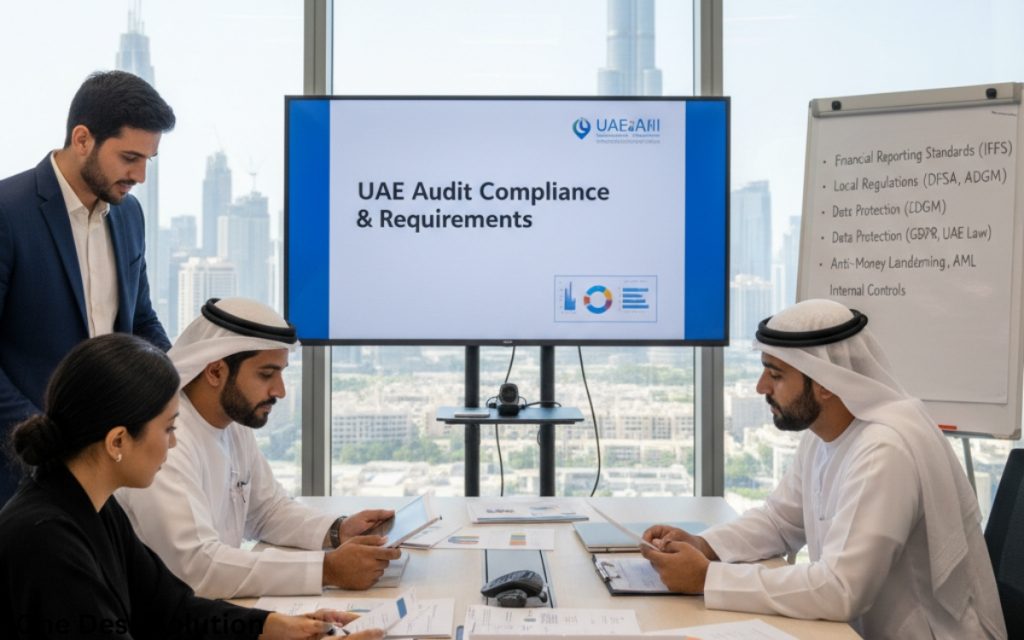
External Audit Process in Dubai 2027
What the auditor actually does at each phase — from acceptance and risk assessment to the signed opinion
Quick Summary: An external audit in Dubai follows a structured sequence: client acceptance and engagement letter, planning and risk assessment, testing of controls and balances, completion procedures, and the issuance of a signed audit report with an opinion. Understanding what the auditor is doing at each phase helps management respond faster, avoid delays, and get the signed report in time for license renewal, bank financing, or Corporate Tax compliance. This guide explains the full process and the types of audit opinion you may receive.
Most business owners only see the visible parts of an audit — the document requests and the final report. Behind that sits a defined methodology that auditors follow, from deciding whether to accept the engagement to forming a professional opinion on whether your financial statements are free from material misstatement.
Knowing what happens at each phase makes the engagement far less opaque. It also helps you anticipate where your team will be asked for input, where delays typically occur, and what the auditor needs from you at each stage. If you want a client-side to-do list rather than an explanation of the auditor's work, see our external audit engagement checklist.
At One Desk Solution, our audit and assurance team carries out statutory audits for UAE businesses and walks clients through each phase, so there are no surprises between kickoff and the signed report.
Want a clear timeline and plan for your next statutory audit? Let's map out the process for your business.
Table of Contents
- The Audit Process at a Glance
- Phase 1: Client Acceptance & Engagement Letter
- Phase 2: Planning & Risk Assessment
- Phase 3: Testing & Evidence Gathering
- Phase 4: Completion Procedures
- Phase 5: Reporting & Audit Opinion
- Types of Audit Opinion
- Indicative Timeline & Where Delays Happen
- Common Mistakes That Slow the Process
- Frequently Asked Questions
1. The Audit Process at a Glance
2. Phase 1: Client Acceptance & Engagement Letter
Before any work begins, the audit firm decides whether it can accept the engagement. This is a professional-standards step, not a formality.
- The firm confirms it is licensed and, where relevant, approved by your Free Zone authority — see our guide on who can perform a statutory audit in UAE
- It assesses independence — no conflicts of interest with management or owners
- It considers the integrity of management and whether the engagement carries unacceptable risk
- An engagement letter is issued setting out scope, responsibilities, fees, and the reporting deadline
3. Phase 2: Planning & Risk Assessment
- Understanding the business: the auditor learns your industry, revenue streams, systems, and control environment
- Risk assessment: identifying areas where material misstatement is most likely — revenue recognition, inventory, related-party transactions, significant estimates
- Setting materiality: deciding the threshold above which an error would influence a reader's decisions
- Designing the audit approach: choosing which areas get detailed testing and which are sampled or reviewed analytically
Why this matters: Business changes during the year — a new revenue stream, a system migration, a new Free Zone entity, or a Corporate Tax position change — directly shape the risk assessment. Telling your auditor early about these changes lets them plan the right procedures instead of discovering them late in fieldwork.
4. Phase 3: Testing & Evidence Gathering
| Procedure | What the Auditor Does |
|---|---|
| Controls testing | Checks whether key internal controls (approvals, segregation of duties, reconciliations) operate as described |
| Substantive testing | Verifies balances and transactions directly against invoices, contracts, bank statements, and other evidence |
| External confirmations | Obtains direct confirmation from banks, customers, or suppliers of balances owed or held |
| Analytical procedures | Compares current-year figures to prior years and expectations to flag unusual movements |
| Inventory and asset verification | Observes or confirms existence and valuation of stock and fixed assets where relevant |
| Tax and compliance review | Checks that VAT, Corporate Tax, and payroll-related balances are consistent with filings and supporting records |
Concerned about how your records will hold up under substantive testing? We can run a readiness review before fieldwork starts.
5. Phase 4: Completion Procedures
- The auditor reviews events after the year-end date that may affect the financial statements (subsequent events)
- A going concern assessment is performed — is the business able to continue operating for the foreseeable future
- Proposed adjustments are discussed with management and, if agreed, reflected in the final figures
- Management signs a representation letter confirming the completeness and accuracy of information provided
- Financial statement presentation and disclosures are reviewed for compliance with the applicable reporting framework
6. Phase 5: Reporting & Audit Opinion
The audit concludes with a signed auditor's report containing the opinion, usually accompanied by the audited financial statements. Many firms also issue a management letter highlighting control weaknesses and recommendations — useful input for your internal audit planning, and relevant to board oversight covered in our board audit committee checklist.
7. Types of Audit Opinion
| Opinion | Meaning |
|---|---|
| Unmodified (clean) | Financial statements present a true and fair view in all material respects |
| Qualified | Statements are fairly presented except for a specific matter that is material but not pervasive |
| Adverse | Statements are materially misstated and do not present a true and fair view |
| Disclaimer of opinion | The auditor could not obtain enough evidence to form an opinion |
- A qualified, adverse, or disclaimed opinion can raise questions with banks, regulators, and Free Zone authorities
- Where audited financials underpin tax positions such as Qualifying Free Zone Person status, an unresolved audit issue can have wider consequences — see our tax services comparison for Mainland and Free Zone companies
8. Indicative Timeline & Where Delays Happen
| Stage | Indicative Duration | Common Delay Cause |
|---|---|---|
| Acceptance & engagement letter | A few days | Slow sign-off or scope disagreements |
| Planning | A few days to a week | Late information about business changes |
| Fieldwork & testing | One to several weeks | Incomplete records, slow responses to queries |
| Completion & reporting | A few days to two weeks | Open adjustments or late representation letter |
Timelines are indicative only and depend on company size, record quality, and whether it is a first-year audit.
9. Common Mistakes That Slow the Process
- Treating the audit as a year-end event instead of keeping records reconciled throughout the year
- Not telling the auditor about significant business or ownership changes until fieldwork is underway
- Slow or inconsistent responses to information requests, extending fieldwork
- Disputing proposed adjustments late, instead of resolving them as they arise
- Waiting until the license renewal deadline is close before starting the engagement
Frequently Asked Questions
What are the main steps in an external audit in Dubai?
The process typically runs through client acceptance and an engagement letter, planning and risk assessment, testing and evidence gathering, completion procedures such as subsequent events and going concern review, and finally the issuance of the signed audit report and opinion.
How long does an external audit take in Dubai?
For a small to mid-sized company with well-organized records, it can often be completed within a few weeks of document submission. Larger groups, first-year audits, and businesses with incomplete bookkeeping can take noticeably longer.
What is the difference between a qualified and an unmodified audit opinion?
An unmodified (clean) opinion states that the financial statements give a true and fair view in all material respects. A qualified opinion means they are fairly presented except for a specific material matter, which the auditor describes in the report.
What happens if the auditor finds errors in my accounts?
The auditor discusses proposed adjustments with management. If management agrees and corrects the figures, the final statements reflect the corrected position. If a material issue remains unresolved, it can lead to a modified opinion.
Is the external audit process different for Free Zone and Mainland companies?
The core audit methodology is the same, but the practical requirements around it can differ — such as Free Zone approved auditor lists, submission formats, and deadlines set by each authority. Always confirm the specific requirements of your licensing authority before starting the engagement.
Related Reading
Ready to take the guesswork out of your statutory audit? Let's plan the process and timeline together.