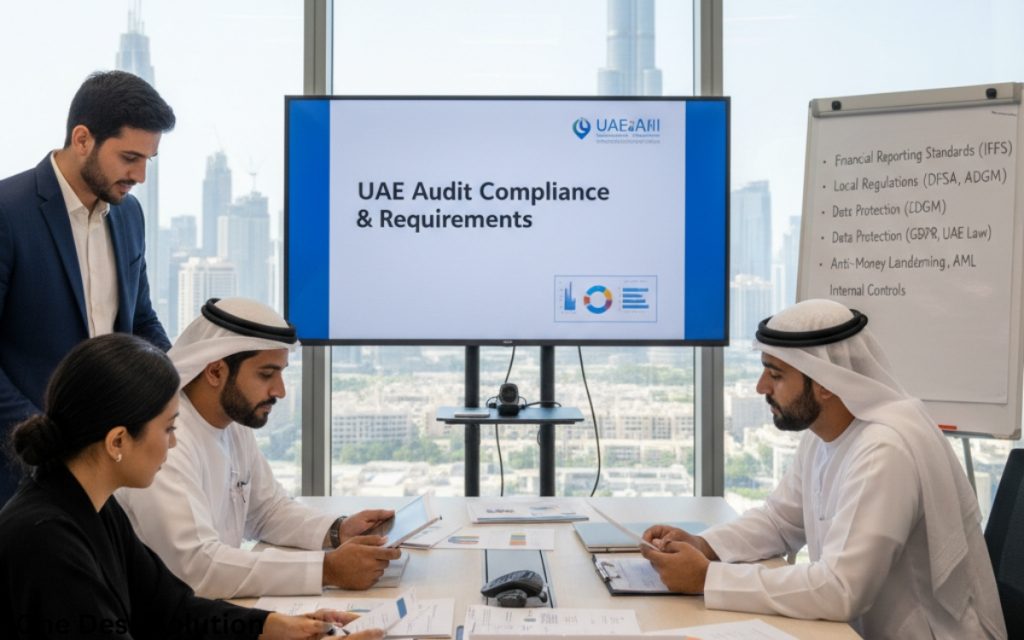
Audit Services for Restaurant and Cafe Owners UAE
POS, Cash & Delivery-Platform Compliance — Complete 2026 Guide
Quick Summary: The UAE's food and beverage sector is now a USD 27+ billion market with over 13,000 restaurants and cafes in Dubai alone, but that growth comes with layered compliance — DED/DTCM licensing, 5% VAT on every dine-in, takeaway, and delivery order, and cash- and POS-heavy revenue streams that generate more audit findings than almost any other sector. Add multi-platform delivery reconciliation (Talabat, Deliveroo, Careem, Noon Food) and Corporate Tax Small Business Relief rules that penalise multi-outlet groups for splitting into separate entities, and a generic audit approach falls short. This guide breaks down exactly what a restaurant or cafe audit in the UAE covers, what it costs, and the most common findings F&B owners run into.
📋 Table of Contents
- Introduction to Audit Services for Restaurant & Cafe Owners
- Why Restaurants & Cafes Face Unique Audit Risk
- UAE Regulatory Landscape for F&B Businesses
- Is an Annual Audit Mandatory for Your Restaurant or Cafe?
- How Auditors Verify POS & Revenue Completeness
- Reconciling Delivery Platform Revenue
- Cash Handling Controls Auditors Look For
- COGS, Inventory & Wastage Audit for F&B
- VAT Treatment for Restaurants & Cafes
- Tourism Dirham, Municipality Fees & Alcohol Licensing
- Corporate Tax & Small Business Relief for F&B Owners
- Staff Visa, WPS & Gratuity Compliance
- Cost of a Restaurant or Cafe Audit in the UAE
- Most Common Audit Findings in UAE F&B Businesses
- Internal Audit vs External Audit — Which Do You Need?
- How One Desk Solution Can Help
- Frequently Asked Questions
- Related Resources
🍽️ Introduction to Audit Services for Restaurant & Cafe Owners
The UAE's food and beverage sector has become one of the country's fastest-growing industries, with the national foodservice market valued at roughly USD 27.28 billion in 2026 and projected to reach USD 61.21 billion by 2031. Dubai alone is home to more than 13,000 restaurants and cafes, and the emirate issued over 1,200 new restaurant licenses in a single recent year. That growth is good news for owners — and it comes with a compliance layer that's more complex than almost any other SME sector, because restaurants generate audit risk in ways office-based businesses simply don't.
A restaurant or cafe audit isn't a generic financial review. Auditors need to reconcile point-of-sale data against bank deposits, verify commission and VAT treatment across four or five delivery platforms, test cash-handling controls shift by shift, and benchmark cost of goods sold against perishable inventory that's genuinely difficult to control. On top of that, F&B businesses sit under DED or DET licensing, DTCM tourism rules where applicable, and Dubai Municipality food safety oversight — each with its own record-keeping expectations that feed into the annual audit.
This guide walks through exactly what a restaurant or cafe audit in the UAE covers in 2026 — from POS revenue verification and delivery-app reconciliation to VAT treatment, Corporate Tax Small Business Relief, and the most common findings audit teams see across F&B clients. If you'd rather have specialists handle it directly, our audit & assurance team works with restaurant and cafe owners across the UAE every day.
Need an Audit Firm That Understands F&B?
Speak to our audit specialists for a free consultation on your restaurant or cafe's compliance and audit requirements.
⚠️ Why Restaurants & Cafes Face Unique Audit Risk
- High transaction volume, low average ticket size — small, frequent discrepancies are easy to miss without systematic reconciliation.
- Multiple revenue channels — dine-in, takeaway, delivery apps, catering, and gift cards, each with different reconciliation needs.
- Heavy cash exposure, especially for quick-service outlets and cafes.
- Perishable inventory that's genuinely hard to control and easy to under-report as "waste."
- Frequent shift handovers that widen the window for control gaps.
- Multi-outlet and franchise structures that complicate consolidated reporting and Corporate Tax grouping.
🏛️ UAE Regulatory Landscape for F&B Businesses
| Regulatory Layer | What It Covers | Audit Relevance |
|---|---|---|
| DED / DET Trade License | Mainland F&B operations hold an annually renewed trade license specifying permitted activities | Audited financial statements support license renewal |
| DTCM Tourism License | Required for F&B outlets classified under Dubai's tourism authority — hotel restaurants, standalone dining venues, licensed cafes | Periodic inspections require maintained financial and operational records |
| Municipality Food Safety | Food establishment permits, HACCP compliance, health inspections | Expired permits or failed inspections create regulatory liabilities that are material to the audit |
| Free Zone F&B | Cloud kitchens, dark kitchens, and food-court units operating in a free zone | Subject to that free zone's own audit and reporting obligations |
✅ Is an Annual Audit Mandatory for Your Restaurant or Cafe?
| Structure | Audit Requirement |
|---|---|
| Mainland LLC (DED/DET) | Annual audit expected under the UAE Commercial Companies Law; now treated as a genuine requirement since it feeds into Corporate Tax compliance |
| Free zone F&B (DMCC, JAFZA, DAFZA, etc.) | Audit mandatory by default at incorporation in most zones — not revenue-based — and needed for license renewal and QFZP 0% tax status |
| Any structure with revenue over AED 50 million | Mandatory statutory audit under Corporate Tax rules, regardless of zone or QFZP status |
| DTCM-licensed outlets | Must maintain financial and operational records that can withstand DTCM review, alongside standard audit obligations |
🧾 How Auditors Verify POS & Revenue Completeness
Revenue completeness is the primary audit risk for F&B businesses — the core question is whether every sale has actually been recorded. Because restaurants process large volumes of small transactions across multiple channels, the reconciliation approach matters more than in most other sectors.
- Full POS transaction data is exported for the audit period and reconciled to the general ledger.
- Voids, refunds, and discounts are tested individually, along with their approval trail.
- POS configuration is reviewed for accurate revenue splits between food, beverage, service charge, and VAT.
- Transaction sequence numbers are checked for gaps that could indicate unrecorded sales.
- Net card receipts (after processing and terminal fees) are reconciled against bank deposits, accounting for T+1/T+2 settlement timing.
- Unexplained variances between POS totals and bank deposits are treated as a significant red flag.
🛵 Reconciling Delivery Platform Revenue
Food delivery has added a genuine layer of reconciliation complexity. For platforms such as Talabat, Deliveroo, Careem Food, and Noon Food, auditors typically request monthly settlement statements and reconcile them line by line against bank receipts.
| Reconciliation Item | What the Auditor Checks |
|---|---|
| Gross order value vs recorded revenue | Match monthly platform settlement statements to the general ledger |
| Platform commission | Verify against the contract rate; confirm whether treated as an expense or netted against revenue, and disclosed either way |
| VAT on delivery orders | Confirm 5% VAT is correctly applied to both the food value and the delivery fee, and remitted |
| Payout timing differences | Reconcile any unsettled platform balances as receivables at period end |
| Platform-funded promotions | Separate discounts funded by the platform from the restaurant's own promotional spend |
💵 Cash Handling Controls Auditors Look For
Cash remains a significant revenue channel for many UAE F&B businesses, and poor cash controls are the single most common finding in F&B audits.
- Daily cash counts: a documented end-of-shift count, signed off by the shift manager plus an independent counter, compared against POS cash totals.
- Safe procedures: dual-control access, logged deposits, and a restricted list of who holds the combination.
- Petty cash reconciliation: vouchers retained, expense categories correctly coded, reconciled at least weekly.
- Cash variance thresholds: a defined acceptable variance per shift, with a clear escalation procedure for anything above it.
📦 COGS, Inventory & Wastage Audit for F&B
Cost of goods sold typically represents 28–35% of revenue for a well-run restaurant, and auditors benchmark your ratio against this range before investigating outliers.
- Supplier invoices: completeness testing and period-end cut-off checks to confirm every COGS entry is supported.
- Physical stock counts: observed or independently verified across dry goods, beverages, wine and spirits, cleaning supplies, and packaging.
- Waste and spoilage: tracked systematically and checked against volume-appropriate benchmarks.
- Yield analysis: for premium ingredients like seafood and meat, comparing purchased weight against dishes sold.
| Inventory Consideration | Recommended Practice | What Auditors Test |
|---|---|---|
| Count frequency | Daily for high-value items; weekly overall | Review count records for the audit period |
| Spoilage rate | Tracked by category — meat, dairy, produce | Compare rate against industry benchmarks |
| FIFO method | First-In, First-Out mandatory for perishables | Inspect date labelling and stock rotation |
| Supplier credit notes | Issued for returned or sub-standard goods | Reconcile credits to the GL and verify receipt |
🧮 VAT Treatment for Restaurants & Cafes
| Transaction Type | VAT Rate | Notes |
|---|---|---|
| Dine-in meals | 5% | Includes food, beverage, and service charge |
| Takeaway meals | 5% | Same rate as dine-in — no reduced rate applies |
| Delivery orders | 5% | Applies to both the food value and the delivery fee |
| Basic unflavored water | 0% | Zero-rated supply |
| Service charge | 5% | Treated as part of the taxable supply |
| Gift cards (issued) | No VAT at issuance | VAT arises on redemption |
Common error: F&B businesses frequently misapply VAT on service charges and bundled combo offers. Auditors examine your VAT returns against POS data specifically to catch under- or over-declaration on these items.
🏨 Tourism Dirham, Municipality Fees & Alcohol Licensing
- Tourism Dirham: Dubai's Tourism Dirham fee (AED 7–20 per room per night) is charged by hotel establishments, including hotel restaurants operating under a hotel property. If your outlet sits inside a licensed hotel, your auditor will reconcile Tourism Dirham collections against DTCM remittances at the property level. Standalone restaurants and cafes not attached to a hotel should confirm their specific obligations directly with DTCM, as fee structures are periodically updated.
- Municipality market fees: commonly calculated as a percentage of the outlet's annual rent, these form part of ongoing trade license costs and should be accrued and reconciled during the audit.
- Alcohol licensing: serving alcohol requires a separate Type C liquor license from DTCM, generally available only to restaurants operating inside licensed hotels or designated zones. Auditors verify this license is current wherever alcohol sales appear on the P&L.
🧾 Corporate Tax & Small Business Relief for F&B Owners
Standard UAE Corporate Tax applies at 0% on taxable income up to AED 375,000 and 9% above that. Small Business Relief lets UAE resident businesses with revenue at or below AED 3 million elect to be treated as having no taxable income, and this relief has recently been extended under Ministerial Decision No. 131 of 2026 to cover tax periods ending on or before 31 December 2029. It must be actively elected each year in the Corporate Tax return — it is not automatic.
Anti-fragmentation warning: multi-outlet restaurant groups that split into separate LLCs per branch — while sharing the same kitchen, staff, or management — risk having the FTA treat them as a single business for revenue-threshold purposes, denying Small Business Relief across the entire group. Free zone Qualifying Free Zone Person entities also cannot combine Small Business Relief with the 0% qualifying-income regime.
Given how easy these rules are to get wrong for a growing F&B group, most owners bring in dedicated tax support early. Our tax services team handles Corporate Tax registration, Small Business Relief elections, and VAT compliance specifically for restaurant and cafe groups.
👥 Staff Visa, WPS & Gratuity Compliance
Labour compliance is reviewed during the audit because related liabilities must be correctly reflected in the financial statements.
- End-of-service gratuity provisions must be calculated and accrued for every staff member — auditors pay particular attention to long-tenure employees.
- Payroll headcount is checked against Wages Protection System (WPS) records.
- Visa-related fees and medical insurance costs must be fully accrued, not simply expensed when paid.
💰 Cost of a Restaurant or Cafe Audit in the UAE
Hospitality and F&B audits in the UAE generally fall between AED 15,000 and AED 45,000 annually, depending on outlet count, revenue, and operational complexity.
| Business Size | Typical Annual Audit Cost (AED) | Notes |
|---|---|---|
| Single-outlet cafe or small restaurant | 15,000 – 22,000 | Standard statutory audit; well-organised POS records reduce cost |
| Multi-outlet group (2–4 branches) | 22,000 – 35,000 | Consolidated reporting across branches adds scope |
| Restaurant group / franchise with bank facility | 35,000 – 45,000+ | Larger scope, bank covenant reporting, multi-entity consolidation |
Add-on: a dedicated internal audit covering cash and POS controls typically adds 20–40% on top of the statutory audit fee. For a full breakdown of audit pricing drivers across UAE industries, see our Guide to Audit Costs and Fees in Dubai.
Indicative Annual F&B Audit Cost by Business Size (AED, 2026 est.)
Indicative 2026 ranges for hospitality/F&B statutory audits. Actual fees depend on transaction volume, number of locations, and quality of records.
🔍 Most Common Audit Findings in UAE F&B Businesses
- Revenue not fully reconciled to POS — unrecorded delivery app settlements
- Cash variance logs incomplete or not maintained
- End-of-service gratuity under-accrued, particularly for long-tenure staff
- Supplier invoices not matched to delivery notes — a risk of phantom invoices
- VAT errors on service charges and bundled offerings
- Tourism Dirham collections not reconciled to DTCM remittances (hotel-linked outlets)
UAE Foodservice Market Growth: 2026 vs 2031 (USD Billion)
UAE foodservice market size, 2026 vs projected 2031 (17.55% CAGR). Growth of this scale is exactly why F&B compliance and audit scrutiny is intensifying.
🔄 Internal Audit vs External Audit — Which Do You Need?
| Aspect | External (Statutory) Audit | Internal Audit |
|---|---|---|
| Purpose | Independent opinion on annual financial statements for regulators, banks, and license renewal | Operational review of cash, POS, and inventory controls to prevent leakage |
| Mandatory? | Generally yes, per structure (see table above) | Optional, but high-value for cash-heavy, multi-outlet F&B businesses |
| Frequency | Annual | Quarterly or ongoing, depending on risk |
| Typical cost impact | Base statutory fee | Adds roughly 20–40% on top of the statutory audit fee |
Most multi-outlet restaurant groups benefit from combining both: the external audit satisfies regulatory and Corporate Tax obligations, while an internal audit catches the cash and POS control gaps before they become a statutory audit finding. Our audit & assurance services cover both.
💼 How One Desk Solution Can Help
Restaurant and cafe audits require sector-specific expertise — reconciling POS systems, delivery platforms, and cash controls isn't the same skillset as auditing a standard trading company. One Desk Solution's audit and assurance services team works directly with F&B owners, supported by our accounting & bookkeeping services for day-to-day books, our tax services team for VAT and Corporate Tax compliance, and our advisory & consultancy services for growth planning across multiple outlets. If you're also opening new locations, our business setup team can help structure new branches correctly from day one. Explore our full range on the services page.
❓ Frequently Asked Questions
Q1: Is an annual audit mandatory for a restaurant or cafe in the UAE?
For most structures, yes. Mainland F&B businesses licensed through DED/DET fall under the UAE Commercial Companies Law and are expected to prepare annual audited financial statements, now enforced more strictly since it ties into Corporate Tax filings. Free zone F&B operations face audit obligations by default at incorporation in most zones, regardless of revenue, and any F&B business with revenue above AED 50 million must have a statutory audit under Corporate Tax rules. DTCM-licensed establishments must additionally maintain financial and operational records that can withstand DTCM review.
Q2: How do auditors handle food delivery app revenue like Talabat or Deliveroo?
Auditors request monthly settlement statements directly from each delivery platform — Talabat, Deliveroo, Careem Food, Noon Food — and reconcile the gross order value line by line against the general ledger and bank receipts. They verify that platform commissions are correctly classified, confirm 5% VAT has been applied to both the food value and the delivery fee, and treat any unsettled platform payouts as receivables at period end. Unreconciled delivery revenue is one of the most common findings in UAE F&B audits.
Q3: What is the correct VAT rate for takeaway and delivery food in the UAE?
The standard 5% VAT rate applies uniformly across dine-in, takeaway, and delivery orders in the UAE — there's no reduced rate for takeaway food as in some other countries. VAT applies to both the food value and the delivery fee on platform orders, and to service charges added to the bill. The one common exception is basic, unflavored water, which is zero-rated.
Q4: How much does a restaurant or cafe audit cost in the UAE?
Hospitality and F&B audits in the UAE typically range from AED 15,000 to AED 45,000 annually, depending on outlet count and complexity. A single-outlet cafe or small restaurant generally falls toward AED 15,000–22,000, a two-to-four-branch group runs AED 22,000–35,000, and larger restaurant groups or franchises with a bank facility or consolidated reporting can reach AED 35,000–45,000 or more. Adding a dedicated internal audit for cash and POS controls typically adds 20–40% on top of the statutory audit fee.
Q5: Can a restaurant chain split into separate companies to qualify for Small Business Relief?
This is risky. UAE Corporate Tax Small Business Relief allows resident businesses with revenue at or below AED 3 million to elect zero taxable income, but the FTA applies anti-fragmentation rules: if a restaurant group splits into multiple LLCs per branch while sharing the same kitchen, staff, or management, the FTA can treat the group as a single business for revenue-threshold purposes and deny the relief across all entities. Small Business Relief has recently been extended to cover tax periods ending on or before 31 December 2029, but multi-outlet groups should get proper tax advice before structuring around the threshold.
🔗 Related Resources
A full breakdown of audit pricing drivers across UAE industries.
Manage billing and engagements as your F&B group scales.
Relevant if your F&B operation runs its own delivery fleet.
Explore another industry-specific UAE tax compliance guide.
Compare free zone setup options across different UAE sectors.
Get Audit-Ready Books for Your Restaurant or Cafe
From POS and delivery-platform reconciliation to VAT and Corporate Tax compliance, One Desk Solution's F&B audit specialists keep your restaurant or cafe compliant year-round.