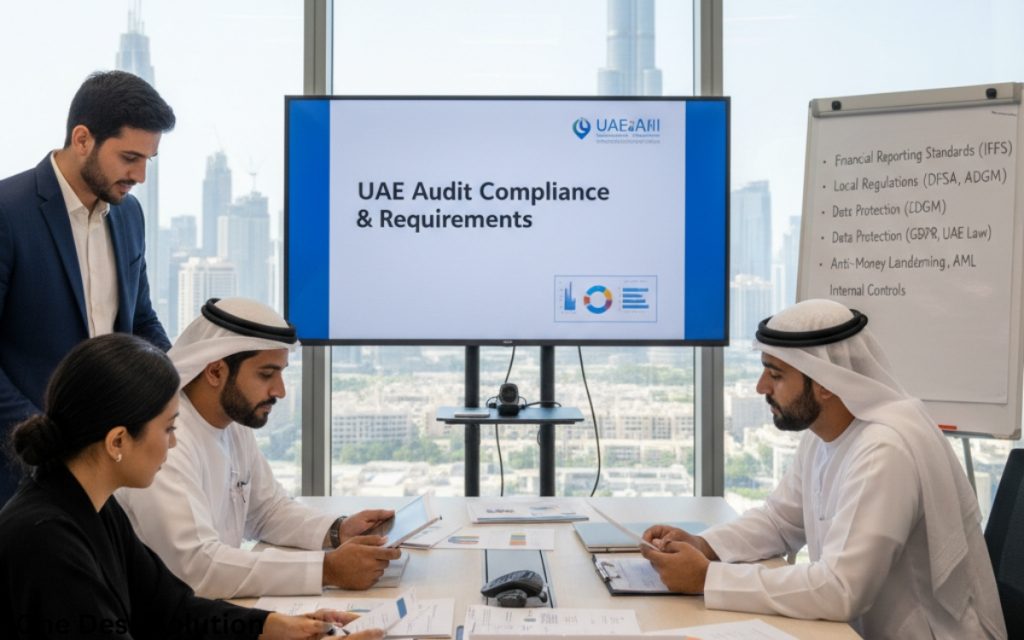
Audit Services in Dubai: Complete Overview 2027
Who needs an audit, what types exist, and how the process works for UAE businesses
Quick Summary: Most Free Zone companies in Dubai must submit audited financial statements annually, and many Mainland companies face similar requirements depending on their licensing authority and size. Audits range from statutory financial audits to internal, tax, and due diligence audits, each serving a different purpose for compliance, financing, or decision-making. This guide covers the main audit types, who's required to have one, the typical process, and how to choose the right audit firm in Dubai.
"Audit" means different things depending on context in the UAE — a statutory requirement to renew a trade license, a lender's condition for financing, or an internal review to tighten controls. For many Dubai businesses, the most pressing version is the annual statutory audit required to maintain good standing with their Free Zone authority or, increasingly, under Corporate Tax compliance obligations.
Understanding which type of audit applies to your business, what the process actually involves, and how to prepare reduces both the cost and the disruption of the audit cycle. It also feeds directly into tax compliance, since audited financials are now a condition for several Corporate Tax reliefs and exemptions.
At One Desk Solution, our audit and assurance team supports Dubai businesses across statutory, internal, and specialized audits, working alongside our bookkeeping and tax teams so your records are audit-ready year-round, not scrambled together at renewal time.
Need an audit for license renewal, financing, or Corporate Tax compliance? Let's scope out exactly what your business requires.
Table of Contents
1. Who Needs an Audit in Dubai?
| Business Type | Typical Audit Requirement |
|---|---|
| Free Zone companies (most authorities) | Annual audited financial statements required for license renewal |
| Mainland LLCs | Requirement varies by activity and size; increasingly expected for Corporate Tax and banking purposes |
| Companies seeking QFZP (0% tax) status | Audited financials are a mandatory condition of Qualifying Free Zone Person status |
| Businesses seeking bank financing | Lenders commonly require audited statements as part of credit assessment |
| Branches of foreign companies | Often required to submit audited accounts of the branch, and sometimes the parent company |
Why this matters: Requirements vary by Free Zone authority and Mainland licensing category, so always confirm the specific audit submission deadline and format with your own authority rather than assuming a single UAE-wide rule applies.
2. Types of Audit Services
- Statutory (External) Financial Audit — an independent review of financial statements for license renewal, shareholder, or regulatory purposes
- Internal Audit — an ongoing review of internal controls, processes, and risk management, usually requested by management or the board rather than a regulator
- Tax Audit Support — preparing for or responding to a Federal Tax Authority (FTA) review of VAT or Corporate Tax filings
- Due Diligence Audit — a deep-dive review conducted ahead of a merger, acquisition, investment, or partnership change
- Agreed-Upon Procedures (AUP) — a limited-scope engagement covering specific areas requested by management or a third party, rather than a full opinion on the financial statements
- Liquidation Audit — required when winding down a company, confirming no outstanding liabilities before deregistration
3. The Audit Process: Step by Step
4. Documents Auditors Typically Request
- General ledger and trial balance for the full financial year
- Bank statements and reconciliations
- Sales and purchase invoices, with supporting contracts where relevant
- Payroll records and end-of-service/gratuity calculations
- Fixed asset register and depreciation schedules
- Prior year audited financial statements, for comparison and opening balances
- VAT returns and Corporate Tax filings for the period under audit
Not sure which documents you'll need to gather, or whether your records are audit-ready? We can run a pre-audit check before the real thing.
5. How to Choose the Right Audit Firm
- Confirm the firm is approved by your specific Free Zone authority, if required — many free zones maintain an approved auditor list
- Check experience in your industry, since sector-specific issues (revenue recognition, inventory, WIP) vary significantly
- Ask about turnaround time relative to your license renewal or reporting deadline
- Clarify whether the engagement includes advisory input on findings, or only the signed report
- Compare fee structures — fixed fee vs scope-based pricing — against the complexity of your transactions
6. What Affects Audit Costs
| Factor | Impact on Cost |
|---|---|
| Transaction volume | Higher volume generally increases fieldwork time and cost |
| Record quality | Disorganized or incomplete bookkeeping increases auditor hours significantly |
| Number of entities/branches | Group or multi-branch audits require consolidation work |
| Industry complexity | Inventory-heavy, WIP-based, or multi-currency businesses require more specialized testing |
| First-year vs recurring audit | First-year audits typically take longer due to opening balance verification |
7. How Audits Connect to Corporate Tax
Since the introduction of UAE Corporate Tax, audited financial statements have taken on a new role: they are a mandatory condition for a Free Zone entity to qualify as a Qualifying Free Zone Person (QFZP) and access the 0% rate on Qualifying Income — see our Free Zone vs Mainland tax guide for the full criteria. Audited financials also provide the supporting evidence the FTA may request during a Corporate Tax or VAT review.
- Missing or late audited financials can jeopardize QFZP status for the tax period
- Inconsistent figures between management accounts, VAT returns, and audited statements can trigger FTA queries
8. Common Mistakes That Delay Audits
- Starting the audit process close to the license renewal deadline, leaving no buffer for queries
- Incomplete or unreconciled bookkeeping handed to the auditor at the start of fieldwork
- Missing supporting contracts or invoices for significant transactions
- Inconsistent treatment of revenue or expenses between periods without documented justification
- Not engaging an auditor approved by the relevant Free Zone authority, requiring a repeat engagement
Frequently Asked Questions
Is an audit mandatory for Free Zone companies in Dubai?
Most Free Zone authorities require annual audited financial statements as a condition of license renewal, and audited financials are also mandatory for any Free Zone entity seeking Qualifying Free Zone Person (QFZP) status for Corporate Tax purposes. Exact requirements vary by authority, so it's worth confirming with your specific Free Zone.
How much does an audit cost in Dubai?
Audit fees depend on factors like transaction volume, record quality, industry complexity, and whether it's a first-year or recurring audit. Businesses with clean, well-organized bookkeeping generally see lower audit costs than those handing over disorganized records.
What's the difference between a statutory audit and an internal audit?
A statutory audit is an independent, external review of financial statements typically required for license renewal or regulatory compliance. An internal audit is a broader, ongoing review of processes and controls, usually commissioned by management or the board to improve operations rather than to satisfy an external requirement.
How long does an audit take?
Timelines vary with business size and record quality, but a straightforward annual audit for a small to mid-sized company can often be completed within a few weeks once all documentation is provided, while larger or first-year audits can take longer.
What documents do I need to prepare for an audit?
At minimum: the general ledger and trial balance, bank statements and reconciliations, sales and purchase invoices, payroll and gratuity records, the fixed asset register, and prior VAT/Corporate Tax filings. Having these organized before fieldwork begins significantly speeds up the process.
Related Reading
Ready for your next audit cycle, or want your bookkeeping audit-ready year-round? Let's get started.