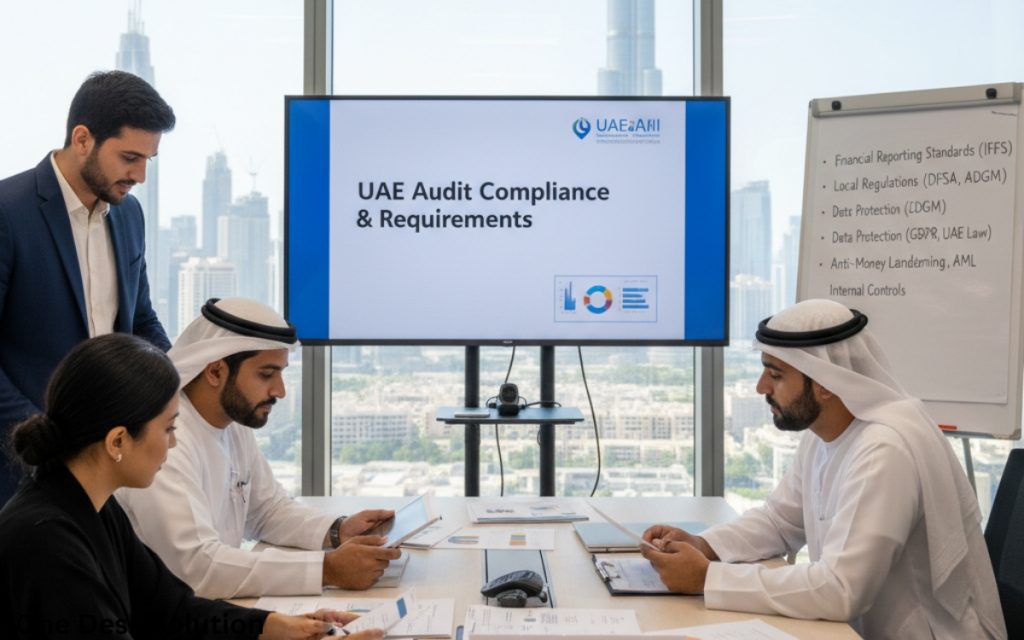
Manufacturing Compliance Audit in the UAE: Licences, Product Standards, Environment, Labour, Tax and ICV Checklist (2027 Guide)
What a Factory Compliance Audit Covers, Who Regulates Each Area, Which Certificates Expire, What the Penalties Are and How to Prepare Before an Inspector, Bank or Buyer Asks
Quick Summary: A manufacturing compliance audit is a structured review that tests whether a UAE factory meets its licensing, product certification, environmental, safety, labour, tax and customs duties, and can prove it with documents. Several rules apply at once: operating without an industrial licence is an offence, ECAS and ICV certificates expire, Emiratisation targets carry monthly contributions and e-invoicing starts for larger businesses on 1 January 2027. This guide uses charts and tables to show what to test, which authority is involved and when each approval runs out.
📋 Table of Contents
- Introduction: One Factory, Many Regulators
- Quick Answer: What the Audit Covers
- Compliance Audit, Statutory Audit, ICV Audit and Certification Compared
- Who Regulates a UAE Factory
- Industrial Licensing and Permits
- Product Conformity: ECAS, EQM and Labelling
- Environment, Health, Safety and Fire
- Labour and Emiratisation
- Tax, Excise and Customs
- In-Country Value (ICV) Certification
- Inventory, Costing and Financial Controls
- How the Audit Runs, Stage by Stage
- Approval and Renewal Calendar
- Common Mistakes to Avoid
- 6 Steps to Prepare for the Audit
- How One Desk Solution Can Help
- Frequently Asked Questions
- Related Resources
🚀 Introduction: One Factory, Many Regulators
A UAE factory answers to more regulators than most businesses. Licensing authorities and the Ministry of Industry and Advanced Technology (MoIAT) decide whether you can produce, environmental and safety bodies set conditions on the plant, the Ministry of Human Resources and Emiratisation (MOHRE) governs the workforce, and the Federal Tax Authority (FTA) and customs bodies govern the money. A manufacturing compliance audit tests each of those duties in turn and checks that your records can prove them.
We did not find a single federal rule that requires a stand-alone audit with that name. Instead, several rules bite at once. Operating without an industrial licence is a criminal offence under Federal Decree-Law No. 25 of 2022, product certificates expire, Emiratisation targets carry monthly financial contributions, and e-invoicing starts for larger businesses on 1 January 2027. An audit finds the gaps before an inspector, a bank or a tender evaluator does.
This guide explains what the audit covers, which authority is behind each area, what the main penalties are and how to prepare. It relies on MoIAT and Ministry of Finance pages, law-firm and consultancy summaries and media reports, and it flags where sources differ. Our audit & assurance services and tax services teams help manufacturers run these reviews and close the findings.
Want a Compliance Audit of Your Factory?
Tell us your licences, products and workforce. We'll scope the audit, test each regulated area and give you a ranked action plan.
✅ Quick Answer: What the Audit Covers
| Area | What the audit tests | Evidence to have ready |
|---|---|---|
| 1. Licences and permits | Industrial and production licences are valid, activities match the licence and changes were notified | Licences, Initial Approval, lease, special approvals |
| 2. Product conformity | Each regulated product holds a current ECAS or EQM certificate, and labels match | Certificates of conformity, lab reports, labels |
| 3. Environment | Emissions, waste and permits match licence conditions, and technical changes were notified | Environmental permits, monitoring reports, waste records |
| 4. Safety and fire | Civil Defence approvals, local OSH rules and incident handling are in place | Safety certificates, inspection reports, incident logs |
| 5. Labour and Emiratisation | Work permits, establishment card and Emiratisation position are current | Employee lists, MOHRE records |
| 6. Tax and customs | Corporate Tax, VAT and excise registrations and filings are on time, and duty exemptions are used correctly | Returns, registrations, customs records |
| 7. Financial reporting and ICV | Audited financial statements exist where required, and the ICV certificate is current | Audited statements, ICV certificate |
| 8. Inventory and costing | Stock counts, costing, scrap and fixed assets support the reported numbers | Stock sheets, bills of materials, asset register |
⚖️ Compliance Audit, Statutory Audit, ICV Audit and Certification Compared
Manufacturers hear the word "audit" for several different things. They have different purposes and different outputs, so it helps to separate them before you scope the work.
| Review | Purpose | Who needs it | Output |
|---|---|---|---|
| Manufacturing compliance audit | Tests legal and regulatory duties across licences, products, environment, labour, tax and customs | Any manufacturer wanting assurance; we found no single rule making it mandatory | Findings log and action plan |
| Financial statement audit | An opinion on the financial statements | Under Ministerial Decision No. 84 of 2025, taxpayers outside a tax group with revenue above AED 50 million, or claiming Qualifying Free Zone Person benefits, and all tax groups | Audit report |
| ICV audit and certification | Verifies your In-Country Value score from audited financials | Suppliers who want an edge in tenders from participating entities | ICV certificate |
| Product certification | Confirms a product meets UAE requirements | Manufacturers and importers of regulated products | ECAS or EQM certificate |
| Regulatory inspection | A government body checks compliance on its own timetable | Triggered by the regulator, not by you | Approval, notice or penalty |
Other audit duties may apply: Your licensing authority, free zone or contracts may add audit requirements that we have not covered here. Check them with your licensing authority or an adviser.
🏛️ Who Regulates a UAE Factory
The right authority depends on the activity, the emirate and whether the plant is in a free zone. The chart gives the usual map for the six areas an audit covers.
Six Regulatory Areas for a UAE Factory
Swipe sideways to see the full chart
Based on MoIAT pages and a published regulatory summary of environment, health and safety authorities in the UAE. Authorities and responsibilities can change, so confirm them for your site.
Free zones add their own bodies: A regulatory summary lists Trakhees, the Occupational Health, Safety and Environment Department at Dubai South and the Health, Safety and Environment Department at Abu Dhabi Ports among free zone authorities. If your plant is in a free zone, add that authority to the audit scope.
🏭 Industrial Licensing and Permits
The MoIAT licensing journey starts with the Department of Economic Development (DED) in the emirate. It has a path of approvals that the audit should trace from beginning to end. Which approvals apply, and in what order, depends on the activity, the emirate and the free zone.
Industrial Licensing Path in the UAE
Swipe sideways to see the full chart
Based on the MoIAT industrial licensing journey page. The Initial Approval is described as allowing industrial activity for one year. The online steps differ by emirate.
The Industrial Production Licence lets holders apply for exemptions from customs duties on imported machinery, equipment, spare parts and other materials used directly in manufacturing. The MoIAT service page lists the application and inspection fees as AED 0 and a processing time of 5 working days, but check the page for current terms. If you are still planning the plant, our pre-setup planning and research checklist and our mainland business setup requirements checklist cover the groundwork, and our guide to the future of business formation in Dubai explains how mainland, free zone and onshore permit routes are changing.
Federal Decree-Law No. 25 of 2022 on the regulation and development of industry is the legal anchor. A published summary says it was issued on 26 September 2022 and took effect on 2 January 2023. Under Article 8 of that summary, an industrial establishment must:
- Comply with the conditions of its industrial licence and any industrial production permit.
- Comply with the mandatory specifications and standards issued by the Ministry.
- Get permission before leasing, disposing of or relocating the establishment.
- Notify the Ministry and the licensing authority of any sale, mortgage, lease or assignment.
- Notify the Ministry and the licensing authority within 30 days if operations stop, in whole or in part.
- Admit authorised representatives, who may view records and monitor production.
Penalties for operating without a licence: The same summary says operating without an industrial licence carries imprisonment, a fine of up to AED 1,000,000, or both. Violators must also remove the causes of a violation and its damage, and if they do not, the authority can do so and recover the cost plus 20%. The summary notes that the Arabic text prevails, so check the original law for your case.
🏷️ Product Conformity: ECAS, EQM and Labelling
Regulated products must hold an Emirates Conformity Assessment Scheme (ECAS) or Emirates Quality Mark (EQM) certificate to be sold in the UAE, whether they are imported or locally made, according to SGS. Covered categories include electrical, mechanical, metrology, chemical and food products, with examples such as lighting, personal protective equipment, cosmetics, textiles, detergents, honey and bottled drinking water.
| Item | ECAS | EQM |
|---|---|---|
| What it is | A product certification scheme that MoIAT mandates for regulated products | A mark showing compliance with the relevant UAE national standards |
| Validity | One year, with annual renewal | Three years |
| Who can apply | Manufacturers, exporters, distributors and traders | Same, with an effective quality management system expected |
A certificate of conformity application typically needs the following, per SGS. The same documents are what your audit should check against each product.
- A valid UAE industry or trade licence.
- An electronic declaration of conformity and a certification request.
- Test reports and certificates for MoIAT-approved standards from an accredited laboratory.
- Product labels, with a user manual or ingredients list in Arabic and English.
- Other technical or legal documents requested for the product scope, and fees.
Drinks producers should check excise too: A Gulf Today report on FTA guidance says producers and importers of sweetened drinks must register them as excise goods, with certified lab reports from MoIAT-accredited facilities. It describes a tiered model based on sugar per 100 ml, to start in 2026 once related legislation is issued. We have not confirmed that the new model is in force, so check the FTA's current position.
🌿 Environment, Health, Safety and Fire
Environmental and safety duties are mostly set by the emirate, so the audit has to follow the plant's location. The table lists the authorities named in a published regulatory summary.
| Level | Environment | Safety and fire |
|---|---|---|
| Federal | Ministry of Climate Change and Environment (MOCCAE) permits imports and exports of items such as hazardous waste | MOHRE's Occupational Health and Safety Department; Civil Defence issues building safety certificates and fire safety approvals |
| Abu Dhabi | Environment Agency (EAD) issues environmental licences for industrial facilities; Tadweer permits waste vendors | Abu Dhabi Public Health Centre supervises the OSHAD framework |
| Dubai | Dubai Municipality issues environmental operating permits and permits for waste vendors and disposal | Dubai Municipality Health and Safety Department inspects workplaces, investigates accidents and issues fines |
| Other emirates | Local bodies such as Sharjah's Environmental Services Department, Fujairah Environmental Authority and Ras Al Khaimah's EPDA | Check the local authority and Civil Defence |
Enforcement is real. The Environment Agency - Abu Dhabi temporarily halted operations at two industrial facilities and fined one of them, according to Gulf News in January 2025. The reasons given were volatile organic compound emissions above permitted limits, failure to take steps to reduce harmful emissions and failure to notify the agency of technical changes that their environmental licences require.
- Match every process and fuel change to the environmental permit, and keep proof you notified the authority of technical changes.
- Keep emission monitoring reports and waste manifests or disposal records for each waste stream.
- Confirm Civil Defence approvals and fire system drawings are current for the building as it stands today.
- Review incident and near-miss logs against the OSH rules of your emirate or free zone.
👷 Labour and Emiratisation
Workforce checks cover the establishment card, work permits and visas through MOHRE, plus Emiratisation for larger employers. Figures differ between sources, so the table shows where each comes from.
| Item | What the sources say |
|---|---|
| Who is covered | Private companies with 50 or more employees (Gulf News, June 2026) |
| Annual target | 2% growth in skilled jobs, split into 1% for the first half and 1% for the second half (Gulf News) |
| First-half 2026 deadline | 30 June 2026 (Gulf News); confirm the second-half date with MOHRE |
| Reported penalty | AED 10,000 a month, or AED 120,000 a year, for each Emirati not hired under the target (Gulf News) |
| Other sanctions | Downgraded company classification, restricted work-permit access and suspended government services (Middle East Briefing) |
| Free zones | Described as outside the mandatory quota regime, with voluntary participation encouraged (Middle East Briefing) |
Using the reported rate of AED 120,000 a year per unfilled position, the exposure grows quickly with the size of the gap.
| Unfilled positions | Monthly contribution | Yearly contribution |
|---|---|---|
| 1 | AED 10,000 | AED 120,000 |
| 2 | AED 20,000 | AED 240,000 |
| 3 | AED 30,000 | AED 360,000 |
| 5 | AED 50,000 | AED 600,000 |
Sources differ on the rate: Middle East Briefing (March 2026) cites AED 6,000 per missing Emirati each month, which Gulf News gives as the 2022 starting rate before increases. The table uses the later Gulf News figure and is illustrative. Confirm the current amount and your own position with MOHRE.
🧾 Tax, Excise and Customs
Tax is where a factory's records meet the law. The table lists the checks an audit should run, with the source behind each figure.
| Area | What to check | Note |
|---|---|---|
| Corporate Tax rate | 0% on the first AED 375,000 of taxable income, 9% above | Standard bands |
| Registration | Newly established UAE entities register within 3 months of incorporation | DLA Piper on FTA Decision No. 3 of 2024; late registration carries a AED 10,000 penalty |
| Return and late filing | Return due 9 months after the tax period ends | Late filing is AED 500 a month for 12 months, then AED 1,000, per secondary summaries |
| Audited financial statements | Needed above AED 50 million of revenue or when claiming Qualifying Free Zone Person benefits; all tax groups prepare special purpose statements | Ministerial Decision No. 84 of 2025, per KPMG, for years starting on or after 1 January 2025 for tax groups |
| Free zone manufacturers | Manufacturing and processing of goods are qualifying activities; transactions with natural persons are excluded for manufacturing | Ministerial Decision No. 229 of 2025; non-qualifying revenue must stay within the lower of 5% of revenue or AED 5 million |
| Distribution by manufacturers | Distribution has its own conditions, including being carried out in or from a Designated Zone | Test it separately from manufacturing income |
| VAT | Registration is mandatory above AED 375,000 and voluntary from AED 187,500 | VAT penalties were revised from 14 April 2026 (Al Tamimi) |
| E-invoicing | AED 50 million or more: provider by 31 July 2026, go-live 1 January 2027. Under AED 50 million: provider by 31 March 2027, go-live 1 July 2027 | Ministerial Decisions Nos. 243 and 244 of 2025; B2C exempt until further notice |
| Excise | Producers of excise goods such as tobacco, energy drinks and sweetened drinks must check FTA registration and product registration | See the drinks note above |
| Customs duty exemptions | Exemptions on machinery and raw materials are claimed through the production licence; check that goods were used directly in manufacturing | MoIAT service page |
Start with our guide on who is required to pay corporate tax in the UAE if you are not sure of your status. Then see what expenses are deductible for corporate tax, because factory costs such as materials, repairs and depreciation feed straight into taxable income. Missed filings cost real money, and our guide to the penalty for late filing explains how to avoid and fix them.
🇦🇪 In-Country Value (ICV) Certification
The National In-Country Value programme channels government procurement and spending by leading national companies into the UAE economy. Manufacturers use the ICV certificate to compete for tenders, and suppliers further down the chain are often asked for one. The score comes from audited financial statements, and local manufacturing carries the biggest weight.
What Counts in an ICV Score
Swipe sideways to see the full chart
Maximum points by attribute per Crowe's ICV FAQ. Free zone service providers are not scored on investments or on the export and investment-growth part of the bonus. There is no minimum score.
- Validity: an ICV certificate is valid for 14 months from the date the audited financial statements were issued.
- Who signs: financial statements follow IFRS and are signed by an auditor approved by the Ministry of Economy, and certification is done by firms authorised by the ICV committee (Crowe).
- Stand-alone statements: for financial years ending on or after 1 January 2025, the certificate needs stand-alone audited statements for the entity being certified (Grant Thornton).
- One certificate per entity or licence: companies with both industrial and commercial licences must split figures by licence type (Crowe).
- New companies: those under 10 months old may use management accounts covering up to nine months (Crowe).
📦 Inventory, Costing and Financial Controls
Compliance with the regulators means little if the books behind the factory are weak. Auditors usually test these controls because tax, ICV and lenders all rely on the same numbers. This is good practice, not a list drawn from one law.
- Stock counts and valuation: physical counts reconcile to the ledger, and raw materials, work in progress and finished goods are valued on a consistent basis.
- Costing: bills of materials, yields and scrap rates match actual production, so margins and transfer prices are supportable.
- Fixed assets: machinery is capitalised correctly, with records that link to customs exemptions claimed on imports.
- Cut-off: sales, purchases and imports fall in the right period for VAT and Corporate Tax.
- Related parties: charges between group entities are documented and priced consistently.
Our accounting & bookkeeping services team can set up monthly stock and cost reporting so these checks are routine rather than a year-end scramble.
🔍 How the Audit Runs, Stage by Stage
A good audit follows a repeatable path from scope to follow-up. Each stage produces a document that both your team and your auditor can check.
Five Stages of a Manufacturing Compliance Audit
Swipe sideways to see the full chart
A practical audit method, not a legal requirement. Scope and depth are agreed up front and vary by plant size, products and sites.
- Who to involve: plant manager, finance, HR, quality, health and safety, and procurement.
- Where to look: every legal entity, licence and site, including warehouses and any free zone or branch operations.
- How to rate findings: by legal exposure (for example a missing licence or certificate) and by cash exposure (for example penalties or lost exemptions).
- How to close them: give every finding an owner, a date and evidence, then re-test.
🗓️ Approval and Renewal Calendar
Many manufacturing approvals run on different clocks. The chart compares the validity periods stated in the sources, and the table adds the other recurring dates an audit should put in one calendar.
How Long Key Approvals Last
Swipe sideways to see the full chart
Validity per MoIAT (Initial Approval), SGS (ECAS and EQM) and Crowe (ICV). Confirm current terms for your products and licence.
| Item | Timing | Source note |
|---|---|---|
| Initial Approval | One year | MoIAT licensing journey |
| ECAS certificate | Annual renewal | SGS |
| EQM certificate | Three years | SGS |
| ICV certificate | 14 months from the audited statements date | Crowe |
| Operations stop | Notify within 30 days if operations stop, in whole or in part | Summary of Federal Decree-Law No. 25 of 2022 |
| Emiratisation | Half-year increments; first-half 2026 deadline was 30 June | Gulf News; confirm the second-half date with MOHRE |
| Corporate Tax return | 9 months after the end of the tax period | FTA rules as summarised |
| E-invoicing | 1 January 2027 (AED 50 million or more); 1 July 2027 (under AED 50 million) | Ministerial Decisions Nos. 243 and 244 of 2025 |
⚠️ Common Mistakes to Avoid
- Treating the industrial licence as a one-off, when changes of lease, ownership or operations must be notified.
- Selling regulated products after the ECAS certificate has lapsed.
- Changing a process or fuel without notifying the environmental authority.
- Leaving Emiratisation to the end of the half-year.
- Assuming free zone status means no Corporate Tax duties, no registration and no filing.
- Claiming customs duty exemptions on goods that were not used directly in manufacturing.
- Preparing an ICV certificate from group accounts instead of stand-alone audited statements.
- Waiting for e-invoicing deadlines before choosing a provider and testing the ERP.
🪜 6 Steps to Prepare for the Audit
Map your licences and regulators
List every legal entity, site and licence, and name the authority behind each one, including any free zone body.
Collect the document file
Gather licences, approvals, product certificates, permits, safety certificates, tax registrations and filings in one indexed folder.
Test product certificates and standards
Match each regulated product to a current ECAS or EQM certificate, test reports and compliant labels.
Review environment, safety and workforce
Check permits against actual processes, Civil Defence approvals, work permits and your Emiratisation position.
Test tax, customs and financial controls
Review Corporate Tax, VAT and excise registrations and filings, duty exemptions, stock records, costing and the ICV certificate.
Rate findings and fix them
Rank gaps by legal and cash risk, assign owners and dates, keep evidence and re-test after the fix.
💼 How One Desk Solution Can Help
Our audit & assurance services team scopes and runs the compliance review. Our tax services team handles Corporate Tax, VAT and excise registrations and returns, and our accounting & bookkeeping services team builds the stock, cost and e-invoicing-ready records. Our advisory & consultancy services team helps with remediation plans and group structures, and our business setup team supports new plants with licences and approvals. Browse everything on our services page.
❓ Frequently Asked Questions
Q1: What is a manufacturing compliance audit in the UAE?
It is a structured review that tests whether a factory meets its legal and regulatory duties and can prove it. It usually covers industrial and production licences, product certificates such as ECAS and EQM, environmental and safety permits, labour and Emiratisation, Corporate Tax, VAT, excise and customs, and financial records. It ends with a ranked findings log and an action plan.
Q2: Is a compliance audit mandatory for manufacturers in the UAE?
We did not find a single federal rule that requires a stand-alone manufacturing compliance audit. Related duties do apply. Taxpayers outside a tax group with revenue above AED 50 million, or claiming Qualifying Free Zone Person benefits, must keep audited financial statements, and an ICV certificate requires audited statements. Your licensing authority, free zone or contracts may add more, so confirm with them.
Q3: Which licences and approvals does a UAE factory need?
The MoIAT licensing journey describes an Initial Approval through the Department of Economic Development and MoIAT, special approvals such as the lease, civil defence, environmental permit, chamber membership and memorandum of association, an industrial licence from the DED, an Industrial Production Licence from MoIAT, and MOHRE set-up for the establishment card and work permits. Exact requirements depend on the activity, emirate and free zone.
Q4: What are the penalties for non-compliance in a UAE factory?
Operating without an industrial licence carries imprisonment, a fine of up to AED 1,000,000, or both, according to a summary of Federal Decree-Law No. 25 of 2022. Gulf News reports Emiratisation contributions of AED 10,000 a month for each unfilled position, late Corporate Tax registration carries a AED 10,000 penalty, and the Environment Agency - Abu Dhabi has halted facilities that exceeded emission limits. Penalties vary by authority, so check the current schedule.
Q5: How often should a manufacturer run a compliance audit?
The sources we reviewed do not set a frequency for a voluntary compliance audit. A common approach is to review at least once a year and before key events such as a licence renewal, a new product line, a tender or a financing round. Align it with your approval calendar, because ECAS certificates renew annually and ICV certificates last 14 months.
🔗 Related Resources
Which companies, free zone entities and individuals are taxable persons.
How deductible and non-deductible expenses affect taxable income.
What late filing can cost and how to avoid it.
Ownership, free zone onshore permits, digital licensing and compliance.
What to plan and research before you set up a company.
Requirements to prepare when setting up a mainland business.
Ready to Audit Your Factory's Compliance?
One Desk Solution helps manufacturers test their licences, products, workforce, tax and records, and close the gaps before they cost money.