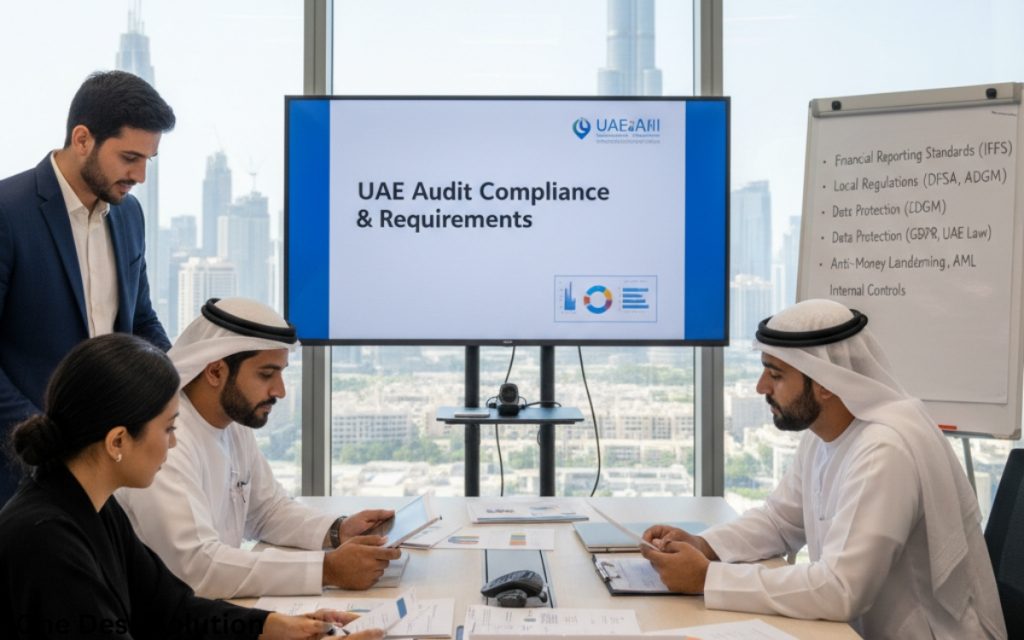
Statutory Audit Requirements Checklist UAE 2026
The complete, action-ready checklist for UAE businesses — who must audit, what documents are required, key IFRS standards to apply, free zone deadlines, and how to prepare for a fast, clean, unqualified audit opinion.
The statutory audit is one of the most important — and most avoidable sources of stress — for UAE business owners. Every year, businesses across Dubai miss audit deadlines, receive qualified opinions, or pay inflated audit fees simply because they were not adequately prepared. The reality is that a well-prepared UAE company with clean, IFRS-compliant books can complete its statutory audit in 3–4 weeks and consistently receive an unqualified opinion. This comprehensive 2026 checklist covers every requirement for a successful UAE statutory audit — the legal basis for who must audit, the complete document and record checklist, the IFRS standards every auditor will check, the specific requirements for major UAE free zones, the step-by-step audit preparation timeline, the most common audit findings and how to avoid them, and expert guidance on choosing a UAE-licensed auditor who is approved by your specific free zone authority.
🏢1. Who Must Have a Statutory Audit in UAE?
| Entity Type | Audit Required? | Legal Basis | Submitting Authority |
|---|---|---|---|
| All UAE Free Zone Companies | Yes — Mandatory | Individual Free Zone Authority Regulations | Free Zone Authority (DMCC, JAFZA, IFZA, etc.) |
| Dubai Mainland LLC | Yes — Mandatory | UAE CCL (Federal Decree-Law No. 32/2021) | DED Dubai (for licence renewal) |
| Public Joint Stock Company (PJSC) | Yes — Mandatory | CCL + SCA Corporate Governance Code | SCA / ADX / DFM |
| Branch of Foreign Company | Yes — Mandatory | UAE CCL + Ministry of Economy | DED / MoE |
| DIFC / ADGM Companies | Yes — Mandatory | DFSA / FSRA regulations | DIFC / ADGM Authority |
| Banks & Financial Institutions | Yes — Mandatory | CBUAE / Insurance Authority regulations | CBUAE / IA |
| Sole Establishment (Mainland) | Not legally mandatory | CCL does not apply | No authority submission |
| Individual Freelancer | Not legally mandatory | Generally exempt | No authority submission |
No Revenue Threshold: Unlike many other countries that exempt small companies from statutory audit, the UAE has no revenue-based audit exemption. A DMCC or JAFZA company generating AED 10,000 per year has the same statutory audit obligation as one generating AED 100 million. The obligation is determined by entity type — not by size, revenue, or profitability. Even a dormant (inactive) free zone company must produce audited accounts or face licence renewal being blocked.
⚖️2. Legal Basis & Regulatory Framework
| Law / Regulation | Applies To | Key Audit Requirement |
|---|---|---|
| UAE Commercial Companies Law (CCL) — Federal Decree-Law No. 32 of 2021 | All mainland UAE commercial companies | Mandatory annual audit by MoE-licensed auditor; appointment at AGM; audited accounts for DED licence renewal |
| Individual Free Zone Authority Regulations | All free zone-licensed entities | Annual audited accounts submitted to free zone authority as mandatory condition of licence renewal |
| UAE Corporate Tax Law — Federal Decree-Law No. 47 of 2022 | All CT-registered entities | CT return must be based on IFRS financial statements; effectively requires audited accounts for defensible CT returns |
| SCA Corporate Governance Code | All listed UAE companies (ADX/DFM) | Mandatory audit committee; annual and semi-annual audited financials; quarterly reviewed financials |
| CBUAE Regulations | Licensed UAE banks & financial institutions | Annual audited IFRS accounts submitted to CBUAE |
| DFSA / FSRA Rules | DIFC / ADGM licensed entities | Audited accounts by DFSA/FSRA-registered firm; additional regulatory reports |
📄3. Complete Document & Record Checklist
This is the master PBC (Prepared by Client) checklist — the documents every UAE auditor will request. Preparing these before audit fieldwork begins is the single most effective way to reduce audit time and cost.
- Closed and agreed Trial Balance — total debits must equal total credits; agrees to draft financial statements
- Draft IFRS Financial Statements: P&L, Balance Sheet, Cash Flow Statement, Equity Statement, and Notes
- Bank reconciliations for ALL bank accounts — reconciled to the last day of the financial year
- General Ledger — full year transaction detail, accessible in the accounting system
- Chart of Accounts — current and complete
- Journal entries listing for the full year — particularly year-end adjusting entries
- Sub-ledgers for accounts payable and accounts receivable — agreeing to trial balance
- EOSB (End of Service Gratuity) calculation — for every employee, showing: join date, current basic salary, years of service, calculated liability
- Payroll summary — monthly payroll amounts, headcount, and agreement to bank WPS transfers
- Complete employee register — name, join date, basic salary, designation, visa status
- Evidence of health insurance coverage for all employees (mandatory in Dubai and Abu Dhabi)
- Staff employment contracts (sample — auditors usually sample 5–10)
- Fixed Asset Register (FAR) — listing all assets with: cost, acquisition date, depreciation rate, accumulated depreciation, net book value
- IFRS 16 Lease Schedules — for every lease >12 months: opening balance, interest, depreciation, closing right-of-use asset and lease liability
- Aged Debtors Report — all trade receivables by customer, with ageing (0–30, 31–60, 61–90, 90+ days)
- ECL (Expected Credit Loss) provision calculation — applied to the aged debtors matrix
- Aged Creditors Report — all trade payables by supplier, with ageing
- Inventory count sheets and valuation (for businesses holding physical stock) — stock count at or near year-end
- Loan / facility schedules — for all bank loans, splitting between current and non-current portions
- All VAT 201 returns for the financial year — downloaded from EmaraTax
- VAT reconciliation — total revenue per accounting system vs. total revenue declared in all VAT returns for the year
- Corporate Tax registration certificate from EmaraTax
- All VAT audit correspondence or FTA notices received during the year
- Input VAT reconciliation — total input tax claimed vs. purchase ledger VAT amounts
- Valid Trade Licence — copy
- Memorandum of Association (MoA) — most recent attested version
- Board minutes and resolutions for the financial year
- Related-party transactions schedule — all transactions with directors, shareholders, group companies, listing: party, nature, amount, balance outstanding
- Material contracts — significant customer contracts, supplier agreements, loan agreements
- Legal correspondence — any claims, disputes, litigation involving the company
- Shareholder register — current ownership structure
Prepare for Your UAE Statutory Audit — Professionally
OneDeskSolution's accounting and audit team prepares your complete audit-ready document pack, IFRS financial statements, and PBC schedules — then coordinates the entire audit process from engagement to final report. Contact us today.
📊4. IFRS Requirements Every Auditor Checks
These are the IFRS standards that UAE auditors specifically test in every engagement. Understanding them helps you prepare the correct provisions and disclosures before the audit — rather than having the auditor propose them as adjustments.
| IFRS Standard | What Auditors Test | Most Common UAE Finding | Priority |
|---|---|---|---|
| IFRS 16 — Leases | Have all leases >12 months been capitalised? Is the ROU asset and lease liability correctly calculated? | Lease not capitalised — rent expensed 100% as operating expense | Critical |
| IAS 19 — EOSB | Has the end of service gratuity provision been calculated correctly for ALL qualifying employees? | EOSB provision missing, underestimated, or not updated for salary changes | Critical |
| IFRS 9 — ECL | Has an expected credit loss provision been applied to trade receivables using an ageing matrix? | No ECL provision — all receivables carried at face value regardless of age | Critical |
| IFRS 15 — Revenue | Is revenue recognised when performance obligations are satisfied — not when invoiced or when cash received? | Revenue recognised on invoice date regardless of delivery/completion stage | High |
| IAS 16 — PP&E | Are fixed assets depreciated at appropriate rates? Has an asset physically verification been performed? | Wrong depreciation rates; disposed assets still on register | High |
| IAS 2 — Inventories | Is stock valued at the lower of cost or NRV? Have slow-moving/obsolete items been written down? | Inventory overvalued; no NRV assessment for aged stock | High (trading cos.) |
| IAS 24 — Related Parties | Are all related-party transactions identified, disclosed in the notes, and at arm's-length pricing? | Undisclosed related-party transactions; missing IAS 24 note | High |
| IAS 1 — Presentation | Are financial statements properly presented? All required notes and accounting policies disclosed? | Missing notes; incomplete accounting policy disclosures | Standard |
📊 Most Common IFRS Gaps in UAE Audits (Frequency)
*Indicative — based on UAE audit practice data. Address these 6 items before audit fieldwork to dramatically reduce audit adjustments.
🏆5. Auditor Selection Requirements
- UAE Ministry of Economy (MoE) audit licence — verify at moec.gov.ae. This is the federal professional licence required to conduct statutory audits in the UAE. No MoE licence = illegal audit = report rejected by all authorities.
- Free zone approved auditor list registration — DMCC, JAFZA, IFZA, DIFC, ADGM, and most other free zones maintain their own list of approved auditors. Using an MoE-licensed auditor who is NOT on your free zone's approved list means the audit report will be rejected — requiring the entire audit to be repeated with an approved firm. Always verify free zone approval before engaging.
| Requirement | Why It Matters | How to Verify |
|---|---|---|
| MoE Audit Licence (valid) | Legal requirement to conduct UAE statutory audits | Verify on MoE eServices portal — moec.gov.ae |
| Free Zone Approved List (if applicable) | Free zone will reject report if auditor not approved | Check directly on the free zone's official website or portal |
| Auditor Independence | Auditor must have no financial interest in the company | Confirm in engagement letter; do not use bookkeeper as auditor |
| IFRS Competency | Must apply IFRS standards correctly — especially IFRS 16, IFRS 9, IAS 19 | Ask for examples of similar UAE business audits completed |
| Sector Experience | Familiarity with your industry reduces audit time and improves quality | Request client references from same sector |
| Fixed Fee Proposal | Avoids open-ended hourly billing; helps budget predictably | Require fixed fee in engagement letter |
| Realistic Timeline | Confirms auditor can meet your free zone deadline | Agree specific delivery date in engagement letter |
📅6. Free Zone Deadlines & Specific Requirements
- Deadline 90 days after FY end
- Approved list Yes — DMCC portal
- Standard IFRS for SMEs
- Submission portal.dmcc.ae
- Late penalty AED 2,000–5,000
- Consequence Licence hold
- Deadline 3 months after FY end
- Approved list Yes — JAFZA list
- Standard IFRS or IFRS for SMEs
- Submission jafza.ae portal
- Late penalty Fines + suspension
- Consequence Licence suspension
- Deadline 90 days after FY end
- Approved list MoE licensed
- Standard IFRS or IFRS for SMEs
- Submission ifza.ae portal
- Late penalty Fines + hold
- Consequence Licence hold
- Deadline 3–6 months after FY end
- Approved list MoE licensed
- Standard IFRS for SMEs
- Submission rakez.com portal
- Late penalty Fines + hold
- Consequence Licence hold
- Deadline 4 months after FY end
- Approved list DFSA registered only
- Standard Full IFRS mandatory
- Submission DIFC portal
- Late penalty DFSA enforcement
- Consequence Regulatory action
- Deadline 6 months after FY end
- Approved list FSRA registered only
- Standard Full IFRS mandatory
- Submission ADGM portal
- Late penalty FSRA penalties
- Consequence Regulatory penalties
December Year-End Companies: If your financial year ends 31 December 2025, your audit deadline at DMCC and IFZA is 31 March 2026. For JAFZA, the deadline is 31 March 2026. This means you have approximately 90 days from year-end to: close your books, prepare IFRS financial statements, complete the audit, and submit to the free zone. Engaging your auditor in November or December — before year-end — is strongly recommended. Companies that wait until January to engage an auditor routinely miss the March deadline.
⏱️7. Pre-Audit Preparation Timeline
⚠️8. Common Audit Findings & How to Prevent Them
| # | Common Finding | IFRS Reference | Prevention Action |
|---|---|---|---|
| 1 | IFRS 16 lease not capitalised — office rent expensed in full | IFRS 16 | Calculate ROU asset and lease liability for all leases >12 months before year-end close |
| 2 | EOSB provision absent or understated | IAS 19 | Recalculate EOSB monthly; update for all salary changes and new joiners/leavers |
| 3 | No ECL provision on trade receivables | IFRS 9 | Apply provision matrix to aged debtors report: 0–30 days (1%), 31–60 (5%), 61–90 (15%), 90+ (50%+) |
| 4 | VAT return revenue ≠ accounting revenue | IAS 1 | Monthly VAT-to-accounting reconciliation — reconcile Box 1 output to accounting revenue every month |
| 5 | Related-party transactions undisclosed or unlisted | IAS 24 | Maintain related-party transaction register throughout the year; confirm with all directors and shareholders |
| 6 | Fixed asset register outdated — disposed assets still showing | IAS 16 | Annual physical asset verification; update FAR immediately on disposal or acquisition |
| 7 | Year-end accruals not posted — services received but unbilled | IAS 1 | Month-11 accruals review: identify all services received but not yet invoiced at year-end |
| 8 | Inventory not physically counted or valued at NRV | IAS 2 | Physical stock count at or near year-end; NRV review for any slow-moving items |
| 9 | Bank reconciliations not prepared or outdated | IAS 1 | Reconcile all bank accounts by the 5th of each month; have second person review |
| 10 | Going concern not assessed — negative working capital | IAS 1 | Prepare 12-month cash flow forecast; document management's going concern rationale |
✅9. Post-Audit Actions Checklist
- Download and securely store the signed, final audit report and audited financial statements — both digitally and in physical format
- Submit audited accounts to your free zone authority portal (DMCC, JAFZA, IFZA, etc.) before the published deadline
- Use the audited financial statements as the basis for your Corporate Tax return — CT return revenue must agree to audited accounts
- Review the Management Letter — implement all recommendations by the agreed deadline; track progress
- If you received a qualified opinion — address the specific qualification immediately; engage your auditor to confirm what needs to change for the next audit cycle
- Present audited accounts to your bank to maintain or upgrade credit facilities — many UAE banks require annual submission
- Use the audited P&L and balance sheet for management decision-making — set budgets, review performance, plan for the year ahead
- Start preparing for the next audit immediately — engage auditor 3–4 months before next year-end, not after
- Provide audited accounts to the DED (for mainland companies) as part of trade licence renewal documentation
Book Your UAE Statutory Audit — Start to Finish
OneDeskSolution conducts IFRS-compliant statutory audits for Dubai mainland and free zone companies — registered with all major UAE free zones, competitive fixed fees, and a track record of fast, clean, unqualified opinions. Start today.
❓10. Frequently Asked Questions
🔗11. Related Resources
Your Trusted UAE Statutory Audit Partner
From first-year startup audits to complex group structures — OneDeskSolution delivers IFRS-compliant statutory audits for Dubai mainland and free zone companies, registered across all major UAE free zones, with a consistent track record of clean opinions and on-time delivery. Contact us for a free quote today.