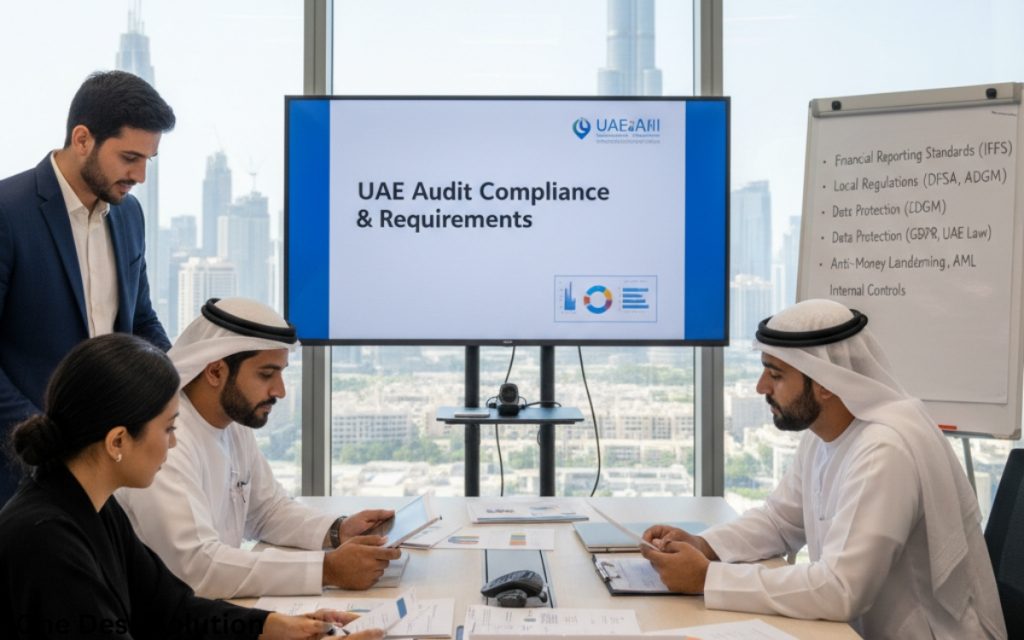
External Audit Engagement Process: Step-by-Step UAE 2026
An external audit isn't just a box-ticking exercise before license renewal — for most UAE companies, it's a legal requirement under the Commercial Companies Law, and increasingly a practical necessity for Corporate Tax filings, bank financing, and Qualifying Free Zone Person status. Yet many business owners only find out how the process actually works once their auditor is already asking for documents, which is exactly when delays start to bite.
The UAE audit engagement follows a structured, standards-based path: appointment and independence checks, planning and risk assessment, control evaluation, fieldwork, completion, and finally the auditor's formal opinion. Every stage is governed by International Standards on Auditing (ISA), and every audit firm must be registered with the UAE Ministry of Economy to issue a legally valid report. Understanding this sequence — and preparing for it — is what separates a smooth 4-6 week audit from one that drags on for months.
This guide walks through the complete external audit engagement process for 2026, who's actually required to have one, realistic timelines, what the different audit opinions mean, and the documents you should have ready before your auditor ever walks through the door. For a hands-on engagement with a Ministry-registered team, our audit and assurance services manage the full process for UAE mainland and free zone companies.
Need a Ministry-approved external audit for license renewal, tax filing, or bank financing? Let's get started.
1. What Is an External Audit in the UAE?
An external audit is an independent examination of a company's financial statements — balance sheet, income statement, cash flow statement, statement of changes in equity, and accompanying notes — carried out by a registered, unrelated audit firm. The auditor forms and expresses an opinion on whether the statements give a true and fair view under IFRS, following the International Standards on Auditing (ISA) issued by the IAASB. Crucially, the audit must be independent: an in-house bookkeeper or finance team member cannot sign the report, and the auditing firm must have no employment or ownership ties to the entity being audited.
2. Who Must Appoint an External Auditor
| Entity Type | Audit Requirement |
|---|---|
| Mainland LLCs & joint-stock companies | Mandatory annually under Federal Decree-Law No. 32 of 2021, regardless of size, employee count, or revenue |
| DMCC, DIFC, ADGM, JAFZA, RAKEZ companies | Mandatory annually regardless of revenue, under each free zone's own regulations |
| Other free zone companies | Often required only above a specific revenue threshold — confirm with your specific free zone authority |
| Any taxable person with revenue over AED 50 million | Mandatory to support Corporate Tax return, under Ministerial Decision No. 82 of 2023 |
| Companies claiming QFZP (0% rate) status | Audited financial statements generally required to support the claim |
| Banks & regulated financial institutions | Mandatory annually under Central Bank, DFSA, or FSRA rules, with regulator-approved auditors |
3. The External Audit Engagement Process: 7 Steps
- Auditor Selection & Engagement Letter Week 1Appoint a Ministry of Economy-registered auditor (verify their listing on the Working-Auditors Record). The auditor performs KYC/AML client-acceptance checks and assesses independence, then both parties sign an Engagement Letter covering scope, responsibilities, fees, and timeline.
- Planning & Risk Assessment 1-2 weeksThe auditor studies your industry, regulatory environment (mainland vs. free zone rules), and business structure, sets a materiality threshold, identifies significant risk areas, and designs a tailored audit strategy.
- Internal Control EvaluationThe auditor assesses the design and effectiveness of your key financial controls and IT systems. Strong controls mean a more efficient audit with less substantive testing; weaknesses are flagged early so management can address them.
- Fieldwork & Substantive Testing 2-4 weeksTransactions, account balances, and disclosures are tested through analytical procedures, sampling, and direct third-party confirmations with banks, debtors, and creditors. Physical asset and inventory verification typically still requires an on-site visit, even for hybrid/remote audits.
- Completion & Review 1-2 weeksThe auditor evaluates all evidence gathered, assesses going-concern status, reviews subsequent events after year-end, and obtains a signed management representation letter. Any material misstatements are discussed with management for adjustment.
- Audit Report IssuanceThe auditor issues the formal Auditor's Report under ISA 700, addressed to shareholders, expressing a clean, qualified, adverse, or disclaimer opinion — typically provided bilingually in Arabic and English.
- Regulatory SubmissionThe audited financial statements are submitted to the relevant licensing authority, presented to the bank where needed, and filed alongside the Corporate Tax return where applicable.
4. Typical Audit Timeline
5. Understanding Audit Opinions
| Opinion Type | What It Means |
|---|---|
| Unqualified (Clean) | Financial statements present a true and fair view in all material respects — no significant issues found |
| Qualified | Statements are fairly presented except for a specific, identified matter or limitation |
| Adverse | Statements do not present a true and fair view — material and pervasive misstatements exist |
| Disclaimer of Opinion | The auditor could not obtain sufficient evidence to form any opinion at all |
An audit doesn't guarantee zero errors — it reduces the risk of material misstatement through testing and professional judgement. Small errors below the materiality threshold are typically noted but not adjusted; material errors must be corrected, or they affect the final opinion.
6. Documents to Prepare Before Your Audit
- Trial balance and general ledger for the full financial year.
- Bank statements and reconciliations for all accounts.
- Sales and purchase invoices, plus supporting contracts.
- Fixed asset register and depreciation schedules.
- Payroll records and WPS payment reports.
- VAT returns and Corporate Tax filings for the period under audit.
- Related-party agreements including loans, leases, and shareholder transactions.
- Prior year audited financial statements, where available.
- Board resolutions and meeting minutes relevant to the period.
Keeping these records accurate and up to date throughout the year — not just before audit season — is what turns a stressful engagement into a routine one. Our accounting and bookkeeping services keep your books audit-ready year-round.
7. Common Causes of Audit Delays
- Incomplete or unreconciled bookkeeping discovered only once fieldwork begins.
- Missing supporting documents for large or unusual transactions.
- No designated contact person available to respond to auditor queries promptly.
- Undocumented related-party transactions requiring extra scrutiny.
- Physical inventory or asset verification not scheduled in advance.
8. How OneDesk Solution Can Help
A smooth audit starts long before the engagement letter is signed. OneDesk Solution supports UAE companies across the full cycle:
- Audit and assurance services — Ministry-registered, ISA-compliant external audits for mainland and free zone companies.
- Accounting and bookkeeping — year-round, audit-ready record keeping.
- Tax services — aligning your audited statements with Corporate Tax and VAT filings.
- Advisory and consultancy — internal control reviews to make future audits faster and smoother.
- Business setup services — structuring new entities with audit obligations planned in from day one.
Explore our complete range of solutions on the OneDesk Solution services page.
Avoid a rushed, delayed audit. Book your engagement early and keep your license renewal on track.
9. Frequently Asked Questions
Who is required to have an external audit in the UAE?
All mainland LLCs and joint-stock companies must be audited annually regardless of size, under the Commercial Companies Law. Free zones including DMCC, DIFC, ADGM, JAFZA, and RAKEZ also mandate annual audits, and any taxable person with revenue over AED 50 million must prepare audited statements to support their Corporate Tax return.
How long does an external audit take in the UAE?
A typical SME audit with clean, reconciled books takes about 4-6 weeks in total: 1-2 weeks for planning, 2-4 weeks for fieldwork, and 1-2 weeks for completion and report sign-off. Larger or more complex entities can take 2-3 months, and messy bookkeeping can extend this to 3 months or more.
What documents do I need to prepare for a UAE external audit?
Core documents include your trial balance, bank statements and reconciliations, sales and purchase invoices, fixed asset register, payroll and WPS records, VAT and Corporate Tax filings, related-party agreements, and prior year audited statements where available.
Can my in-house accountant or bookkeeper perform the external audit?
No. An external audit must be independent, conducted by a separate UAE-licensed audit firm registered with the Ministry of Economy, with no employment or ownership ties to your company. Your in-house team cannot sign the audit report.
What is the difference between a statutory audit and an internal audit in the UAE?
A statutory audit is external, legally mandated, and results in a published independent opinion used by regulators, banks, and shareholders. An internal audit is typically voluntary, can be conducted by in-house or outsourced staff, and focuses on evaluating and improving internal controls and operational efficiency rather than issuing a formal opinion.
10. Related Articles
Ready to schedule your external audit with a Ministry-registered team? Get in touch today.