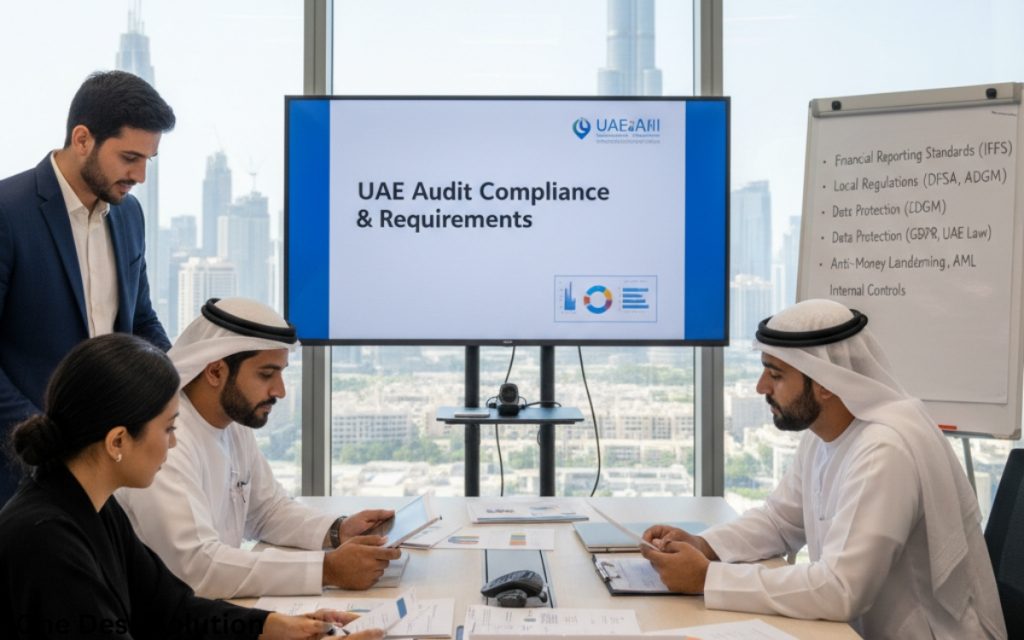
Insurance Company Audit:
Regulatory Requirements in UAE
The complete 2026 expert guide to UAE insurance company audit obligations — Insurance Authority requirements, IFRS 17, actuarial valuation, solvency margin, technical provisions, reinsurance auditing, and regulatory reporting.
UAE insurance companies operate in one of the most heavily regulated audit environments in the region — subject to dual regulatory oversight from the Central Bank of the UAE (CBUAE) (which assumed jurisdiction over the insurance sector following the Insurance Authority's merger in 2021), mandatory external audits under specific financial and actuarial standards, IFRS 17 insurance contract accounting (mandatory from 2023), quarterly and annual regulatory submissions with strict deadlines, mandatory solvency margin maintenance, and increasingly rigorous AML/CFT compliance requirements. Missing any of these obligations can trigger regulatory sanctions, licence suspension, or mandatory capital injections. This comprehensive 2026 guide covers every audit and regulatory compliance requirement for UAE-licensed insurance companies — the full regulatory framework, IFRS 17 audit implications, actuarial report requirements, solvency margin calculations, technical provisions auditing, reinsurance audit obligations, regulatory filing calendar, and how expert audit and advisory services help UAE insurance companies navigate this complex compliance landscape successfully.
🏛️1. UAE Insurance Regulatory Framework 2026
The UAE insurance sector underwent a significant regulatory restructuring in 2021 when the Insurance Authority (IA) was merged into the Central Bank of the UAE (CBUAE) under Federal Decree No. 25 of 2020. The CBUAE Insurance Supervision Department now serves as the primary prudential and conduct regulator for all UAE-licensed insurance companies, replacing the former IA framework with an enhanced, bank-equivalent supervisory approach.
The core legal framework for UAE insurance is established by Federal Law No. 6 of 2007 (as amended) and the extensive regulations, circulars, and resolutions issued thereunder — including the CBUAE Insurance Supervision Regulations, Board of Directors and Senior Management Requirements, Financial Regulations for Insurance Companies, and the specific IFRS 17 implementation guidance. Companies operating in the Dubai International Financial Centre (DIFC) are separately regulated by the Dubai Financial Services Authority (DFSA) under its own regulatory framework.
Understanding which regulatory authority governs your insurance company — and therefore which audit and reporting requirements apply — is the critical starting point. Mainland UAE insurance companies fall under CBUAE/ISA jurisdiction. DIFC-based insurance and reinsurance companies fall under DFSA jurisdiction. Each has distinct audit, capital, and reporting requirements.
| Regulatory Body | Jurisdiction | Key Laws / Regulations | Primary Audit Oversight |
|---|---|---|---|
| CBUAE (Insurance Supervision) | All mainland UAE-licensed insurers and reinsurers | Federal Law No. 6/2007; CBUAE Insurance Regs; Circular 49 | Annual statutory audit; quarterly regulatory returns; solvency margin reporting |
| DFSA | Insurance and reinsurance companies in DIFC | DFSA Rulebook — Insurance Business Module (IB) | Annual audit by DFSA-registered auditor; additional prudential returns |
| Abu Dhabi Global Market (ADGM) | Insurance companies in ADGM | FSRA Insurance Business Rules | FSRA-registered auditor; annual and interim reporting |
🏢2. Who Must Be Audited — UAE Insurance Entities
Life Insurance Companies
Full statutory audit + actuarial valuation of life liabilities + IFRS 17 GMM/PAA measurement
Non-Life / General Insurers
Statutory audit + technical provisions audit + claims reserves testing + IFRS 17 PAA/GMM
Reinsurance Companies
Enhanced audit scope including ceded/assumed business, retrocession, premium reserve auditing
Takaful Operators
Shariah compliance audit + participant fund / operator fund segregation + specific takaful actuarial requirements
Branches of Foreign Insurers
UAE branch statutory audit + parent company accounts coordination + local capital adequacy demonstration
Takaful-Specific Audit: Takaful companies in the UAE have additional audit requirements beyond standard insurance obligations. The Shariah Supervisory Board issues an annual Shariah compliance report that must be coordinated with the external audit. Participant funds (Tabarru funds) and the operator's own funds must be audited separately, and the allocation of surplus/deficit between participants and the operator must be verified against the Takaful model's terms and conditions.
📋3. Core Audit Requirements for UAE Insurance Companies
| Requirement | Legal Basis | Frequency | Submission Deadline |
|---|---|---|---|
| Annual Statutory Audit | Federal Law No. 6/2007 + CBUAE Regs | Annual | Within 3 months of financial year end |
| IFRS 17 Compliant Financial Statements | CBUAE + IASB IFRS 17 | Annual + quarterly | Annual: 3 months; Quarterly: 45 days after quarter end |
| Actuarial Valuation Report | CBUAE Financial Regulations for Insurers | Annual (minimum) | With or before statutory audit submission |
| Solvency Margin Certificate | CBUAE Insurance Regulations | Quarterly + Annual | Quarterly: 45 days; Annual: 3 months |
| Technical Provisions Report | CBUAE Financial Regulations | Quarterly + Annual | As part of solvency margin reporting |
| Auditor's Report on Internal Controls | CBUAE Corporate Governance for Insurers | Annual | With annual audited accounts |
| Anti-Money Laundering Audit | CBUAE AML/CFT Regulations | Annual | Annual — independent AML compliance review |
| Reinsurance Statement Audit | CBUAE Reinsurance Regulations | Annual | With statutory audit |
✅ Auditor Appointment Requirements
- Auditor must be licensed by the UAE Ministry of Economy (MoE audit licence) — this is the baseline requirement
- For CBUAE-regulated insurers — auditor must be registered on the CBUAE's approved insurance auditors list. This list is separate from general MoE licensing
- For DIFC-based insurers — auditor must be registered with the DFSA and on the DFSA's approved auditors list
- Auditor must have demonstrated insurance sector expertise — CBUAE expects insurance audit teams to include professionals with specific insurance accounting and actuarial awareness
- Auditor rotation requirements apply — the engagement partner must be rotated per CBUAE/IESBA rotation rules; check your engagement history
- Appointment approved by the Board of Directors and notified to CBUAE within the prescribed period
Need Insurance Sector Audit & Advisory Services?
OneDeskSolution provides specialist audit and assurance services for UAE-licensed insurance companies — IFRS 17-compliant financial audits, regulatory filing support, solvency margin review, and CBUAE-aligned compliance advisory. Contact us today.
📊4. IFRS 17 — Insurance Contracts Audit
IFRS 17 Insurance Contracts (effective 1 January 2023) replaced IFRS 4 and fundamentally changed how insurance contract revenue, liabilities, and performance are reported. For UAE insurance companies, the first full-year IFRS 17 audit (for 2023 year-end) was one of the most significant audit events in UAE insurance history — and the standard continues to create complex audit issues in 2026.
🔑 The Four Measurement Models Under IFRS 17
General Measurement Model (GMM / BBA)
The Building Block Approach — used for most insurance contracts. Three building blocks: fulfilment cash flows, risk adjustment, and contractual service margin (CSM). The CSM represents unearned profit released as service is provided over the coverage period.
Premium Allocation Approach (PAA)
Simplified model permitted for short-duration contracts (cover period ≤ 1 year, or immaterial difference). Most general/non-life insurance products qualify. Closer to previous IFRS 4 approach — reduces implementation complexity.
Variable Fee Approach (VFA)
Applies to direct participating contracts (with-profits life products, unit-linked) where policyholder shares in investment returns. The CSM adjusts for changes in the insurer's share of investment returns.
Reinsurance Contracts Held
Separate IFRS 17 measurement model for reinsurance purchased by cedents — recognises gains on onerous underlying contracts; specific disclosure requirements for proportional and non-proportional arrangements.
📋 IFRS 17 Audit Focus Areas for UAE Insurers
- Grouping of insurance contracts: Auditors test whether contracts are correctly grouped into cohorts (annual groups) and portfolios — improper grouping can significantly misstate CSM and P&L
- Fulfilment cash flows: Auditors challenge discount rates used, risk adjustment methodology, and cash flow projection assumptions — these involve significant management judgement
- Contractual Service Margin (CSM): Auditors verify CSM opening balance, current period adjustments (for changes in fulfilment cash flows relating to future service), and release rate to P&L (coverage units)
- Onerous contracts: Auditors test identification of loss component — does management identify all groups of contracts where fulfilment cash flows exceed premiums? Failure to recognise losses creates material misstatement risk
- PAA eligibility: Auditors verify that contracts measured under PAA actually qualify — the shortcut test of "coverage period ≤ 12 months" or "no significant variability in fulfilment cash flows"
- Discount rates: For GMM contracts, discount rates significantly affect the insurance liability — auditors examine whether the yield curve used reflects the characteristics of the insurance liabilities and is consistent with observable market data
- Risk adjustment methodology: IFRS 17 permits various techniques (confidence interval, VaR, CoV) — auditors assess whether the chosen method is appropriate and applied consistently
⚖️5. Solvency Margin & Capital Requirements
UAE insurance companies must maintain minimum solvency margins as prescribed by CBUAE regulations — these are the core financial soundness indicators that the regulator monitors most closely. Failure to maintain required solvency margins triggers mandatory regulatory intervention.
| Company Type | Minimum Paid-Up Capital | Solvency Margin Basis | Reporting Frequency |
|---|---|---|---|
| Life Insurance Company | AED 250 million | Greater of: minimum guarantee fund or % of mathematical reserves + risk capital | Quarterly + Annual audited |
| Non-Life Insurance Company | AED 250 million | Greater of: minimum guarantee fund or premium-based formula or claims-based formula | Quarterly + Annual audited |
| Reinsurance Company | AED 350 million | Higher thresholds than direct insurers; similar formula basis | Quarterly + Annual audited |
| Takaful Operator | AED 100 million (operator fund) | Separate solvency assessment for participant fund and operator fund | Quarterly + Annual audited |
| Branch of Foreign Insurer | AED 25 million (local deposit) | Net premium or claims formula applied to UAE branch business only | Quarterly + Annual |
📊 CBUAE Solvency Margin Audit — What Auditors Verify
- Admissible assets calculation — auditors verify which assets qualify for inclusion in the solvency calculation and at what value (not all IFRS assets are admissible at their full carrying value)
- Technical provisions adequacy — the solvency margin is computed net of technical provisions; overstated provisions overstate apparent solvency
- Reinsurance recoveries credit — reinsurance recoverables reduce net technical provisions but only to the extent approved; auditors verify recoverable amounts and reinsurer credit quality
- Mathematical reserves (life) — verified by the actuary but auditors consider reasonableness of actuarial report conclusions
- Investments at admissible values — regulatory admissible values often differ from IFRS fair values; auditors reconcile the two
🔢6. Technical Provisions Auditing
Technical provisions represent the most significant liability on a UAE insurer's balance sheet and the area with the greatest audit complexity and risk. They must be calculated on both an IFRS 17 basis (for financial reporting) and a regulatory basis (for solvency margin reporting) — and the two can differ significantly.
| Technical Provision Type | Description | Who Calculates? | Audit Approach |
|---|---|---|---|
| Unearned Premium Reserve (UPR) | Portion of written premium relating to unexpired risk — pro-rata time apportionment | Finance team (typically) | Recalculation testing on a sample of policies; tie to premium ledger |
| Claims Outstanding Reserve (OCR) | Best estimate of cost to settle all known reported claims at year end | Claims team / actuary | Test against claims file data; consider adequacy vs. historical development |
| Incurred But Not Reported (IBNR) | Estimated cost of claims incurred but not yet reported at year end | Actuary — required for most lines | Review actuarial methodology; test assumptions vs. data; consider alternative development patterns |
| Unexpired Risk Reserve (URR) | Additional provision where premium is insufficient to cover expected future losses from unexpired policies | Actuary | Test URR calculation; review loss ratio assumptions for unexpired policies |
| Mathematical Reserves (Life) | Present value of future policyholder benefits less future premiums — the core life insurance liability | Actuary — mandatory | Review actuarial report; assess appropriateness of valuation basis; test data quality |
| Loss Adjustment Expense Reserve | Costs expected to settle claims (legal fees, investigators, surveyors) | Finance / claims team | Test methodology; assess LAE ratio vs. industry benchmarks |
IBNR is the Highest Audit Risk: The Incurred But Not Reported reserve is typically the technical provision with the highest estimation uncertainty — and therefore the highest audit risk — in a UAE insurer's accounts. Auditors must engage an actuary (either the company's own or an independent "auditor's actuary") to review the IBNR methodology, test data quality, and provide an independent opinion on the reasonableness of management's estimate. IBNR underestimation is one of the most common causes of UAE insurance company financial restatements and regulatory interventions.
🔬7. Actuarial Valuation Requirements
| Requirement | Applies To | Frequency | Regulatory Submission |
|---|---|---|---|
| Appointed Actuary (Life) | All UAE life insurance companies | Annual minimum valuation | Annual Actuarial Report submitted to CBUAE with audited accounts |
| Actuarial Report (Non-Life IBNR) | All UAE non-life insurers with significant long-tail business | Annual minimum; recommended semi-annual | Report provided to auditors; summary in regulatory return |
| Loss Reserving Opinions | Large non-life insurers, reinsurers | Annual | Signed actuarial opinion on adequacy of reserves |
| IFRS 17 Actuarial Support | All IFRS 17 preparers (all UAE insurers) | Quarterly + Annual | Actuarial support for fulfilment cash flows, risk adjustment, CSM amortisation |
📋 Auditor Interaction with Actuarial Reports
- External auditors must review the actuarial report and assess whether the methodologies, assumptions, and data quality are appropriate — auditors cannot simply accept the actuarial report without critical evaluation
- For high-complexity IBNR or life reserves, auditors should consider engaging an auditor's actuary (independent actuary working for the audit firm) to provide an independent check on management's actuarial estimates
- Auditors must verify that the data provided to the actuary is complete, consistent with accounting records, and has not been modified between actuarial submission and accounts preparation
- Where actuarial estimates fall within an acceptable range, auditors must determine whether management has selected an appropriate point within that range — management should not consistently choose the optimistic end of the range without justification
🔄8. Reinsurance Audit Requirements
Reinsurance is integral to UAE insurance company financial statements and regulatory position — and its audit presents specific complexities around counterparty credit risk, accounting for ceded business, and coordination between cedent and reinsurer financial reporting timelines.
- Reinsurance assets adequacy: Auditors test whether reinsurance recoverables are stated at the correct amounts — verifying the ceded premium amounts, estimated claims recoveries, and ensuring amounts due from reinsurers are collectable (credit quality assessment)
- Reinsurance treaties compliance: Auditors verify that the company is operating within the terms of its reinsurance treaties — excess of loss limits, proportional arrangements, premium payment deadlines, and claims notification requirements
- Reinsurance premium accounting: Ceded premiums must be recognised in the correct period and at the correct amounts per the treaty terms — timing errors are common where reinsurance accounts are settled on a lagged basis
- Reinsurance counterparty credit risk: UAE regulations require reinsurers to meet minimum credit rating requirements. Auditors verify that all reinsurers used meet CBUAE minimum rating requirements and that any credit risk on unrated or sub-investment-grade reinsurers is appropriately provided for
- CBUAE reinsurance statement: The annual CBUAE regulatory return includes a detailed reinsurance statement — auditors verify this statement is consistent with the audited financial statements and accurately reflects all reinsurance arrangements
- Fronting arrangements: Where a UAE insurer fronts for a foreign reinsurer, special audit attention is required to the legal form vs. substance of the arrangement and the completeness of disclosure
🔒9. AML/CFT Compliance for UAE Insurers
Insurance companies are designated as financial institutions under UAE AML/CFT legislation — carrying full AML obligations including customer due diligence, suspicious transaction reporting, and staff training. CBUAE requires insurers to have independent AML audits and maintain documented AML frameworks.
- Annual independent AML audit: CBUAE requires insurance companies to arrange for an independent review of their AML/CFT compliance framework annually — typically by external auditors or an independent compliance specialist
- Customer Due Diligence (CDD): Verified for all policyholders at onboarding — enhanced due diligence for high-risk customers, PEPs (Politically Exposed Persons), and high-value life policies
- Sanctions screening: All policyholders, beneficial owners, and claims payees screened against UAE sanctions lists, UN sanctions lists, and OFAC — at inception and on an ongoing basis
- Suspicious Transaction Reports (STRs): Filed with UAE Financial Intelligence Unit (FIU) via goAML portal for any suspicion of money laundering — includes unusual large cash premium payments, early policy surrenders, and third-party premium payments
- UBO identification: Ultimate Beneficial Owners of corporate policyholders must be identified and documented per UAE UBO regulations
- AML training records: Annual AML training for all staff documented — auditors review training records as part of AML compliance assessment
Expert UAE Insurance Audit & Compliance Advisory
OneDeskSolution's audit team provides specialist insurance sector audit services — CBUAE-aligned statutory audits, IFRS 17 implementation review, solvency margin verification, technical provisions review, and AML compliance audit for UAE insurance companies. Contact us today.
📅10. UAE Insurance Regulatory Filing Calendar
| Filing | Deadline | Authority | Audit Involvement |
|---|---|---|---|
| Q1 Regulatory Return (Financial + Solvency) | 45 days after 31 March | CBUAE | Unaudited — management certification |
| Q2 Regulatory Return | 45 days after 30 June | CBUAE | Unaudited — management certification |
| Q3 Regulatory Return | 45 days after 30 September | CBUAE | Unaudited — management certification |
| Annual Audited Financial Statements (IFRS 17) | 3 months after financial year end | CBUAE | External auditor sign-off required |
| Annual Solvency Margin Certificate (audited) | 3 months after financial year end | CBUAE | Auditor certification required |
| Actuarial Valuation Report | With or before annual audit submission | CBUAE | Appointed Actuary's signed report |
| Annual Reinsurance Statement | With annual audited accounts | CBUAE | Auditor verification required |
| AML/CFT Annual Compliance Report | 3 months after year end | CBUAE | Independent review required |
| Investment Return / Asset Report | 45 days after each quarter end | CBUAE | Quarterly: management; Annual: audited |
✅11. Insurance Audit Preparation Checklist
- Engage CBUAE-approved auditor at least 3–4 months before financial year end
- Confirm actuarial firm engagement — both for IFRS 17 support and regulatory technical provisions
- IFRS 17 financial statements prepared: Insurance Service Result (revenue, incurred claims, insurance finance income/expense), Balance Sheet with insurance liabilities properly disaggregated
- Reconciliation of IFRS 17 insurance liabilities to prior year — movement analysis by portfolio and group
- CSM roll-forward schedule prepared for all GMM contract groups — showing opening balance, experience adjustments, changes in estimates, CSM release to P&L
- Technical provisions schedules completed: UPR, OCR, IBNR, URR, LAE reserves — by class of business
- Solvency margin calculation prepared — admissible assets schedule and technical provisions net of reinsurance
- Reinsurance statement prepared — all treaties, premium amounts, claims recoveries, reinsurer ratings verified
- Actuarial report obtained — signed by Appointed Actuary; data reconciliation confirmed
- Investment portfolio valuation confirmed — fair values for investment-grade securities, property, and other assets
- AML compliance documentation assembled — CDD files, training records, STR log, sanctions screening records
- Board minutes and Audit Committee papers compiled — including any material regulatory correspondence
- Prior year audit adjustments confirmed as implemented in current year accounts
- CBUAE regulatory return Q3 figures reconciled to opening balances for annual audit
❓12. Frequently Asked Questions
🔗13. Related Resources
Your Trusted UAE Insurance Audit & Advisory Partner
From IFRS 17-compliant statutory audits and solvency margin review to CBUAE regulatory filing support, technical provisions assessment, and AML compliance review — OneDeskSolution provides specialist audit and advisory services for UAE-licensed insurance companies. Contact us for a consultation today.