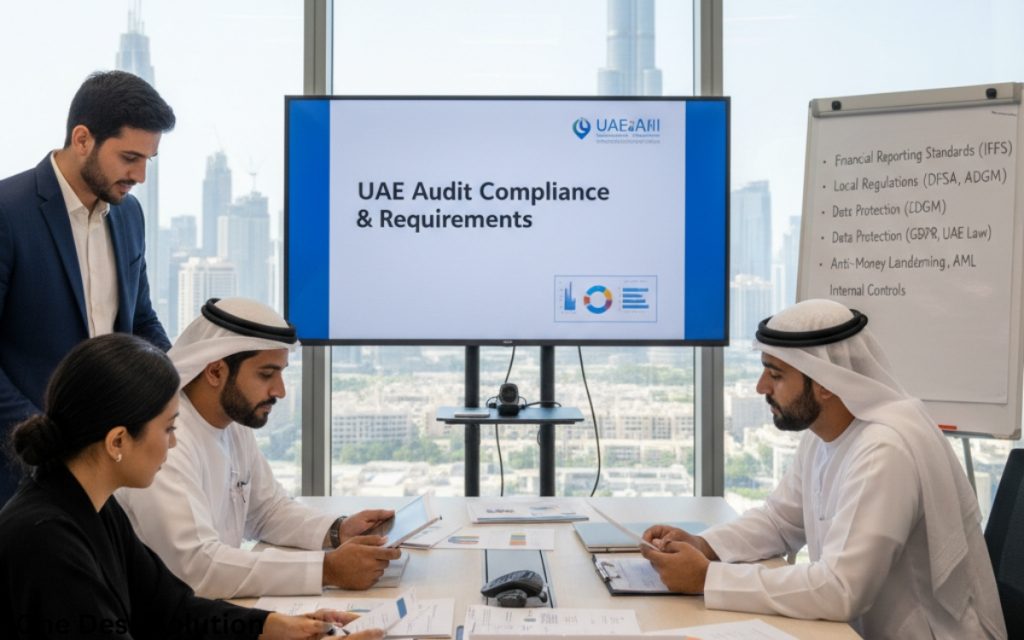
Internal Audit Implementation in UAE: Step-by-Step
Who Needs It, the New IIA 2026 Rules & the Right Reporting Lines
Quick Summary: Internal audit is mandatory for UAE banks, DFSA and FSRA-regulated firms, and listed companies — and since January 2024, the Securities and Commodities Authority's Corporate Governance Code has specifically required boards to maintain internal controls robust enough for the external auditor to opine on. The newest development lands almost immediately: the Institute of Internal Auditors' Third-Party Topical Requirement takes effect on 15 September 2026, extending internal audit's reach into vendor and outsourcing relationships. For private companies, it remains voluntary but increasingly expected by lenders and larger clients. This guide walks through exactly how to implement an internal audit function in a UAE organization, step by step, in 2026.
📋 Table of Contents
- Introduction to Internal Audit Implementation
- Internal Audit vs External Audit
- Who Needs an Internal Audit Function in the UAE?
- The Regulatory Landscape: SCA/CMA, CBUAE, DFSA & FSRA
- What's New for 2026: The IIA's Topical Requirements
- The Independence Principle: Reporting Lines
- In-House, Outsourced, or Co-Sourced
- Step-by-Step: Implementing Internal Audit
- Building the Internal Audit Charter
- Risk-Based Audit Planning
- Internal Audit Scope: What Gets Reviewed
- Internal Audit vs Audit Committee
- Quality Assurance: Keeping the Function Effective
- Cost of Internal Audit Implementation
- Common Mistakes to Avoid
- How One Desk Solution Can Help
- Frequently Asked Questions
- Related Resources
🛡️ Introduction to Internal Audit Implementation
Internal audit and external audit get confused constantly, and the confusion matters because the two serve completely different purposes. An external auditor delivers a once-a-year independent opinion on your financial statements to shareholders and regulators. Internal audit is an ongoing function that gives your board and audit committee continuous assurance that risks are actually being managed, controls actually work, and governance is actually sound — not a statutory sign-off, but a running diagnostic.
Whether you're required to have one depends entirely on what kind of entity you are. It's mandatory for UAE banks and financial institutions under Central Bank rules, required for firms regulated by the DFSA in the DIFC and the FSRA in ADGM, and expected of listed companies under the Securities and Commodities Authority's Corporate Governance Code — which, since a January 2024 amendment, specifically requires boards to maintain internal controls robust enough for the external auditor to form an opinion on their effectiveness. For private companies and SMEs, it's still voluntary, but it's the function that catches control gaps and fraud before they turn into real losses, and it's increasingly what lenders and larger clients expect to see.
This guide walks through exactly how to implement an internal audit function in a UAE organization, step by step, in 2026 — the regulatory drivers, the independence principle that makes or breaks the function, your sourcing options, and a genuinely new requirement from the Institute of Internal Auditors taking effect this September. If you'd rather have specialists set this up for you, our audit & assurance team implements internal audit functions for organizations across the UAE.
Ready to Build a Real Internal Audit Function?
Speak to our specialists for a free consultation on your risk profile, regulatory obligations, and the right sourcing model.
🔀 Internal Audit vs External Audit
| Aspect | Internal Audit | External Audit |
|---|---|---|
| Purpose | Ongoing assurance to the board/audit committee on risk, controls, and governance | Independent opinion on the financial statements, once a year |
| Who it reports to | Board/audit committee (functionally), for independence | Shareholders and regulators |
| Who performs it | In-house team, outsourced provider, or co-sourced arrangement | Must be a Ministry of Economy-registered audit firm |
| Frequency | Continuous, risk-based, throughout the year | Annual |
| Statutory requirement? | Depends on entity type and regulator | Generally yes, for most company structures |
For genuine independence, these two functions are usually delivered by different teams or firms — the same provider handling both creates a conflict that undermines the value of each.
👥 Who Needs an Internal Audit Function in the UAE?
- Mandatory: banks and financial institutions regulated by the Central Bank of the UAE.
- Mandatory: firms regulated by the DFSA (DIFC) or the FSRA (ADGM).
- Expected: listed companies on DFM/ADX under the SCA/CMA Corporate Governance Code.
- Voluntary but common: private LLCs with multiple shareholders, international parent companies with group governance requirements, or businesses seeking to satisfy lender or larger-client due diligence.
- Growth, control failures, regulatory scrutiny, and major system changes are the most common triggers for a private company to establish the function even without a formal mandate.
🏛️ The Regulatory Landscape: SCA/CMA, CBUAE, DFSA & FSRA
| Regulator | Applies To | Requirement |
|---|---|---|
| SCA / CMA (Capital Markets Authority) | UAE listed companies (DFM/ADX) | Corporate Governance Code expects an internal audit function; since January 2024, boards must maintain internal controls robust enough for the external auditor to opine on effectiveness |
| CBUAE (Central Bank of the UAE) | Banks and financial institutions | Mandatory independent internal audit function, qualified auditors, independent board/audit committee reporting line |
| DFSA | DIFC-regulated firms | Internal audit function required; outsourcing permitted if the provider meets DFSA competency and independence standards |
| FSRA | ADGM-regulated firms | Internal audit function required, scaled to business model and risk; in-house or outsourced |
🆕 What's New for 2026: The IIA's Topical Requirements
- The Institute of Internal Auditors' (IIA) International Standards remain the accepted global benchmark for internal audit quality, independence, planning, execution, and reporting — used across CBUAE-regulated banks, DIFC entities, and ADGM-licensed firms.
- A new Third-Party Topical Requirement takes effect on 15 September 2026, extending internal audit's scope specifically into third-party relationships — technology providers, payment processors, distributors, contractors, logistics partners, and outsourced functions.
- This means internal audit assurance now needs to consider third-party due diligence, contracting, ongoing monitoring, access controls, incident management, business continuity, and exit arrangements — not just the organization's own internal processes.
- Organizations with an existing internal audit function should reassess their methodology and audit plan against this new requirement; those without one yet should build it in from the start.
⚖️ The Independence Principle: Reporting Lines
The Reporting Structure That Actually Creates Independence
The solid functional line to the board/audit committee is what creates real independence — the dotted administrative line to management is for day-to-day logistics only.
- The internal auditor should report functionally to the board or audit committee — not to management — regardless of who employs or contracts them.
- This reporting line is what actually makes internal audit independent; an internal auditor reporting to the CFO or CEO on matters that concern their own decisions has a structural conflict.
- Regulators (DFSA, FSRA) explicitly recognize outsourced internal audit as acceptable, provided the external provider is independent and meets the relevant competency standards.
🔧 In-House, Outsourced, or Co-Sourced
| Model | Description | Best For |
|---|---|---|
| In-House | A dedicated internal audit team employed directly by the organization | Larger organizations with the scale to justify a full-time function |
| Outsourced | An external, independent provider delivers the entire internal audit function | Smaller or mid-size firms, or those needing specialist regulatory expertise |
| Co-Sourced | An internal audit lead supplemented by external specialists for specific reviews (IT, third-party risk, fraud) | Organizations wanting internal ownership with access to specialist skills as needed |
🧭 Step-by-Step: Implementing Internal Audit
Secure Board/Audit Committee Sponsorship
Internal audit needs genuine top-level backing to be effective, not just a policy on paper.
Draft & Approve the Internal Audit Charter
Defining the function's purpose, authority, independence, and reporting line.
Conduct a Risk Assessment
Mapping the organization's key risks across finance, operations, compliance, technology, and third-party relationships.
Build the Audit Universe
A comprehensive list of everything that could potentially be audited, prioritized by risk.
Develop the Annual Risk-Based Audit Plan
Selecting which areas to review, in what order, based on the risk assessment.
Choose Your Sourcing Model
In-house, outsourced, or co-sourced, based on scale and specialist needs.
Confirm the Reporting Line
Functionally to the board/audit committee, administratively to management.
Execute the First Audits
Following IIA International Standards methodology.
Report Findings with Owned, Time-Bound Actions
Every finding needs a named owner and a deadline.
Track Remediation to Closure
Independently verifying that agreed actions are actually completed.
Establish a Quality Assurance Programme
Periodically reviewing the internal audit function's own effectiveness.
📜 Building the Internal Audit Charter
- The charter is the founding document — it defines the internal audit function's purpose, authority, and responsibility.
- It should explicitly state the function's independence, its reporting line to the board/audit committee, and its right of access to records, personnel, and physical property relevant to any review.
- Approved formally by the board or audit committee, and reviewed periodically to stay current as the organization and its risks evolve.
📊 Risk-Based Audit Planning
- Internal audit resources should be allocated based on genuine risk, not just historical habit or convenience.
- The annual audit plan should be revisited during the year as new risks emerge — a risk-based plan set once a year and never revisited defeats the purpose.
- High-risk areas (financial controls, fraud exposure, regulatory compliance, and now third-party relationships under the new IIA requirement) typically warrant more frequent or deeper review.
🔍 Internal Audit Scope: What Gets Reviewed
- Finance and financial controls
- Procurement and vendor management
- Inventory and asset management
- Payroll
- Regulatory and AML/compliance
- Technology and cybersecurity
- Fraud risk
- Business continuity
- Third-party and outsourcing relationships (now explicitly covered under the IIA's 2026 Topical Requirement)
🤝 Internal Audit vs Audit Committee
- The audit committee is a board sub-committee responsible for overseeing financial reporting, internal controls, and both external and internal audit — it's the governance body internal audit reports to.
- Under SCA/CMA rules, audit committees are mandatory for public JSCs listed on DFM/ADX, requiring at least three independent directors.
- See our companion guide on audit committee formation requirements for UAE companies for the full detail on composition, responsibilities, and meeting obligations.
- Internal audit and the audit committee work together: internal audit executes the reviews, the committee provides oversight, challenge, and escalation to the full board where needed.
✅ Quality Assurance: Keeping the Function Effective
- The internal audit function itself should be periodically reviewed for effectiveness — not just the areas it audits.
- IIA standards call for both ongoing internal monitoring and periodic external quality assessments of the internal audit function.
- This keeps the function credible and prevents it from becoming a box-ticking exercise over time.
💰 Cost of Internal Audit Implementation
| Model | Typical Annual Cost (AED) |
|---|---|
| Outsourced internal audit (SME/mid-size) | 30,000 – 80,000 |
| Co-sourced internal audit (internal lead + specialist support) | 60,000 – 150,000 |
| In-house internal audit function (small dedicated team) | 250,000+ (salary-driven) |
For a full breakdown of audit pricing drivers across UAE industries, see our Guide to Audit Costs and Fees in Dubai.
⚠️ Common Mistakes to Avoid
- Setting up internal audit without genuine board/audit committee sponsorship, so findings get quietly ignored.
- Allowing the internal auditor to report to the CFO or CEO instead of the board/audit committee, undermining independence from day one.
- Writing an audit plan once a year and never revisiting it as new risks emerge.
- Treating internal audit as a compliance checkbox rather than a genuine risk-management tool.
- Overlooking third-party and outsourcing relationships in the audit scope, now a specific gap under the IIA's 2026 requirement.
- Not tracking findings through to actual closure, so the same issues resurface audit after audit.
💼 How One Desk Solution Can Help
Implementing internal audit correctly means getting the charter, reporting lines, and risk-based plan right from day one — not retrofitting independence after the fact. Our audit and assurance services team designs and delivers internal audit functions — in-house, outsourced, or co-sourced — aligned with IIA standards and your specific regulator, supported by our advisory & consultancy services for governance structuring, our accounting & bookkeeping services for the underlying financial records, and our tax services team for related compliance. Explore our full range on the services page.
❓ Frequently Asked Questions
Q1: Is internal audit mandatory for private companies in the UAE?
Generally, no — for private LLCs and SMEs, internal audit remains voluntary. It's mandatory, however, for banks and financial institutions under Central Bank of the UAE rules, for firms regulated by the DFSA in the DIFC or the FSRA in ADGM, and expected of listed companies under the SCA/CMA Corporate Governance Code. Many private companies still choose to implement internal audit voluntarily, particularly where there are multiple shareholders, an international parent company with group governance requirements, or lenders and larger clients expecting to see it.
Q2: What is the difference between internal audit and an audit committee?
They're related but distinct. The audit committee is a board sub-committee that oversees financial reporting, internal controls, and both the internal and external audit functions — it's a governance body made up of directors. Internal audit is the operational function that actually performs risk-based reviews across the organization and reports its findings to the audit committee. Under SCA/CMA rules, audit committees are mandatory for public JSCs listed on DFM/ADX and require at least three independent directors.
Q3: Can internal audit be outsourced in the UAE?
Yes, and both the DFSA and FSRA explicitly permit it for regulated firms, provided the external provider is independent and meets the relevant competency standards. Outsourcing is a common choice for smaller or mid-size organizations that don't have the scale to justify a full-time in-house team, and a co-sourced model — combining an internal lead with external specialist support — is also widely used.
Q4: What is the new IIA Third-Party Topical Requirement effective September 2026?
It's a new requirement from the Institute of Internal Auditors, taking effect on 15 September 2026, that extends internal audit's scope specifically into an organization's third-party relationships — technology providers, payment processors, distributors, contractors, logistics partners, and outsourced functions. It means internal audit assurance now needs to cover third-party due diligence, contracting, ongoing monitoring, access controls, incident management, business continuity, and exit arrangements, not just internal processes.
Q5: Who should the internal auditor report to for genuine independence?
The internal auditor should report functionally to the board or audit committee, not to management, regardless of whether the function is in-house or outsourced. This reporting line is what actually creates independence — an internal auditor reporting to the CFO or CEO on matters that concern their own decisions has a structural conflict of interest that undermines the value of the function.
🔗 Related Resources
The governance body internal audit reports to — full composition and duty details.
A full breakdown of audit pricing drivers across UAE industries.
See how sector-specific external audit needs differ from internal audit.
A practical UAE governance question relevant to reporting-line design.
Explore setup requirements for another operationally complex UAE sector.
Relevant for firms building technology-risk internal audit capability.
Another practical UAE compliance question, clearly explained.
Relevant groundwork for building an in-house internal audit team.
Build an Internal Audit Function That Actually Works
From the charter and reporting lines to the first risk-based audit plan, One Desk Solution implements internal audit functions built for UAE regulatory reality.