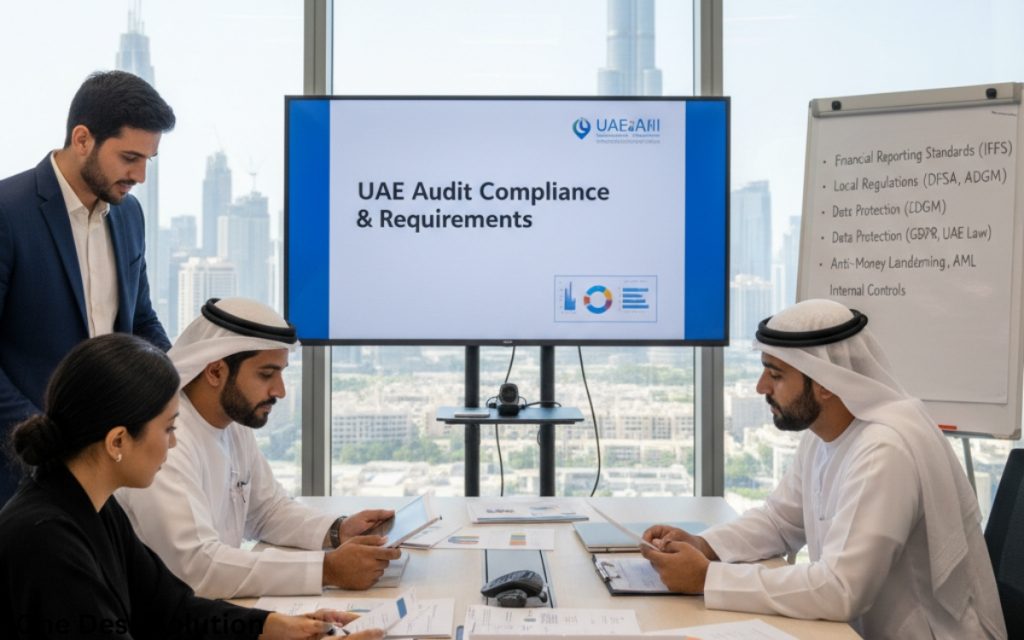
Audit Services for Hotel & Resort Chains in the UAE
From statutory financial audits to internal controls and VAT compliance — your authoritative guide to professional audit services for UAE's thriving hospitality sector.
The UAE hospitality industry — home to some of the world's most prestigious hotels and resort chains — operates under a rigorous compliance framework that demands professional, sector-specific audit services to meet statutory, tax, and operational requirements in 2026.
Hotel and resort chains in the UAE must navigate statutory audit obligations, UAE Corporate Tax filings, VAT compliance, tourism dirham reporting, related-party transactions, and internal control audits — all simultaneously and to a high standard expected by international brands, investors, and regulators.
This comprehensive guide explains every audit dimension relevant to UAE hotel chains — from the types of audit required to industry-specific risk areas, the audit process timeline, and critical compliance checkpoints for 2026.
OneDeskSolution provides tailored audit and assurance services for hotel groups, resort chains, and hospitality businesses across Dubai, Abu Dhabi, Ras Al Khaimah, and all UAE emirates — delivering audit-ready financials that satisfy brand standards, investors, and the FTA.
1. UAE Hotel Industry — Why Auditing Is Mission-Critical
The UAE is one of the world's premier hospitality destinations, home to more than 1,200 hotels and hotel apartments across its seven emirates, generating billions of dirhams in annual revenue. With Dubai consistently ranking among the world's top-five most visited cities and Abu Dhabi and Ras Al Khaimah rapidly growing as resort destinations, the UAE hospitality sector attracts significant domestic, regional, and international investment.
For hotel and resort chains, professional auditing is not simply a regulatory box-tick — it is a strategic business imperative. International brand operators (Marriott, Hilton, IHG, Rotana, Accor, etc.) require annual audited financial statements as a condition of management agreements. UAE commercial law mandates statutory audits for all registered companies. And since the introduction of UAE Corporate Tax (CT) in 2023, hotels are now subject to an additional layer of tax-related financial scrutiny.
Beyond compliance, a thorough audit provides hotel management with reliable financial data to make informed decisions on pricing strategy, department profitability, capital expenditure, and expansion planning — data that is only trustworthy when produced under rigorous audit standards.
- 🏨 Brand Operator Requirements: International hotel management agreements universally require audited financial statements — non-compliance can trigger agreement termination or dispute.
- ⚖ UAE Commercial Companies Law: All UAE-registered hotels are legally required to appoint a licensed UAE auditor and submit audited financial statements annually.
- 🏛 FTA Tax Compliance: UAE Corporate Tax and VAT obligations both require supporting audited accounts — errors in these can trigger FTA audits, penalties, and reputational damage.
- 💼 Investor & Lender Confidence: Banks financing hotel construction or expansion, and equity investors in hotel real estate investment trusts (REITs), require independently audited financials before advancing or continuing funding.
- 🔍 Operational Fraud Detection: Hotels handle high volumes of cash, perishables, and inventory — making them particularly susceptible to fraud, pilferage, and revenue leakage without robust internal audit controls.
Does Your Hotel Chain Have Audit-Ready Financials?
OneDeskSolution's specialist audit team delivers statutory, internal, VAT, and Corporate Tax audit services tailored specifically for UAE hotel and resort operations. Let's make your next audit seamless.
2. Types of Audit Services for Hotel & Resort Chains
UAE hotel and resort chains typically require several distinct but complementary types of audit engagements throughout the year:
| Audit Type | Purpose | Frequency | Mandatory? |
|---|---|---|---|
| Statutory / External Audit | Independent opinion on financial statements; required by UAE law | Annual | Mandatory |
| Internal Audit | Evaluate operational controls, fraud risks, and departmental efficiency | Quarterly / Ongoing | Recommended |
| VAT Compliance Audit | Verify correctness of VAT treatment, filing accuracy, input tax recovery | Annual or Pre-FTA Inspection | Highly Recommended |
| Corporate Tax Audit Support | Verify CT return accuracy, deductions, related-party compliance | Annual | Mandatory (CT Registered) |
| Revenue Audit | Verify room revenue, F&B income, ancillary revenue integrity | Monthly / Annual | Recommended |
| Procurement / Cost Audit | Detect overpricing, supplier fraud, unapproved purchases | Quarterly | Recommended |
| Brand / Management Fee Audit | Verify base management fees and incentive fee calculations per HMA | Annual | Per HMA Terms |
| Payroll Audit | Validate payroll accuracy, ghost employees, WPS compliance | Annual / Semi-Annual | Recommended |
| Tourism Dirham Audit | Verify correct collection and remittance of Tourism Dirham fees | Annual | Emirate-Specific |
| Sustainability / ESG Reporting Audit | Verify ESG disclosures for institutional investors and brand standards | Annual | Emerging Requirement |
3. Key Numbers: UAE Hospitality Sector at a Glance
* Bar length reflects audit complexity/risk level for that revenue stream. Percentage shows typical share of total revenue.
4. Statutory Audit Requirements for UAE Hotels
Every hotel company registered in the UAE — whether a mainland LLC, a PJSC, a free zone company, or a branch of a foreign company — is legally required under Federal Law No. 32 of 2021 (Commercial Companies Law) to have its annual financial statements audited by a licensed UAE auditor.
📋 What Statutory Audit Covers
- Balance sheet & equity positions
- Income statement (P&L by department)
- Cash flow statement
- Notes to financial statements
- Related-party transaction disclosures
- Going concern assessment
- Compliance with IFRS or UAE GAAP
- Auditor's independent opinion
✅ Who Must Be Appointed
- UAE Ministry of Economy licensed auditor
- Member of UAE Accountants & Auditors Association (AAA)
- For large hotels: Big 4 or top-tier regional firms
- For free zone entities: JAFZA, DMCC, DIFC-approved auditors
- Auditor must be independent of management
- Annual rotation recommended (mandatory for some entity types)
- Engagement letter required before work commences
Accounting Standards for UAE Hotels
UAE hotel financial statements are typically prepared under International Financial Reporting Standards (IFRS), with specific attention to:
| IFRS Standard | Relevance to Hotel Accounting |
|---|---|
| IFRS 15 | Revenue recognition — loyalty points, advance bookings, package deals, management fees |
| IFRS 16 | Lease accounting — hotel properties leased from property owners, equipment leases |
| IAS 16 | Property, plant & equipment — hotel buildings, FF&E (furniture, fixtures & equipment) |
| IAS 36 | Impairment of assets — particularly relevant for hotels with COVID-19 aftermath or market shifts |
| IAS 19 | Employee benefits — gratuity, annual leave, bonus accruals for hotel staff |
| IFRS 9 | Financial instruments — hotel group treasury, intercompany loans, foreign exchange |
| IAS 2 | Inventories — F&B stock, minibar, spa products, guest amenities |
5. Internal Audit & Controls for Hotel Operations
For hotel and resort chains, internal audit is often more operationally impactful than the statutory audit. A well-run hotel internal audit programme directly protects revenue, reduces costs, and identifies process failures before they escalate into financial losses or compliance breaches.
Key Internal Audit Focus Areas in Hotels
- 🛏 Night Audit Process: Verify that daily room revenue is correctly posted, all departures are settled, no-shows are charged, and the daily revenue report ties to the PMS (Property Management System) — this is the heartbeat of hotel internal controls.
- 🍽 F&B Revenue & Cost Controls: Audit menu pricing accuracy, point-of-sale (POS) system reconciliation, wastage reports, void and discount approvals, and kitchen cost vs. menu engineering profitability.
- 🛒 Procurement & Receiving: Verify purchase orders match delivery notes and supplier invoices, check for vendor collusion, price variance from approved supplier lists, and unauthorized purchasing.
- 💳 Cash & POS Reconciliation: Daily reconciliation of front desk cash, F&B outlet POS, spa, parking, and gift shop — with supervisor approval for discrepancies and management review of voids.
- 👤 Payroll & Ghost Employees: Cross-reference payroll rosters against HR records and WPS submissions, verify shift schedules for housekeeping and part-time staff, and review commission payments for sales teams.
- 🔑 IT & System Access Controls: Review PMS, POS, and ERP system access rights, segregation of duties, deletion/amendment logs, and cybersecurity controls for guest data (PCI-DSS compliance for card payments).
- 🏊 Fixed Asset & FF&E Verification: Physical verification of hotel furniture, fixtures and equipment against the asset register, tracking disposals, and ensuring capital vs. revenue expenditure is correctly classified.
Best practice for UAE hotels with annual revenue above AED 20 million is to conduct formal internal audit reviews quarterly, with daily/weekly operational controls embedded in departmental procedures. Hotels operating under international management agreements (IMA) are typically required by the brand operator to maintain internal audit programmes as a contractual obligation.
6. VAT Compliance Audit for Hotels in UAE
Hotels in the UAE are among the most complex VAT environments — dealing with multiple revenue streams, international guests, zero-rated supplies, exempt services, and the Tourism Dirham — all within a single property's billing system.
| Hotel Revenue / Service | VAT Treatment | Rate | Common Error |
|---|---|---|---|
| Room Accommodation (UAE guests) | Standard Rated | 5% | Confusing tourism dirham with VAT |
| Room Accommodation (Export — qualifying) | Zero Rated | 0% | Incorrectly applying 5% to foreign business travelers |
| Food & Beverage Sales | Standard Rated | 5% | VAT on complimentary F&B not properly handled |
| Spa & Wellness Services | Standard Rated | 5% | Medical/therapeutic services misclassified |
| Meeting Room Hire (MICE) | Standard Rated | 5% | International event packages incorrectly rated |
| Tourism Dirham (Dubai/Abu Dhabi) | Outside Scope | N/A | Tourism Dirham included in VAT-taxable base |
| Loyalty Points Redemption | Complex | Varies | VAT on points redemption not correctly timed |
| Management Fee Income (Operator) | Standard Rated | 5% | Incentive fee VAT treatment inconsistency |
| Interest / Financial Income | Exempt | 0% | Impacts partial exemption input VAT recovery |
| Sale of Hotel Property | Complex | 5% or Zero | Going concern transfer rules not applied |
The Tourism Dirham (collected in Dubai, Abu Dhabi, and other emirates) is not a tax — it is a government fee collected on behalf of the Department of Tourism. It must never be included in the VAT-taxable base when calculating output VAT. Many hotels incorrectly charge 5% VAT on the Tourism Dirham component, which constitutes a VAT overpayment that distorts returns and creates reconciliation errors. A VAT compliance audit will identify and correct this.
7. UAE Corporate Tax Audit Considerations for Hotels 2026
Since the UAE Corporate Tax regime became effective for most businesses from June 2023, hotel and resort chains are subject to a 9% CT rate on taxable income exceeding AED 375,000. For large hotel chains, CT compliance introduces significant audit complexity.
| CT Topic | Implication for UAE Hotels | Audit Risk Level |
|---|---|---|
| Revenue Recognition Timing | Advance bookings, loyalty programme revenue, and package deals must follow IFRS 15 for CT purposes | High |
| Management Fee Deductibility | Fees paid to international brand operators must be arm's-length; transfer pricing documentation required | High |
| IFRS 16 Lease Adjustments | Right-of-use assets and lease liabilities under IFRS 16 require CT-specific adjustments in calculating taxable income | Medium-High |
| FF&E Depreciation | Hotel furniture, fixtures & equipment typically have 5–7 year lives — depreciation rates for CT must align with IFRS or approved CT depreciation schedules | Medium |
| Interest Limitation (EBITDA Cap) | Hotels with significant renovation or expansion financing may trigger the 30% EBITDA cap on net interest deductibility | High |
| Intercompany Charges | Shared service costs, group insurance, IT charges from parent or regional HQ must be documented on arm's-length basis | High |
| Free Zone Hotels | Hotels in JAFZA, DMCC, or DIFC may qualify for 0% CT on qualifying income — but direct UAE customer revenue requires careful analysis | Medium-High |
| Tax Loss Carry-Forward | Hotels with post-pandemic losses may carry forward up to 75% of taxable income in future years — proper documentation is essential | Medium |
One of the highest-risk CT areas for international hotel chains is the deductibility of management fees, technical services fees, and royalties paid to international brand operators. The UAE CT law requires these to be at arm's length. Hotels in groups with revenue above AED 200 million must maintain a local file and, above AED 3.15 billion, a master file as part of transfer pricing documentation. Our audit team assesses and supports full transfer pricing documentation for hotel management agreements.
8. High-Risk Audit Areas Specific to Hotel Chains
Hotels present unique audit risk profiles that differ substantially from other industries. Here are the areas our audit team focuses on most intensively for UAE hotel clients:
- 🚨 Revenue Leakage at POS: Walk-in guests, cash F&B transactions, and spa bookings are high-leakage points. Unauthorized discounts, voids without approval, and unposted charges directly erode revenue and taxable income.
- 🚨 Complimentary & Discount Authorisation: Complementary rooms, food discounts, and loyalty upgrades must have documented approval trails — undocumented complimentaries are a recurring audit finding and can indicate management abuse.
- 🚨 Procurement Fraud: Collusion between purchasing staff and vendors — including inflated invoices, kickbacks, and unauthorized supplier substitutions — is a documented risk in hotel F&B and engineering departments.
- ⚠ Inventory Shrinkage: F&B inventory, minibar stock, spa products, and guest amenities are subject to shrinkage — audits should verify that cycle counts are conducted, wastage is approved, and variance reports reviewed monthly.
- ⚠ Third-Party OTA Commissions: Online Travel Agency (OTA) commissions (Booking.com, Expedia, etc.) must be properly accrued, reconciled to actual bookings received, and matched to remittance statements — overpayments and double-billing are common.
- ⚠ Guest Deposit & Advance Payment Management: Advance deposits received for future bookings must be treated as deferred revenue — recognising them immediately inflates current period income and distorts VAT and CT calculations.
- ⚠ FF&E Reserve Funds: Most hotel management agreements require a FF&E Reserve (typically 3–5% of gross revenue) held for capital refurbishment. Audit must verify correct contribution, segregation, and deployment of these funds per HMA terms.
9. The Hotel Audit Process — Step by Step
Understanding what to expect from a professional hotel audit helps management prepare effectively and minimise disruption to operations. Here is OneDeskSolution's structured audit process for UAE hotel and resort clients:
10. Auditing Multi-Property & International Hotel Groups
Hotel and resort chains with multiple properties across UAE emirates — or internationally — require a coordinated audit approach that goes beyond a single-entity statutory audit.
🌐 Group Consolidation Audit
- Consolidate financials across all UAE entities
- Eliminate intercompany transactions
- Uniform accounting policy application
- Group CT return preparation support
- Transfer pricing documentation review
- Minority interest/JV accounting
- Consolidation adjustments and goodwill
🏨 Multi-Property Considerations
- Separate legal entity audits per property
- Shared service centre cost allocation
- Central procurement/treasury audit
- Management fee audit (owner vs. operator)
- FF&E Reserve fund audit per property
- Brand royalty and technical fee review
- Franchise agreement compliance testing
In UAE hotels operating under Hotel Management Agreements (HMAs), the property owner and the brand operator maintain separate financial interests. Owners require an annual audit to verify that management fees, incentive fees, and FF&E reserves have been correctly calculated per the HMA terms. Many UAE hotel owners engage independent auditors specifically to audit the operator's fee calculations — separate from the statutory audit — and this is a service OneDeskSolution provides.
11. Pre-Audit Readiness Checklist for UAE Hotels
Being audit-ready reduces time, cost, and disruption. Use this checklist to prepare your hotel for the annual statutory and compliance audit:
| # | Preparation Task | Department | Status Check |
|---|---|---|---|
| 1 | Trial balance reconciled to PMS / ERP system | Finance | Critical |
| 2 | All bank accounts reconciled — no unreconciled items older than 30 days | Finance | Critical |
| 3 | Accounts receivable aging prepared — city ledger, OTA, corporate accounts | Finance / Reservations | Critical |
| 4 | Fixed asset register updated — additions, disposals, depreciation current | Finance / Engineering | Critical |
| 5 | Inventory count completed — F&B, spa, housekeeping, engineering stores | F&B / Stores | Critical |
| 6 | All VAT returns filed and reconciled to revenue records | Finance / Tax | Critical |
| 7 | Tourism Dirham remittances reconciled and paid to date | Finance | High |
| 8 | Payroll records and WPS submissions verified for full year | HR / Finance | Critical |
| 9 | End-of-service gratuity accruals calculated and agreed to staff records | HR / Finance | Critical |
| 10 | Management fee calculations prepared and agreed to HMA schedule | Finance / GM | High |
| 11 | All intercompany balances confirmed and reconciled with related parties | Finance / Group | High |
| 12 | Advance deposits and deferred revenue schedule prepared | Finance / Reservations | High |
| 13 | Corporate Tax computation draft prepared with prior year comparison | Finance / Tax Advisor | Critical |
| 14 | Prior year audit management letter — all action points addressed | Finance / Management | High |
Ready for a Seamless Hotel Audit in 2026?
OneDeskSolution delivers expert audit, accounting, tax, and advisory services to UAE hotel and resort chains of all sizes — from boutique properties to large international-branded multi-property groups. Get in touch today for a tailored audit proposal.
12. Frequently Asked Questions (FAQs)
These are the top questions being searched on Google, ChatGPT, Claude, Perplexity, and DeepSeek by UAE hotel owners, financial controllers, and general managers:
13. Related Articles & Resources
Explore these additional guides from OneDeskSolution to support your UAE compliance and business advisory needs:
Disclaimer: This article is provided for general informational purposes only and does not constitute professional audit, accounting, tax, or legal advice. UAE laws and regulations are subject to change. Always engage a licensed UAE auditor or tax advisor for guidance specific to your hotel or resort business.
© 2026 OneDeskSolution — UAE Audit, Accounting, Tax & Advisory Services | 📞 +971-52 797 1228 | 💬 WhatsApp