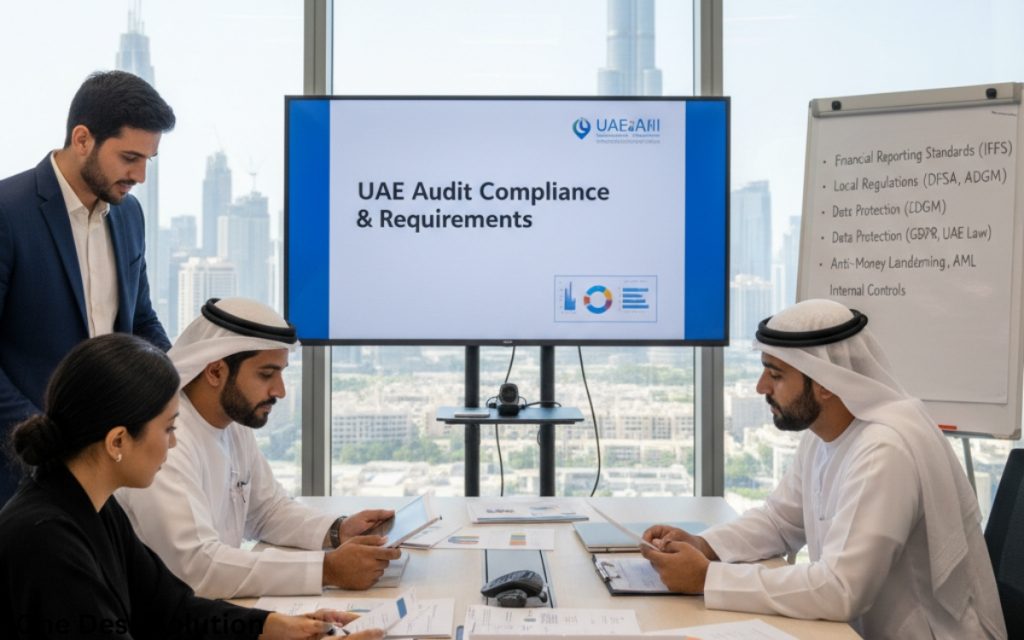
External Audit Services Dubai 2026
Your definitive guide to external auditing in Dubai — legal requirements, the audit process, free zone vs mainland rules, corporate tax links, costs, and how to choose the right audit firm for your business.
By OneDeskSolution Audit Experts | Updated: June 2026 | 15 min read
External audits are no longer optional for most businesses operating in Dubai in 2026. With UAE Corporate Tax now fully embedded in the compliance landscape, mandatory free zone audit requirements, and an FTA that cross-references audited financial statements with tax returns, having a credible, independent external auditor has become a fundamental business necessity — not a box-ticking exercise. This in-depth guide explains exactly what an external audit is, who needs one, what the legal framework requires, how the audit process works, what it costs, and why choosing the right audit partner in Dubai is one of the most important compliance decisions your business will make this year.
- What is an External Audit? Overview for Dubai Businesses
- Legal Requirements: Who Must Have an External Audit in UAE 2026?
- External Audit vs Internal Audit — Key Differences
- What Do External Auditors Examine in Dubai?
- The External Audit Process — Step by Step
- Free Zone External Audit Requirements 2026
- External Audit & UAE Corporate Tax — The Critical Link
- External Audit Costs & Timelines in Dubai
- How to Choose the Right External Audit Firm in Dubai
- Why OneDeskSolution for Your Dubai External Audit?
- Frequently Asked Questions
- Related Expert Resources
1. What is an External Audit? Overview for Dubai Businesses
An external audit is an independent, objective examination of a company's financial statements — conducted by a qualified, licensed auditor who is entirely independent of the company being audited. The external auditor's role is to form and express a professional opinion on whether the financial statements present a true and fair view of the company's financial position and performance, and whether they comply with the applicable accounting standards (typically IFRS — International Financial Reporting Standards in the UAE).
Unlike an internal audit — which is conducted by employees or consultants working within the company — an external auditor has no employment relationship, financial interest, or other connection to the business. This independence is the cornerstone of the external audit's credibility. Stakeholders — including banks, investors, regulators, free zone authorities, and the Federal Tax Authority — rely on externally audited financial statements precisely because the opinion comes from an unconnected third party whose professional reputation depends on getting it right.
In Dubai's business environment in 2026, the external audit has taken on additional significance. The introduction of UAE Corporate Tax has created a direct linkage between audited financial statements and tax returns — with the FTA expecting businesses to base their CT computations on IFRS-compliant audited accounts. Free zone authorities have simultaneously tightened their annual audit submission requirements. The result is that the quality and timeliness of your external audit now has a direct bearing on your corporate tax compliance and your standing with your licensing authority.
Need a Reliable External Audit in Dubai 2026?
OneDeskSolution provides independent, IFRS-compliant external audit services for mainland, free zone, and offshore entities across Dubai and the UAE — delivering accurate, insightful audits that satisfy regulators and add real business value.
2. Legal Requirements: Who Must Have an External Audit in UAE 2026?
External audit requirements in the UAE are spread across several legislative instruments and regulatory frameworks, creating a complex — but manageable — compliance landscape. Here is the complete picture for 2026:
| Entity Type | Legal Basis | Audit Required? | Submission Deadline |
|---|---|---|---|
| Public Joint Stock Company (PJSC) | Federal Law No. 32 of 2021 | Mandatory | Within 3 months of year-end |
| Private Joint Stock Company (PrJSC) | Federal Law No. 32 of 2021 | Mandatory | Within 4 months of year-end |
| Limited Liability Company (LLC) — Mainland | Federal Law No. 32 of 2021 (Art. 26) | Mandatory | Within 4 months of year-end |
| Free Zone Companies (most zones) | Free zone-specific regulations (DMCC, DIFC, JAFZA, etc.) | Mandatory | Typically within 90–120 days of year-end |
| DIFC Entities | DIFC Companies Law (DIFC Law No. 5 of 2018) | Mandatory | Within 6 months of financial year-end |
| ADGM Entities | ADGM Companies Regulations 2020 | Mandatory | Within 6 months of financial year-end |
| Branch of Foreign Company | Determined by parent company audit + DED requirement | Usually required | Aligned with parent company deadline |
| Sole Establishment / Civil Company | No statutory mandate (but strongly recommended) | Recommended | N/A (voluntary) |
| Free Zone — Corporate Tax filers | FTA CT guidance; Ministerial Decision No. 68 of 2023 | De-facto mandatory | Required to support CT return |
3. External Audit vs Internal Audit — Key Differences
Many business owners confuse external and internal audits, or assume one substitutes for the other. They serve fundamentally different purposes and should be viewed as complementary, not competing:
| Feature | External Audit | Internal Audit |
|---|---|---|
| Who conducts it? | Independent, licensed external audit firm | Internal staff or in-house audit department |
| Primary purpose | Provide independent opinion on financial statements for external stakeholders | Evaluate and improve internal controls, risk management, and governance |
| Independence | Fully independent — no relationship with the company | Not independent — employed by or contracted to the company |
| Legal requirement | Mandatory for most UAE entities (UAE Companies Law, free zone regulations) | Voluntary for most SMEs; mandatory for banks, insurance, listed companies |
| Output | Auditor's Report + Audited Financial Statements (IFRS-compliant) | Internal audit reports, control weakness findings, management letters |
| Audience | Shareholders, regulators, free zone authorities, banks, FTA | Management, board, audit committee |
| Accounting standard | IFRS (required in UAE) | Internal framework — varies by company |
| FTA acceptability | Fully accepted as basis for CT return | Not accepted — cannot replace external audit |
4. What Do External Auditors Examine in Dubai?
A Dubai external audit covers far more than checking that the numbers add up. A comprehensive external audit conducted in accordance with International Standards on Auditing (ISAs) examines every material aspect of your financial statements:
Revenue Recognition
Verifying that revenue is recognised in the correct period, in the correct amount, and in accordance with IFRS 15 — particularly important for long-term contracts, advance payments, and subscription businesses.
Inventory & Stock Valuation
Physical counts, valuation methodology (FIFO/weighted average), obsolescence provisions, and cut-off procedures to ensure inventory is correctly stated under IAS 2.
Fixed Assets & Depreciation
Verification of asset existence, ownership, carrying values, depreciation rates, impairment assessments, and right-of-use assets under IFRS 16 (leases).
Accounts Receivable
Assessment of debtor balances, credit risk, Expected Credit Loss (ECL) provisions under IFRS 9, and confirmation of year-end balances from major debtors.
Liabilities & Provisions
Completeness of creditor balances, accuracy of provisions (gratuity, warranty, legal), and treatment of contingent liabilities under IAS 37.
Bank & Cash Balances
Bank confirmation letters, reconciliation of bank statements to ledger balances, and assessment of restricted cash balances and overdraft facilities.
Related Party Transactions
Identification, disclosure, and assessment of all transactions with related parties under IAS 24 — critical for UAE CT transfer pricing compliance.
Tax Positions (VAT & CT)
Verification of VAT receivable/payable balances, assessment of uncertain CT positions, and appropriate disclosure of current and deferred tax liabilities.
Going Concern Assessment
Assessment of whether the business has sufficient resources to continue operating for at least 12 months from the financial statement date — a key auditor responsibility.
5. The External Audit Process — Step by Step
Understanding what happens at each stage of an external audit helps businesses prepare effectively, minimise disruption, and achieve a smooth, timely audit completion:
Engagement Planning & Appointment
The audit engagement begins with appointment of the external auditor — this requires a shareholder resolution and the signing of an Engagement Letter that sets out the scope, timelines, fees, and both parties' responsibilities. The auditor conducts independence checks to confirm there is no conflict of interest before accepting the engagement.
Risk Assessment & Audit Planning
The auditor conducts a preliminary risk assessment, studying your business model, industry, accounting policies, prior year financials, and internal control environment. This determines the audit strategy — which areas carry highest risk of material misstatement and how much testing is required in each area.
Internal Control Evaluation
The auditor reviews and tests your key accounting controls — invoice approval processes, bank reconciliation procedures, payroll authorisation, access controls on accounting software. Strong controls allow the auditor to rely more heavily on them; weak controls require more detailed substantive testing.
Interim Audit (if applicable)
For larger or more complex businesses, an interim audit visit is conducted mid-year — testing controls and transactions over the first six to nine months. This distributes the audit workload and allows issues to be identified and corrected before year-end, resulting in a smoother final audit.
Year-End Fieldwork
The main audit fieldwork occurs after your financial year-end. Auditors test transactions, confirm balances, conduct physical counts (inventory, cash), obtain third-party confirmations (banks, debtors, legal counsel), and examine the completeness and accuracy of all material financial statement line items.
Management Queries & Responses
The auditor raises queries — both routine and technical — during fieldwork. Management must respond promptly with supporting documentation and explanations. Unanswered or poorly supported queries extend the audit timeline and can escalate to qualified audit opinions if unresolved.
Draft Financial Statements Review
The auditor reviews the complete draft financial statements — including notes and disclosures — against audit findings. Any adjustments required (misstatements, reclassifications, additional disclosures) are communicated to management and agreed before the audit opinion is finalised.
Management Letter & Auditor's Report
The auditor issues: (a) a Management Letter identifying internal control weaknesses and recommendations; and (b) the Auditor's Report containing the formal audit opinion. For a clean (unqualified) opinion, the financial statements must present a true and fair view with no material misstatements.
Submission to Authorities
Audited financial statements are submitted to: the relevant free zone authority, the UAE Ministry of Economy (if applicable), supporting the Corporate Tax return on EmaraTax, and provided to banks or other stakeholders as required. Timely submission is critical — late filing can result in licence renewal issues and CT penalties.
6. Free Zone External Audit Requirements 2026
Every major free zone in the UAE mandates annual external audits as a condition of licence renewal. Requirements vary between zones in terms of deadlines, approved auditor lists, and financial reporting standards:
| Free Zone | Audit Mandatory? | Submission Deadline | Approved Auditor List? | Accounting Standard |
|---|---|---|---|---|
| DMCC (Dubai) | Yes | Within 90 days of year-end | Yes — DMCC approved list | IFRS |
| DIFC (Dubai) | Yes | Within 6 months of year-end | DFSA registered auditors | IFRS |
| JAFZA (Dubai) | Yes | Within 90 days of year-end | Yes — JAFZA approved list | IFRS |
| Dubai Internet City / DIC | Yes | Within 90 days of year-end | TECOM approved list | IFRS |
| IFZA (Dubai) | Yes | Within 120 days of year-end | Registered UAE audit firms | IFRS |
| Dubai South | Yes | Within 90 days of year-end | Approved auditor list | IFRS |
| ADGM (Abu Dhabi) | Yes | Within 6 months of year-end | FSRA approved auditors | IFRS |
| RAK ICC (Offshore) | Recommended | No formal deadline | No mandatory list | IFRS or local GAAP |
7. External Audit & UAE Corporate Tax — The Critical Link
The introduction of UAE Corporate Tax (effective for financial years beginning on or after 1 June 2023) has created a direct, formal linkage between a company's externally audited financial statements and its Corporate Tax return. This connection operates on several levels:
🔗 How External Audit Connects to UAE Corporate Tax
- CT taxable income starts with accounting profit — the starting point for the UAE CT calculation is the net profit per the IFRS financial statements. Unaudited accounts that contain errors will produce incorrect CT computations.
- Free zone qualifying income — to claim the 0% CT rate as a Qualifying Free Zone Person, audited financial statements are required to demonstrate qualifying vs non-qualifying income split and substance.
- Transfer pricing documentation — related-party transactions disclosed in audited accounts under IAS 24 must be supported by transfer pricing documentation if they exceed AED 3 million (controlled transactions) or AED 50 million (related party balance).
- FTA audit credibility — audited accounts significantly strengthen a business's position in an FTA tax audit. Unaudited or internally prepared financials carry much lower evidential weight when defending a tax position.
- Small Business Relief (SBR) — revenue below AED 3 million required to claim SBR must be demonstrated through reliable financial records — audited accounts provide the strongest possible evidence.
- Group tax relief — businesses seeking to apply tax group treatment or transfer losses must have audited accounts for each group entity to support the group CT return.
Get Your External Audit & Corporate Tax Right Together
OneDeskSolution provides integrated external audit and corporate tax services — ensuring your audited financials are perfectly aligned with your CT return, maximising tax efficiency and minimising FTA audit risk.
8. External Audit Costs & Timelines in Dubai
External audit fees in Dubai vary considerably based on company size, complexity, sector, and the quality of your accounting records. Here is a realistic guide for 2026:
| Business Type / Size | Estimated Annual Audit Fee (AED) | Typical Timeline | Key Fee Drivers |
|---|---|---|---|
| Small free zone company (1–5 employees, simple ops) | AED 3,500 – 8,000 | 2–4 weeks | Record quality, number of transactions |
| Medium SME (5–30 employees, multiple revenue streams) | AED 8,000 – 20,000 | 3–6 weeks | Number of transactions, related parties, inventory |
| Larger SME / trading company (30–100 employees) | AED 20,000 – 45,000 | 4–8 weeks | Complexity, multi-entity, international transactions |
| Large company / group (100+ employees) | AED 45,000 – 150,000+ | 6–14 weeks | Group structure, consolidation, CT complexity |
| DIFC / ADGM regulated entity | AED 25,000 – 80,000+ | 6–12 weeks | Regulatory requirements, DFSA/FSRA standards |
| Healthcare / clinical facility | AED 15,000 – 40,000 | 4–8 weeks | DHA compliance, complex revenue recognition |
| Real estate company | AED 20,000 – 60,000+ | 5–10 weeks | Property valuation, IFRS 15 revenue, escrow accounts |
* Relative impact ratings based on OneDeskSolution audit engagement data and Dubai market standards. For illustrative purposes.
9. How to Choose the Right External Audit Firm in Dubai
Not all audit firms in Dubai offer the same quality, responsiveness, or expertise. Choosing the wrong auditor can result in delayed licence renewals, qualified opinions that damage your credit standing, and missed opportunities to improve your tax and financial position. Here is what to look for:
✅ What to Look For in a Dubai Audit Firm
- Licensed by UAE Ministry of Economy (MOE) and approved by your free zone
- IFRS and ISA-qualified audit team (ACCA, CA, CPA qualified staff)
- Experience in your specific industry (real estate, healthcare, F&B, tech)
- Strong CT integration — auditors who understand CT filing implications
- Responsive communication with clear timelines and dedicated manager
- Transparent, fixed-fee pricing with no surprise add-ons
- Ability to provide integrated audit + tax + bookkeeping services
- Track record of meeting free zone submission deadlines
❌ Red Flags to Avoid
- Suspiciously low fees that cannot fund proper audit procedures
- No licensed auditors — firms using unqualified staff for sign-offs
- Not on your free zone's approved auditor list (causes licence issues)
- No understanding of UAE CT — treating audit as purely a compliance box
- Slow responses, no dedicated contact, template-based approach
- No management letter or control recommendations provided
- Unable to provide audit reports in English and Arabic
- History of qualified opinions without valid technical justification
10. Why OneDeskSolution for Your Dubai External Audit?
OneDeskSolution is a full-service professional firm offering integrated external audit, tax, accounting, and advisory services to businesses across Dubai and the UAE. Here is what sets us apart as an external audit partner in 2026:
| Your Requirement | OneDeskSolution Delivers |
|---|---|
| Free zone approved auditor status | Approved by major Dubai free zones including DMCC, JAFZA, DIFC, DIC, IFZA, Dubai South |
| IFRS-compliant audit reports | Full ISA-compliant audit procedures; IFRS expert team; reports accepted by all UAE authorities |
| CT-aware audit approach | Every audit engagement considers CT implications — qualifying income, TP positions, SBR eligibility |
| Industry expertise | Specialist teams for real estate, healthcare, F&B, logistics, tech, hospitality, and financial services |
| Integrated services | Audit + Tax + Bookkeeping + Advisory — all under one roof; no coordination gaps |
| Timely delivery | Structured audit process with agreed milestones; track record of meeting all free zone deadlines |
| Management value-add | Detailed management letters with actionable control recommendations — not just a regulatory box-tick |
| Transparent pricing | Fixed-fee engagement letters; no surprise charges; scope clearly defined upfront |
11. Frequently Asked Questions
Not every single entity in Dubai has a statutory audit obligation — but the vast majority do. Under Federal Law No. 32 of 2021 (Commercial Companies Law), all Limited Liability Companies (LLCs), Public Joint Stock Companies (PJSCs), and Private Joint Stock Companies (PrJSCs) are legally required to appoint an external auditor and have their annual financial statements audited. In addition, virtually all free zone authorities (DMCC, JAFZA, DIFC, ADGM, DIC, IFZA, Dubai South, and others) require licensed companies to submit annually audited financial statements as a condition of licence renewal. From a practical perspective, even entities without a strict statutory obligation — such as civil companies or sole establishments — should obtain audited accounts in 2026 to support their UAE Corporate Tax filings, banking relationships, and investor reporting. In short: if you are operating a company structure in Dubai, assume an external audit is required and consult a professional to confirm the specific obligation for your entity type.
The timeline for a Dubai external audit depends primarily on two factors: the complexity of your business and the quality of your accounting records. For a small free zone company with clean, well-organised books, an audit can typically be completed within 2 to 4 weeks of the auditor receiving the final trial balance and supporting documents. For a medium-sized SME, the typical timeline is 4 to 6 weeks. For larger or more complex entities — groups, multi-currency businesses, those with inventory, or DIFC/ADGM entities — the audit process typically takes 6 to 14 weeks. The single most common cause of extended timelines is delayed document provision by the client — missing invoices, incomplete bank reconciliations, or unanswered management queries. Engaging OneDeskSolution for bookkeeping throughout the year ensures your year-end records are audit-ready, dramatically compressing audit turnaround times.
Missing a free zone audit submission deadline can have serious consequences for your licence. Most free zones — including DMCC, JAFZA, and DIC — will refuse to renew your trade licence until the audited financial statements are submitted. This means your licence lapses, which can: prevent you from renewing employee visas, invalidate your ability to legally operate, create banking complications (many UAE banks require a valid licence), and in some cases result in administrative fines. In practice, the best approach is to engage your auditor well in advance of the deadline — ideally within 30 days of your financial year-end. If you have already missed a deadline, engage a professional auditor immediately and contact your free zone authority to understand the remediation process. Most authorities prefer businesses to come forward proactively rather than waiting until the next licence renewal cycle.
For most UAE free zones, only auditors on the free zone's approved auditor list are accepted. Submitting audited financial statements signed by an audit firm not on the approved list will result in the submission being rejected — even if the audit was conducted competently and the financials are correctly prepared. Each free zone maintains its own approved list — DMCC, JAFZA, DIFC, DIC/TECOM, and ADGM all have their own separate approved registrations. An auditor approved by DMCC may not automatically be approved by JAFZA. Before appointing an auditor, always verify that they are on the approved list for your specific free zone. For mainland DED-licensed entities, the requirement is that the auditor holds a valid UAE Ministry of Economy audit licence. OneDeskSolution is approved by all major Dubai free zones — we confirm our approval status for your specific jurisdiction at the start of every engagement.
An unqualified (clean) audit opinion — formally called an "Unmodified Opinion" under ISA 700 — means the external auditor has concluded that the financial statements present a true and fair view in all material respects, in accordance with IFRS, and that no significant issues were found. This is the outcome every business should aim for. A qualified opinion means the auditor found one or more specific issues — a material misstatement, a scope limitation (e.g., unable to verify a specific balance), or a departure from IFRS — that prevented them from issuing a clean opinion, but the issue is limited to a specific area (not pervasive). A disclaimer of opinion or adverse opinion signals more serious problems. Banks, free zone authorities, and the FTA view qualified or adverse opinions very negatively — a qualified audit can trigger enhanced regulatory scrutiny, banking facilities being recalled, and licence renewal complications. The best prevention is year-round bookkeeping quality and early engagement with your auditor to resolve issues before they become audit qualifications.
📚 Related Expert Resources
Commission Your Dubai External Audit with OneDeskSolution
Fast, accurate, and commercially insightful external audits — approved by all major Dubai free zones, fully IFRS-compliant, and perfectly integrated with your UAE Corporate Tax filing. Let's start your audit today.
© 2026 OneDeskSolution.com — Accounting · Tax · Audit · Advisory · Business Setup across UAE. This article is for informational purposes only and does not constitute legal or financial advice. Always consult a licensed professional for your specific circumstances.