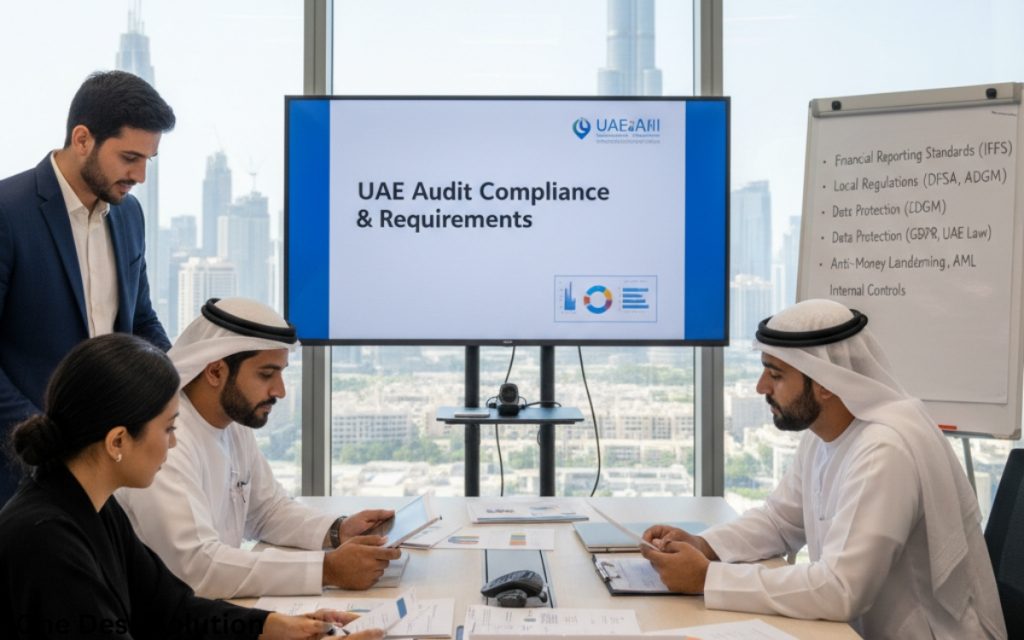
Complete Audit Preparation Checklist Dubai
The definitive 2026 guide for Dubai businesses — everything you need to prepare for a statutory, external, or regulatory audit with confidence and zero last-minute scrambles.
For most Dubai businesses, the annual statutory audit is one of the most demanding compliance exercises of the year — requiring meticulous preparation of financial statements, supporting documents, VAT records, board resolutions, and now Corporate Tax records. Yet most businesses that struggle with audits do so not because their finances are poor, but because their preparation is incomplete, poorly organised, or left too late. This comprehensive 2026 audit preparation checklist covers every document, process, and best practice a Dubai company needs — whether you are a mainland LLC, a free zone entity, a financial services firm, or a large group undergoing consolidated audit. We cover statutory requirements under UAE law, IFRS financial statement obligations, VAT audit trail requirements, Corporate Tax records, internal control documentation, and how to select and engage the right Dubai-licensed auditor — plus a complete 90-day pre-audit preparation timeline to keep you ahead of every deadline.
💡1. Why Audit Preparation Matters in Dubai
An annual statutory audit in Dubai is far more than a regulatory box-ticking exercise. For Dubai businesses, a clean, unqualified audit opinion is a critical business asset — it is required for trade licence renewals with the Department of Economic Development (DED), mandatory for all free zone company licence renewals, essential for obtaining bank financing or credit facilities, required for corporate tax compliance submissions, and increasingly demanded by international business partners and investors as proof of financial credibility.
The consequences of a qualified, adverse, or disclaimer audit opinion — or failing to submit audited accounts at all — can be severe: licence cancellation, exclusion from government tenders, bank account freezes, FTA audit triggers, and loss of investor confidence. With the UAE's Corporate Tax regime now fully operational and the FTA conducting an increasing number of audits in 2025–2026, the audit has also become a critical Corporate Tax compliance verification exercise.
The good news is that audit preparation is entirely manageable when done systematically and started early. Businesses that prepare proactively — maintaining audit-ready records throughout the year rather than scrambling in the last 30 days — experience faster audit completion, lower audit fees, fewer audit queries, and consistently clean opinions. This checklist is your complete playbook for achieving exactly that outcome.
2026 Compliance Alert: Following the introduction of UAE Corporate Tax, audited financial statements are now also required as the basis for Corporate Tax returns for most UAE entities. This means a delayed or qualified audit directly impacts your CT filing timeline, potentially triggering late filing penalties of up to AED 20,000.
🏢2. Who Needs a Statutory Audit in UAE?
| Business Type | Audit Requirement | Legal Basis | Frequency |
|---|---|---|---|
| Dubai Mainland LLC | Mandatory | UAE Commercial Companies Law (CCL), DED requirement | Annual |
| Free Zone Companies (All) | Mandatory | Individual free zone authority regulations (DMCC, JAFZA, IFZA etc.) | Annual |
| Public Joint Stock Companies (PJSC) | Mandatory | UAE Securities & Commodities Authority (SCA), CCL | Annual + quarterly (listed) |
| Banks & Financial Institutions | Mandatory | CBUAE regulations, DFSA (DIFC), FSRA (ADGM) | Annual |
| VAT-Registered Businesses | Strongly Advised | FTA may request audited accounts during tax audit | Annual |
| UAE Corporate Tax Registrants | Practically Required | CT return must be based on audited/IFRS accounts for most entities | Annual |
| Sole Establishments / Freelancers | Optional | No statutory requirement, but may be required by banks or clients | As needed |
Free Zone Deadlines Vary: Each free zone authority sets its own deadline for submitting audited accounts — typically between 3 and 6 months after the financial year end. DMCC requires submission within 90 days; JAFZA within 3 months; IFZA within 90 days of the financial year end. Missing these deadlines results in licence renewal being blocked and fines. Check your specific free zone authority's deadline.
🔍3. Types of Audits Dubai Businesses Face
Understanding which audit type you are preparing for will determine exactly which documents and processes to prioritise:
Statutory / External Audit
Annual mandatory audit by an independent UAE-licensed auditor. Required for licences, CT returns, and investor filings.
FTA Tax Audit
UAE Federal Tax Authority review of VAT returns, CT filings, transfer pricing, and financial records. Can be triggered or routine.
Internal Audit
Management-initiated review of internal controls, processes, and risk management. Often a prerequisite for external audit readiness.
Bank / Lender Audit
Required by banks for credit facilities, trade finance, or mortgage products. Requires clean audited accounts with specific disclosures.
Due Diligence Audit
Pre-acquisition or pre-investment audit commissioned by potential buyers or investors. Requires deep financial documentation.
ESG / Sustainability Assurance
Independent verification of ESG disclosures for listed or large companies. Growing requirement for Dubai-listed entities from 2026.
Need Expert Audit Support in Dubai?
OneDeskSolution's UAE-registered auditors prepare and conduct statutory audits for Dubai mainland and free zone businesses — fast, accurate, and fully IFRS compliant. Speak to our audit team today.
📅4. 90-Day Audit Preparation Timeline
Starting audit preparation 90 days before your financial year end is the gold standard. This timeline gives you enough runway to close the books cleanly, resolve queries, and deliver everything your auditor needs before their fieldwork begins:
Phase 1: Days 90–60
Planning, gap assessment, document gathering, bank reconciliation.
Phase 2: Days 60–30
Books closure, IFRS adjustments, tax provision, internal review.
Phase 3: Days 30–0
Financial statement finalisation, auditor briefing, PBC list delivery.
Phase 4: Audit Fieldwork
Respond to queries promptly, sign management representation letter.
📊5. Financial Statements Checklist
Your auditors will review the following financial statements, each of which must be prepared in accordance with International Financial Reporting Standards (IFRS) or IFRS for SMEs as applicable:
🔴 Mandatory IFRS Financial Statements
- Statement of Financial Position (Balance Sheet) — as at year-end date, with comparatives from prior year
- Statement of Profit or Loss and Other Comprehensive Income — full year with comparative period
- Statement of Cash Flows — direct or indirect method (indirect most common in UAE)
- Statement of Changes in Equity — share capital movements, retained earnings, reserves
- Notes to the Financial Statements — accounting policies, significant estimates, detailed disclosures for all material line items
📝 Key Notes & Disclosures Required
- Basis of preparation note (IFRS or IFRS for SMEs, going concern assessment)
- Significant accounting policies (revenue recognition, depreciation, impairment)
- Related party transactions disclosure (loans, management fees, cross-shareholding)
- Segment information (if applicable — multiple business lines or geographies)
- Contingent liabilities note (legal proceedings, guarantees, disputed VAT/CT)
- Events after the reporting period (material events between year-end and audit sign-off date)
- Capital commitments (contracted but not yet incurred capital expenditure)
- COVID/economic risk disclosures (if applicable to going concern assessment)
IFRS vs. IFRS for SMEs: Most UAE companies can choose between full IFRS and IFRS for SMEs. Full IFRS applies to listed companies (SCA-regulated) and banks. IFRS for SMEs is a simpler standard suitable for most privately-held UAE companies. Discuss with your auditor which standard applies — using the wrong standard invalidates the audit opinion. Our audit team can advise on this.
📁6. Supporting Documents Checklist
Every figure in your financial statements must be supportable by source documentation. Here is the complete supporting document checklist organised by category:
- 12 months of bank statements for all UAE accounts
- Bank reconciliation statements for each account
- Petty cash count sheet (if petty cash maintained)
- Bank confirmation letters (auditor will request directly)
- Outstanding cheques and deposits list
- Aged debtors listing as at year-end
- All sales invoices (12 months) in sequence
- Customer statements / confirmations
- Bad debt provision calculation & justification
- Collection records for post year-end receipts
- Aged creditors listing as at year-end
- Supplier invoices and purchase orders (12 months)
- Supplier statements / confirmations
- Accruals schedule with backup documentation
- Goods received not invoiced (GRNI) report
- Fixed Asset Register (FAR) as at year-end
- Purchase invoices for all new additions
- Disposal documentation (sale agreements, approvals)
- Depreciation calculation schedules by asset class
- Physical asset verification report
- Physical stock count sheets (year-end count)
- Inventory valuation (lower of cost or NRV)
- Slow-moving and obsolete stock analysis
- Consignment stock documentation
- Goods in transit documentation
- Monthly payroll summaries (12 months)
- End of Service Gratuity (EOSB) calculation sheet
- WPS payment confirmation reports
- Leave liability calculation
- Employee contracts for senior staff
- Trade Licence (valid, current year)
- Certificate of Incorporation
- Memorandum & Articles of Association
- All shareholder / board resolutions (year)
- Material contracts (leases, major suppliers)
- All lease agreements (office, warehouse, equipment)
- IFRS 16 right-of-use asset calculation
- Lease liability amortisation schedule
- Ejari registration for all UAE properties
- Short-term / low-value lease exemption assessment
IFRS 16 Reminder: All Dubai businesses with office or warehouse leases must apply IFRS 16 — recognising a right-of-use asset and corresponding lease liability on the balance sheet. Many UAE companies still incorrectly expense all lease payments through P&L only, which is non-compliant. This is one of the most common audit adjustments in Dubai — ensure your books are correctly structured before audit fieldwork begins.
📋7. VAT Records & Tax Compliance Checklist
Since the FTA may review VAT records as part of its own audit processes — and your statutory auditor will reconcile revenue and expenses to VAT returns — comprehensive VAT documentation is essential:
- All 4 quarterly VAT return filings (VAT 201) for the financial year — print from EmaraTax
- VAT ledger from accounting system — reconciled to each submitted return
- All sales tax invoices issued during the year (must meet FTA format with TRN)
- All purchase tax invoices received — input tax claimed must be supported
- Output VAT reconciliation: total revenue per accounting system vs. total revenue per VAT returns
- Input VAT reconciliation: input tax claimed vs. purchases per accounting system
- Export documentation supporting any zero-rated supplies (customs declarations, airway bills)
- Reverse charge calculations for imported services (overseas software, consulting, subscriptions)
- Any FTA correspondence, rulings, or voluntary disclosure submissions
- VAT payment confirmation receipts from EmaraTax for all 4 quarters
- Designated Zone documentation if operating in JAFZA, DIP, KIZAD
Pro Tip — Revenue Reconciliation: One of the most time-consuming parts of a UAE audit is reconciling revenue per the accounting system to revenue declared on VAT returns. If these don't match — due to timing differences, export sales, or exempt income — you need a detailed written reconciliation ready before auditors ask for it. Prepare this reconciliation as part of your pre-audit close.
🏛️8. Corporate Tax Records Checklist
Since UAE Corporate Tax became effective for most businesses from 2023 or 2024 financial years, auditors are now also reviewing CT-related records as part of their work:
- CT registration confirmation and Tax Registration Number (TRN for CT)
- Corporate Tax Return (CT 201) if already filed for any completed periods
- IFRS-compliant financial statements (the basis for taxable income calculation)
- Accounting adjustment workings to move from accounting profit to taxable income
- Non-deductible expenses list (entertainment, fines, capital expenditure misclassified)
- Related party transactions schedule and Transfer Pricing documentation (Local File if applicable)
- QFZP qualifying income calculation and supporting documentation (free zone entities)
- Small Business Relief election documentation (if applicable — taxable revenue under AED 3M)
- Exempt income documentation (qualifying dividend, capital gains participation exemption)
- Deferred tax calculation (if full IFRS adopted — IAS 12 deferred tax asset/liability)
- Tax provision calculation and board approval
📊 CT Compliance Status: Common Pre-Audit Issues
*Based on OneDeskSolution pre-audit assessment data across Dubai client engagements, 2024–2025. Indicative.
🔒9. Internal Controls Documentation Checklist
Auditors assess not just whether your numbers are correct, but whether your internal control environment gives them sufficient confidence in the reliability of your financial records. Weak internal controls require auditors to do more substantive testing — which takes longer and costs more.
- Written authorisation levels/approval matrix (who can approve payments, contracts, write-offs at each AED threshold)
- Segregation of duties — evidence that the person who approves payments is different from the person who records them
- Bank signatory mandate on file — authorised bank signatories match company resolutions
- Written accounting policies and procedures manual
- IT access controls — accounting system login records, user access rights review
- Reconciliation sign-off records — monthly bank reconciliations signed by a reviewer, not just the preparer
- Physical asset controls — fixed asset verification records, inventory count procedures
- Anti-fraud policy and whistleblower mechanism documentation
- Management review of monthly financial reports (board pack or management accounts)
- ISO certification, ESG policy documentation (if applicable — positive for auditor risk assessment)
Auditor Risk Assessment: At the start of every audit, auditors perform a risk assessment of your control environment. If controls are strong and documented, they rely on them and reduce the extent of their substantive testing — meaning a faster, cheaper audit. If controls are weak or undocumented, they test every transaction individually — meaning a slower, more expensive audit with more queries. Investing in basic internal control documentation is one of the highest-ROI activities in audit preparation.
🏆10. How to Choose the Right Auditor in Dubai
The quality of your audit depends heavily on choosing the right audit firm. In the UAE, auditors must be licensed by the Ministry of Economy (MoE) and registered with the relevant free zone authority. Here is the complete selection checklist:
✅ Auditor Selection Criteria
- Licensed by the UAE Ministry of Economy — verify licence number on MoE portal (required by law)
- Registered with your specific free zone authority (DMCC, JAFZA, IFZA, etc. maintain approved auditor lists)
- Experienced in your industry sector (manufacturing, trading, financial services, real estate, technology)
- Proficiency in IFRS and UAE Corporate Tax regulations
- Ability to issue audit report in both English and Arabic if required
- Clear communication of fees upfront — fixed fee preferred over hourly billing for predictability
- References from similar-sized Dubai businesses in your sector
- Additional capability in VAT advisory, CT compliance — enables seamless one-stop compliance service
- Demonstrated turnaround time within your free zone deadline (critical for DMCC 90-day requirement)
| Firm Size | Best For | Typical Audit Fee (AED) | Turnaround |
|---|---|---|---|
| Big 4 (Deloitte, EY, KPMG, PwC) | Large enterprises, listed companies, multinationals | AED 50,000 – 500,000+ | 6–12 weeks |
| Mid-tier (Baker McKenzie, Grant Thornton, BDO) | Mid-market, growing businesses, complex structures | AED 15,000 – 80,000 | 4–8 weeks |
| Boutique UAE Firms (Licensed) | SMEs, free zone startups, trading companies | AED 3,000 – 25,000 | 2–4 weeks |
Avoid: Unlicensed "auditors" or companies offering extremely low-cost audits (below AED 2,000) with no MoE registration. These audit reports are not legally valid, will not be accepted by free zone authorities, and constitute fraud if submitted as official audited accounts. Always verify your auditor's MoE licence number before signing the engagement letter. Our certified audit team is fully licensed and registered across all major UAE free zones.
⚠️11. Common Audit Findings & How to Prevent Them
| # | Common Finding | Audit Impact | Prevention Strategy |
|---|---|---|---|
| 1 | Revenue and VAT return discrepancy | Qualified opinion risk | Prepare monthly revenue-to-VAT reconciliation; investigate differences immediately |
| 2 | IFRS 16 lease assets not recognised | Adjustment required | Calculate right-of-use assets and lease liabilities for all leases > 12 months |
| 3 | Unrecorded year-end accruals | P&L adjustment | Run accruals review in month 11; list all services received but not yet invoiced |
| 4 | Related party transactions undisclosed | Serious finding | Maintain a related party register; disclose all transactions in notes with amounts |
| 5 | Fixed asset register not maintained / outdated | Audit delay | Update FAR monthly; conduct annual physical verification before year-end |
| 6 | Bank reconciliation not prepared monthly | Control weakness flagged | Reconcile all bank accounts by the 5th of each following month; have second person review |
| 7 | Intercompany balances not confirmed | Audit query | Agree all intercompany balances with related entities at least 30 days before year-end |
| 8 | Going concern not assessed | Emphasis of matter | Prepare 12-month cash flow forecast; document management's going concern assessment |
| 9 | Slow-moving inventory not provisioned | P&L impact | Run inventory ageing report; apply NRV adjustment for slow-moving stock >6 months |
| 10 | No EOSB provision for long-serving employees | Liability understatement | Calculate end-of-service gratuity annually per UAE Labour Law for all qualifying staff |
Get Audit-Ready in 30 Days
OneDeskSolution's audit preparation team conducts pre-audit health checks, prepares your PBC document pack, closes your books to IFRS standards, and coordinates directly with your auditors — ensuring a clean opinion and on-time submission.
❓12. Frequently Asked Questions
🔗13. Related Articles & Expert Resources
Explore more expert guides from OneDeskSolution to support your UAE business compliance:
Your Trusted Audit & Accounting Partner in Dubai
From audit preparation and statutory audits to bookkeeping, VAT, and Corporate Tax — OneDeskSolution delivers end-to-end financial compliance for Dubai businesses. Contact our experts today for a free consultation.